ŠUL.PA.E3: Difference between revisions
JanSafford (talk | contribs) No edit summary |
DavidHilder (talk | contribs) No edit summary |
||
| Line 9: | Line 9: | ||
===Kurtik with Hilder, Hoffmann, Horowitz, Kim === |
===Kurtik with Hilder, Hoffmann, Horowitz, Kim === |
||
= <sup>mul (d)</sup>''Šul-pa-e''<sub>3</sub>-''a'', lit. "A youngster appears with brilliance"; = Jupiter [ |
= <sup>mul (d)</sup>''Šul-pa-e''<sub>3</sub>-''a'', lit. "A youngster appears with brilliance"; = Jupiter [Gössmann<ref name=":0">''Gössmann P.F''. Planetarium Babylonicum, Rom, 1950 (A. Deimel. Šumerisches Lexikon 4/2).</ref> 383]. |
||
See also |
See also |
||
| Line 15: | Line 15: | ||
* (Kurtik a19) [[UD.AL.TAR|AL.TAR]], |
* (Kurtik a19) [[UD.AL.TAR|AL.TAR]], |
||
* (Kurtik a28) [[AMAR.UD|<sup>d</sup>AMAR.UTU]], |
* (Kurtik a28) [[AMAR.UD|<sup>d</sup>AMAR.UTU]], |
||
* (Kurtik e01) ''E-pa''<sub>2</sub>-''e'', for this reading also [BPO 2, 2-3; Lambert 1987a, 94-95]. |
* (Kurtik e01) ''E-pa''<sub>2</sub>-''e'', for this reading also [BPO 2<ref name=":1">''Reiner E., Pingree D''. Enuma Anu Enlil, Tablets 50-51. Undena Publications, Malibu, 1981 (Babylonian Planetary Omens: Part Two).</ref>, 2-3; Lambert 1987a<ref>''Lambert W.G.'' Babylonian Astrological Omens and Their Stars / JAOS. 1987. V. 107. Р. 93-96.</ref>, 94-95]. |
||
'''<sup>mul</sup>''E-pa<sub>2</sub>-e'' only occurs one time in a Boghazkoi version 'Prayer to the Gods of the Night' and is almost certainly a simplified miswriting for the name of Jupiter ''Šul''-''pa<sub>2</sub>-e''''' |
'''<sup>mul</sup>''E-pa<sub>2</sub>-e'' only occurs one time in a Boghazkoi version 'Prayer to the Gods of the Night' and is almost certainly a simplified miswriting for the name of Jupiter ''Šul''-''pa<sub>2</sub>-e''''' |
||
Earlier it read of "''E-pa''<sub>2</sub>-''e''": <sup>mul</sup>''e-ku-e'' and was identified with <sup>mul</sup>AŠ.GAN<sub>2</sub> = ''ikû'' "Field". [HBA, 60; Weidner 1957-59, 73], see for example [ |
Earlier it read of "''E-pa''<sub>2</sub>-''e''": <sup>mul</sup>''e-ku-e'' and was identified with <sup>mul</sup>AŠ.GAN<sub>2</sub> = ''ikû'' "Field". [HBA<ref>''Weidner E.'' Handbuch der babylonischen Astronomie. Bd. I. Leipzig, 1915.</ref>, 60; Weidner 1957-59<ref>''Weidner E.'' mul gir<sub>2</sub>.tab = ''zuqaqîpi'' // AfO. 1957-1958. Bd. 18. S. 393-394].</ref>, 73], see for example [Gössmann<ref name=":0" /> 117; AHw<ref>''Soden von W''. Akkadisches Handwörterbuch. Wiesbaden, 1985.</ref>, 370; Van der Toorn 1985<ref name=":2">''K. van der Toorn.'' Sin and Sanction in Israel and Mesopotamia. A Comparative Study. Maastricht, Van Gorcum, 1985.</ref>, 129:43]. |
||
{| class="wikitable" |
{| class="wikitable" |
||
| Line 27: | Line 27: | ||
|- |
|- |
||
|'''Lexical texts.''' |
|'''Lexical texts.''' |
||
* (1) Unilingual Sumerian lists of stars: <sup>mul</sup>Šul.pa.e<sub>3</sub>.a [Emar VI/4, 154:108]. |
* (1) Unilingual Sumerian lists of stars: <sup>mul</sup>Šul.pa.e<sub>3</sub>.a [Emar VI/4<ref>''D. Arnaud''. Texte de la bibliothèque, transcriptions et traductions, 1987. (= Emar 6/4).</ref>, 154:108]. |
||
* (2) Urra XXII series: <sup>mul</sup>šul.bi.en = ''Šul-be'' [Emar VI/4, 151:158], <sup>mul</sup>al.tar = ''šul-pa-e''<sub>3</sub>, <sup>mul</sup>šul.pa.e<sub>3</sub>.a = ŠU (=''šul-pa-e''<sub>3</sub>) [MSL XI, 31, Section 11 col. v 6a, 7; Weidner 1959-60, 112, VAT 9430:23-24], <sup>mul</sup>ud.al.tar = <sup>d</sup>''Šul-pa-e''<sub>3</sub>-''a'' [SpTU III, 228, 114A v 53; Bloch-Horowitz 2015, 110:310ʹ], [<sup>mul</sup>in.d]ub<sup>?</sup>.an.na = <sup>d</sup>''Šul-pa-e''<sub>3</sub>-''a'' [Cavigneaux 1979, 134,17:17]. |
* (2) Urra XXII series: <sup>mul</sup>šul.bi.en = ''Šul-be'' [Emar VI/4, 151:158], <sup>mul</sup>al.tar = ''šul-pa-e''<sub>3</sub>, <sup>mul</sup>šul.pa.e<sub>3</sub>.a = ŠU (=''šul-pa-e''<sub>3</sub>) [MSL XI<ref>''Materials for the Sumerian Lexicon''. Vol. XI. The Series HAR-ra = ''hubullu.'' Tablets XX-XXIV. Ed. by E.Reiner with the coll. of M.Civil. Roma, 1974.</ref>, 31, Section 11 col. v 6a, 7; Weidner 1959-60, 112, VAT 9430:23-24], <sup>mul</sup>ud.al.tar = <sup>d</sup>''Šul-pa-e''<sub>3</sub>-''a'' [SpTU III, 228, 114A v 53; Bloch-Horowitz 2015<ref>Bloch Y. and W. Horowitz (2015): “Urra = hubullu XXII: The Standard Recension,” with Y. Bloch, Journal of Cuneiform Studies 67: 71-125.</ref>, 110:310ʹ], [<sup>mul</sup>in.d]ub<sup>?</sup>.an.na = <sup>d</sup>''Šul-pa-e''<sub>3</sub>-''a'' [Cavigneaux 1979<ref>''Cavigneaux A.'' // Baghdader Mitteilungen. 1979. Bd. X. S. 132-134.</ref>, 134,17:17]. |
||
* (3) Antagal series (G 305): <sup>d</sup>da.pi.nu = <sup>d</sup>''šul-pa-e''<sub>3</sub>-''a'' [MSL XVII, 229]. |
* (3) Antagal series (G 305): <sup>d</sup>da.pi.nu = <sup>d</sup>''šul-pa-e''<sub>3</sub>-''a'' [MSL XVII<ref>Cavigneaux, A. ''The Series Erim-ḫuš = anantu and An-ta-gál = šaqû''. Pontificium Institutum Biblicum. 1985.</ref>, 229]. |
||
* (4) AN: <sup>d</sup>''Anum'' series (II 47): <sup>d</sup>U<sub>4</sub>.al.TAR = <sup>d</sup>Šul.pa.e<sub>3</sub> [Litke 1998, 72]. |
* (4) AN: <sup>d</sup>''Anum'' series (II 47): <sup>d</sup>U<sub>4</sub>.al.TAR = <sup>d</sup>Šul.pa.e<sub>3</sub> [Litke 1998<ref>''Litke R.L''. A Reconstruction of the Assyro-Babylonian God-Lists, AN:<sup>d</sup>A-nu-um and AN:Anu ša<sub>2</sub> amēli. New Haven, 1998 (Texts from the Babylonian Collection, Vol. 3).</ref>, 72]. |
||
| |
| |
||
|- |
|- |
||
|'''"Prayers to the Gods of the Night."''' |
|'''"Prayers to the Gods of the Night."''' |
||
* (1) Hittite prayer, see (Kurtik e02) ''E-pa''<sub>2</sub>-''e''. |
* (1) Hittite prayer, see (Kurtik e02) ''E-pa''<sub>2</sub>-''e''. |
||
* (2) Neo-Assyrian prayer: <sup>mul</sup>ŠUL.PA.E [Oppenheim 1959, 282:11]. |
* (2) Neo-Assyrian prayer: <sup>mul</sup>ŠUL.PA.E [Oppenheim 1959<ref>''Oppenheim A.L.'' A New Prayer to the “Gods of the Night” // Analecta biblica. 1959. Vol. 12. P. 282-301.</ref>, 282:11]. |
||
| |
| |
||
|- |
|- |
||
|'''A Hittite Prayer to the Gods of the Night.''' |
|'''A Hittite Prayer to the Gods of the Night.''' |
||
* <sup>mul</sup>''E-pa''<sub>2</sub>-''e'' [KUB IV, 47 r. 43; BPO 2, 2:5; Van der Toorn 1985, 129:43]. |
* <sup>mul</sup>''E-pa''<sub>2</sub>-''e'' [KUB<ref>''Keilschrifturkunden aus Boghazköi'' (''Berlin''). KBo</ref> IV, 47 r. 43; BPO 2<ref name=":1" />, 2:5; Van der Toorn 1985<ref name=":2" />, 129:43]. |
||
| |
| |
||
|- |
|- |
||
|'''EAE.''' |
|'''EAE.''' |
||
See. [BPO 2<ref name=":1" />, II 14c; BPO 3<ref name=":3">''Reiner E., Pingree D''. Babylonian Planetary Omens. Part Three. Groningen, STYX Publications. 1998.</ref>, 288; Borger 1973<ref>''Borger R.'' Keilschrifttexte verschiedenen Inhalts / Symbolae Biblicae et Mesopotamicae. Festschrift Th. de Liagre Böhl. Ed. M.A.Beek et al. Leiden, 1973. Р. 38-55.</ref>, LB 1321 r. 14′, 18′; Verderame 2002<ref name=":4">''Verderame L.'' Enūma Anu Enlil Tablets 1-13 // Under One Sky. Astronomy and Mathematics in the Ancient Near East. Ed. J.M.Steele – A.Imhausen. Münster, Ugarit-Verlag 2002. P. 447- 455.</ref>, 249; Van Soldt 1995<ref>''Soldt W.H. van''. Solar Omens of Enuma Anu Enlil: Tablets 23(24) – 29(30). Istanbul, 1995.</ref>, Tablet 25 I 10; Largement 1957<ref name=":5">''Largement R.'' Contribution à l’Etudes des Astres errants dans l’Astrologie chaldéenne // ZA. 1957. Bd. 18. S.235-264. Abbreviated ACh.</ref> 242:33a; SpTU III<ref>''Špätbabylonische Texte aus Uruk.'' Teil III / Bearb. von Weiher E. von. Berlin, 1988.</ref>, 101:23, 28, 30] as well as [Biggs 1987<ref name=":6">''Biggs R.D.'' Babylonian Prophecies, Astrology, and A New Source for "Prophecy Text B" / Fs. Reiner. P. 1-14.</ref>, 10 r. 10]. |
|||
See. [BPO 2, II 14c; BPO 3, 288; Borger 1973, LB 1321 r. 14′, 18′; Verderame 2002, 249; Van Soldt 1995, Tablet 25 I 10; Largement 1957 242:33a; SpTU III, 101:23, 28, 30] as well as [Biggs 1987, 10 r. 10]. |
|||
| |
| |
||
|- |
|- |
||
| Line 51: | Line 51: | ||
* (1) List (12´3): mul gal ''nam-ru ša ina'' zi im.[xx] / gub <sup>mul</sup>šu.pa uš.uš ki.gub ku[r<sub>2</sub>.kur<sub>2</sub>] / <sup>mul</sup>''Šul-pa-e''<sub>3</sub> sukkal <sup>d</sup>a[mar.utu] "The big shining star, which is where the [...] wind rises [...], stands, this (is) Shupa, (whose) position constantly ch[anges]: Shulpae, messenger of M[arduk]" (B iii 21-23). |
* (1) List (12´3): mul gal ''nam-ru ša ina'' zi im.[xx] / gub <sup>mul</sup>šu.pa uš.uš ki.gub ku[r<sub>2</sub>.kur<sub>2</sub>] / <sup>mul</sup>''Šul-pa-e''<sub>3</sub> sukkal <sup>d</sup>a[mar.utu] "The big shining star, which is where the [...] wind rises [...], stands, this (is) Shupa, (whose) position constantly ch[anges]: Shulpae, messenger of M[arduk]" (B iii 21-23). |
||
* (2) List (3´12): <sup>iti</sup>šu ... <sup>mul</sup>''Šul-pa-e''<sub>3</sub> ''šu-ut'' <sup>d</sup>[''En-lil''<sub>2</sub>] "The month of duuzu: ...Shulpae (on the path of) [Enlil] (rising)" (C iii 4). |
* (2) List (3´12): <sup>iti</sup>šu ... <sup>mul</sup>''Šul-pa-e''<sub>3</sub> ''šu-ut'' <sup>d</sup>[''En-lil''<sub>2</sub>] "The month of duuzu: ...Shulpae (on the path of) [Enlil] (rising)" (C iii 4). |
||
* (3) List (rising-sunset=6m): rising — ''duuzu'', setting — ''tebetu'' [KAV 218, C 19, 32; Horowitz 2014, 39-40], see (Kurtik k10) [[KAK.SI.SA2|KAK.SI.SA<sub>2</sub>]]. |
* (3) List (rising-sunset=6m): rising — ''duuzu'', setting — ''tebetu'' [KAV<ref>''Schroeder O.'' Keilschrifttexte aus Assur verschiedenen Inhalts. Leipzig, 1920.</ref> 218, C 19, 32; Horowitz 2014<ref>Horowitz, W. (2014), The three stars each: the Astrolabes and related texts, Archiv für Orientforschung AfO Beiheft, 33.</ref>, 39-40], see (Kurtik k10) [[KAK.SI.SA2|KAK.SI.SA<sub>2</sub>]]. |
||
| |
| |
||
|- |
|- |
||
|'''BM 82923.''' |
|'''BM 82923.''' |
||
* Duuzu month, stars of Enlil: <sup>mul</sup>[ŠUL.PA.E<sub>3</sub> // 55 // ...] "[Šulpae // 55 // ...]" [Walker-Hunger 1977, 30:12]. |
* Duuzu month, stars of Enlil: <sup>mul</sup>[ŠUL.PA.E<sub>3</sub> // 55 // ...] "[Šulpae // 55 // ...]" [Walker-Hunger 1977<ref>''Walker C.B.F., Hunger H.'' Zwölfmaldrei // MDOG. 1977. Bd. 109. S. 27-34.</ref>, 30:12]. |
||
| |
| |
||
|- |
|- |
||
| '''MUL.APIN.''' |
| '''MUL.APIN.''' |
||
* Planets "in the path of the Moon": KASKAL <sup>d</sup>''Sin'' DU-''ku'' <sup>d</sup>''Šul-pa-e''<sub>3</sub>-''a'' DU-''ak'' "Jupiter takes (the same) path that the Moon takes" (II i 2) [MA, 70]. |
* Planets "in the path of the Moon": KASKAL <sup>d</sup>''Sin'' DU-''ku'' <sup>d</sup>''Šul-pa-e''<sub>3</sub>-''a'' DU-''ak'' "Jupiter takes (the same) path that the Moon takes" (II i 2) [MA<ref>Hunger, H. and Steele, J. M. (2019). The Babylonian Astronomical Compendium MUL.APIN, Routledge, NY</ref>, 70]. |
||
| |
| |
||
|- |
|- |
||
|'''"Reports."''' |
|'''"Reports."''' |
||
See. [SAA 8<ref name=":7">''Hunger H.'' Astrological Reports to Assyrian Kings. Helsinki, 1992 (State Archives of Assyria, VIII).</ref>, 352b]. |
|||
See. [SAA 8, 352b]. |
|||
| |
| |
||
|- |
|- |
||
|'''Šumma Sîn ina tāmartīšu.''' |
|'''Šumma Sîn ina tāmartīšu.''' |
||
See. [Koch Westenholz 1999, 154:19, 159:85-86]. |
See. [Koch-Westenholz 1999<ref name=":8">''Koch-Westenholz U''. The Astrological Commentary ''Šumma'' ''Sîn ina tāmartīšu'' Tablet 1 // Res Orientales. 1999. Vol. XII. P.149-165.</ref>, 154:19, 159:85-86]. |
||
| |
| |
||
|- |
|- |
||
|'''"Great Star List and Miscellenia."''' |
|'''"Great Star List and Miscellenia."''' |
||
* List of 7 planets: <sup>d</sup>šul.pa.e<sub>3</sub> in third place after the Moon and the Sun [Mesop.Astrol., App. B: 242]. |
* List of 7 planets: <sup>d</sup>šul.pa.e<sub>3</sub> in third place after the Moon and the Sun [Mesop.Astrol.<ref>''Koch-Westenholz U''. Mesopotamian Astrology. Copenhagen, Museum Tusculanum Press. 1995.</ref>, App. B: 242]. |
||
| |
| |
||
|- |
|- |
||
|'''List of 12 names of Marduk.''' |
|'''List of 12 names of Marduk.''' |
||
* ''ina'' <sup>iti</sup>bar<sub>2</sub> <sup>d</sup>šul.pa.e<sub>3</sub> = <sup>d</sup>amar.utu "In the month of Nisanu Shulpae = Marduk" [IIIR, 53,2:2]. |
* ''ina'' <sup>iti</sup>bar<sub>2</sub> <sup>d</sup>šul.pa.e<sub>3</sub> = <sup>d</sup>amar.utu "In the month of Nisanu Shulpae = Marduk" [IIIR<ref>''Rawlinson H.'' The Cuneiform Inscriptions of Western Asia. Vol. I-V. London, 1861-1909. (cited as I R, II R, etc.)''.''</ref>, 53,2:2]. |
||
| |
| |
||
|- |
|- |
||
| '''Late Astrology.''' |
| '''Late Astrology.''' |
||
* Prediction text [SpTU IV, 159], see (Kurtik a21) [[ALLA]]. |
* Prediction text [SpTU IV<ref>''URUK. Špätbabylonische Texte aus dem Planquadrat U 18''. Teil IV / Bearb. von Weiher E. von. Mainz am Rhein, 1993.</ref>, 159], see (Kurtik a21) [[ALLA]]. |
||
| |
| |
||
|} |
|} |
||
| Line 86: | Line 86: | ||
==== II. Deity. ==== |
==== II. Deity. ==== |
||
Shulpae's name already occurs in the list of gods from Fara [Krebernik 1986, 190:49]. According to one tradition, he was considered the husband of the "mother goddess" Ninhursag, who bore three children with him, including [[LI9.SI4|<sup>d</sup>LI<sub>9</sub>.SI<sub>4</sub>]] (see Kurtik L07). Shulpae is not a very significant deity, who apparently had an obscure and unfavorable character [Black-Green 1992, 173; Tallqvist 1938, 267-8]. In AN: <sup>d</sup>''Anum'' (I 187, IV 269) he is identified with the god <sup>d</sup>Maškin.ge<sub>6</sub>.lu<sub>2</sub>.ḫar.ra.na, who is defined as an "evil god" (DINGIR ''lim-nu-um'') [CT 25, 22:42; Litke 1998, 41:187 + note]. In the Old Babylonian periods, Shulpae’s astral meaning, Jupiter, coincides with that of Marduk’s own astral definition. Among his epithets are ''eṭlu ša elât šamê uštappâ'' "the youth who appears with splendor in the heights of the heavens" [Tallqvist 1938, 468]. On some Old Babylonian seal impressions, one can see a star next to the anthropomorphic image of Shulpae [Braun-Holzinger 1996, Nr. 1148, 1150]. The connection of Shulpae with Jupiter may be explained by his role as Marduk's vizier, which seems to be asserted in the poorly preserved text of the Astrolabe. For the astronomical meaning of the name, as recorded in Neo-Assyrian texts: Shulpae is Jupiter during heliacal risings [SAA 8, 147:7; BPO 3, 230, K.3124:5′], see (Kurtik a28) [[AMAR.UD|<sup>d</sup>AMAR.UTU]], IV 8. |
Shulpae's name already occurs in the list of gods from Fara [Krebernik 1986<ref>''Krebernik M.'' Die Götterlisten aus Fāra // ZA. 1986. Bd. 76, Halbband II. S. 161-204.</ref>, 190:49]. According to one tradition, he was considered the husband of the "mother goddess" Ninhursag, who bore three children with him, including [[LI9.SI4|<sup>d</sup>LI<sub>9</sub>.SI<sub>4</sub>]] (see Kurtik L07). Shulpae is not a very significant deity, who apparently had an obscure and unfavorable character [Black-Green 1992<ref>''Black J., Green A.'' Gods, Demons and Symbols of Ancient Mesopotamia. An Illustrated Dictionary. London, British Museum Press, 1992.</ref>, 173; Tallqvist 1938<ref name=":9">''Tallqvist K''. Akkadische Götterepitheta. Helsingforsiae, 1938.</ref>, 267-8]. In AN: <sup>d</sup>''Anum'' (I 187, IV 269) he is identified with the god <sup>d</sup>Maškin.ge<sub>6</sub>.lu<sub>2</sub>.ḫar.ra.na, who is defined as an "evil god" (DINGIR ''lim-nu-um'') [CT<ref name=":10">''Cuneiform Texts from Babylonian Tablets in the British Museum.''</ref> 25, 22:42; Litke 1998<ref>''Litke R.L''. A Reconstruction of the Assyro-Babylonian God-Lists, AN:<sup>d</sup>A-nu-um and AN:Anu ša<sub>2</sub> amēli. New Haven, 1998 (Texts from the Babylonian Collection, Vol. 3).</ref>, 41:187 + note]. In the Old Babylonian periods, Shulpae’s astral meaning, Jupiter, coincides with that of Marduk’s own astral definition. Among his epithets are ''eṭlu ša elât šamê uštappâ'' "the youth who appears with splendor in the heights of the heavens" [Tallqvist 1938<ref name=":9" />, 468]. On some Old Babylonian seal impressions, one can see a star next to the anthropomorphic image of Shulpae [Braun-Holzinger 1996<ref>''Braun-Holzinger E.A.'' Altbabylonische Götter und ihre Symbole // BaM . 1996. Bd. 27. S.235-359, Tafel 1-42.</ref>, Nr. 1148, 1150]. The connection of Shulpae with Jupiter may be explained by his role as Marduk's vizier, which seems to be asserted in the poorly preserved text of the Astrolabe. For the astronomical meaning of the name, as recorded in Neo-Assyrian texts: Shulpae is Jupiter during heliacal risings [SAA 8<ref name=":7" />, 147:7; BPO 3<ref name=":3" />, 230, K.3124:5′], see (Kurtik a28) [[AMAR.UD|<sup>d</sup>AMAR.UTU]], IV 8. |
||
===== Prayers and rituals. ===== |
|||
| ⚫ | * (1) Old Babylonian incantations: <sup>mul d</sup>šul.pa.e<sub>3</sub>.a gub.ba.me.eš "(Before) the star of Shulpae, they (the priests?) stood up" [CT<ref name=":10" /> 42, 6 iii 20; Falkenstein 1963<ref>''Falkenstein A.'' Sumerische religiöse Texte // ZA. 1963. Bd. XXI. S. 11-67.</ref>, 33], see also [CT<ref name=":10" /> 42, 6 iii 36]. |
||
* (2) A ritual against an epidemic [TuL<ref>''Ebeling E.'' Tod und Leben nach den Vorstellungen der Babilonier. Berlin-Leipzig, 1931.</ref>, 163, 34:13]. |
|||
| ⚫ | |||
* (2) A ritual against an epidemic [TuL, 163, 34:13]. |
|||
==== III. Astrology. ==== |
==== III. Astrology. ==== |
||
(1) The Moon in Neomenia and Shulpae; DIŠ 30 ''ina'' UD.1.KAM ''ina'' IGI.LA<sub>2</sub>-''šu''<sub>2</sub> SI-''šu''<sub>2</sub> ''ša''<sub>2</sub> 15 GAM-''ma'' <sup>mul</sup>ŠUL.PA.˹E<sub>3</sub>˺ [...] "If the Moon’s right horn bends (much) on the 1st day (of the month) during its appearance, Shulpae [...]" [Verderame 2002, 28, Tav. I: §20]; DIŠ 30 ''ina'' UD.1.KAM ''ina'' IGI.LA<sub>2</sub>-''šu''<sub>2</sub> SI-''šu''<sub>2</sub> ''ša''<sub>2</sub> 2,30 ''e-du-ud-ma'' <sup>mul</sup>ŠUL.PA.˹E<sub>3</sub>˺ [...] "If the Moon’s left horn is pointed (much) on the 1st day (of the month) during its appearance, Shulpae [...]" [ibid., Tav. I: §22]; [DIŠ <sup>mul</sup>ŠUL].PA.E<sub>3</sub> ''ina'' A<sub>2</sub>-''šu''<sub>2</sub> GUB MU.3.KAM KUR<sub>2</sub> KUR KU<sub>2</sub> LUGAL GAL U[Š<sub>2</sub>...] "[If (during the Moon's appearance) Shul]pae is on her side: within three years the enemy will devour the country, the great king will die [...]" [Verderame 2002, 183, Text VIa1: v. 4′], variant apodosis: MU.3.KAM KUR<sub>2</sub> KUR-''Gu-ti-i'' KUR.NIM.MA<sup>ki</sup> [KU<sub>2</sub>...] "Within three years, enemy countries, the Gutians and the Elamites, [will devour ...]" [ibid., 183, Text VIa1: v. 5′]. |
(1) The Moon in Neomenia and Shulpae; DIŠ 30 ''ina'' UD.1.KAM ''ina'' IGI.LA<sub>2</sub>-''šu''<sub>2</sub> SI-''šu''<sub>2</sub> ''ša''<sub>2</sub> 15 GAM-''ma'' <sup>mul</sup>ŠUL.PA.˹E<sub>3</sub>˺ [...] "If the Moon’s right horn bends (much) on the 1st day (of the month) during its appearance, Shulpae [...]" [Verderame 2002<ref name=":4" />, 28, Tav. I: §20]; DIŠ 30 ''ina'' UD.1.KAM ''ina'' IGI.LA<sub>2</sub>-''šu''<sub>2</sub> SI-''šu''<sub>2</sub> ''ša''<sub>2</sub> 2,30 ''e-du-ud-ma'' <sup>mul</sup>ŠUL.PA.˹E<sub>3</sub>˺ [...] "If the Moon’s left horn is pointed (much) on the 1st day (of the month) during its appearance, Shulpae [...]" [ibid.<ref name=":4" />, Tav. I: §22]; [DIŠ <sup>mul</sup>ŠUL].PA.E<sub>3</sub> ''ina'' A<sub>2</sub>-''šu''<sub>2</sub> GUB MU.3.KAM KUR<sub>2</sub> KUR KU<sub>2</sub> LUGAL GAL U[Š<sub>2</sub>...] "[If (during the Moon's appearance) Shul]pae is on her side: within three years the enemy will devour the country, the great king will die [...]" [Verderame 2002<ref name=":4" />, 183, Text VIa1: v. 4′], variant apodosis: MU.3.KAM KUR<sub>2</sub> KUR-''Gu-ti-i'' KUR.NIM.MA<sup>ki</sup> [KU<sub>2</sub>...] "Within three years, enemy countries, the Gutians and the Elamites, [will devour ...]" [ibid.<ref name=":4" />, 183, Text VIa1: v. 5′]. |
||
(2) The Moon appears on the 30th day and Jupiter stands before it; diš 30 ''ina'' ud-30-kam igi-''ma'' <sup>d</sup>šul.pa.e<sub>3</sub> ''ana'' igi-''šu''<sub>2</sub> ki.ta-''ma'' gub-''iz ina'' iti.bi an.mi gar-''ma'' lugal uri<sup>ki</sup> uš<sub>2</sub> / 30 ''ina'' igi.lal''-šu''<sub>2</sub> ud-30-kam ki.ta-''ma'' igi-''ma'' "If the Moon appears on the 30th day and Shulpae stands low before it: there will be an eclipse this month, the king of Akkad will die; (it means): The moon (stands) low during its appearance on the 30th day" [Koch-Westenholz 1999, 154:19-20]. |
(2) The Moon appears on the 30th day and Jupiter stands before it; diš 30 ''ina'' ud-30-kam igi-''ma'' <sup>d</sup>šul.pa.e<sub>3</sub> ''ana'' igi-''šu''<sub>2</sub> ki.ta-''ma'' gub-''iz ina'' iti.bi an.mi gar-''ma'' lugal uri<sup>ki</sup> uš<sub>2</sub> / 30 ''ina'' igi.lal''-šu''<sub>2</sub> ud-30-kam ki.ta-''ma'' igi-''ma'' "If the Moon appears on the 30th day and Shulpae stands low before it: there will be an eclipse this month, the king of Akkad will die; (it means): The moon (stands) low during its appearance on the 30th day" [Koch-Westenholz 1999<ref name=":8" />, 154:19-20]. |
||
(3) Jupiter standing with the Moon; diš 30 nu igi-''ma'' 3 ud.sakar.meš igi.meš sal.kur<sub>2</sub> ''ina'' kur du<sub>3</sub>.a.bi gar-[''an''] / ud-14-kam ''ina nab-ṭe-e'' igi.meš-''ma'' kimin <sup>d</sup>šul.pa.e<sub>3</sub> ki 30 gub-''ma'' "If the Moon is not visible, but it is visible for 3 months: there will be warfare in the whole country. (This means): on the 14th day they are visible on the horizon, var: Shulpae stands with the Moon" [Koch-Westenholz 1999, 159:85-86]. |
(3) Jupiter standing with the Moon; diš 30 nu igi-''ma'' 3 ud.sakar.meš igi.meš sal.kur<sub>2</sub> ''ina'' kur du<sub>3</sub>.a.bi gar-[''an''] / ud-14-kam ''ina nab-ṭe-e'' igi.meš-''ma'' kimin <sup>d</sup>šul.pa.e<sub>3</sub> ki 30 gub-''ma'' "If the Moon is not visible, but it is visible for 3 months: there will be warfare in the whole country. (This means): on the 14th day they are visible on the horizon, var: Shulpae stands with the Moon" [Koch-Westenholz 1999<ref name=":8" />, 159:85-86]. |
||
(4) The Moon is surrounded by a halo and Shulpae stands in it; DIŠ 30 TUR<sub>3</sub> NIGIN<sub>2</sub>-''ma'' <sup>d</sup>ŠUL.PA.E<sub>3</sub> ''ina'' ŠA<sub>3</sub>-''šu''<sub>2</sub> GUB-''iz'' / LUGAL MAR.TU ŠU<sub>2</sub>-''tu''<sub>2</sub> DU<sub>3</sub>-''ma a-bi-ik-ti'' KUR KUR KUR<sub>2</sub>-''šu''<sub>2</sub> GAR-''an'' "If the Moon is surrounded by a halo and Shulpae stands in it: the king of the Western country will show universal power, he will strike, and defeat his enemy countries" [SAA 8, 147 r. 6-7], see also [ibid., 93:1-4, 398:3-6]. |
(4) The Moon is surrounded by a halo and Shulpae stands in it; DIŠ 30 TUR<sub>3</sub> NIGIN<sub>2</sub>-''ma'' <sup>d</sup>ŠUL.PA.E<sub>3</sub> ''ina'' ŠA<sub>3</sub>-''šu''<sub>2</sub> GUB-''iz'' / LUGAL MAR.TU ŠU<sub>2</sub>-''tu''<sub>2</sub> DU<sub>3</sub>-''ma a-bi-ik-ti'' KUR KUR KUR<sub>2</sub>-''šu''<sub>2</sub> GAR-''an'' "If the Moon is surrounded by a halo and Shulpae stands in it: the king of the Western country will show universal power, he will strike, and defeat his enemy countries" [SAA 8<ref name=":7" />, 147 r. 6-7], see also [ibid.<ref name=":7" />, 93:1-4, 398:3-6]. |
||
(5) Connections between Moon-Jupiter; ˹DIŠ˺ <sup>d</sup>30 <sup>mul</sup>ŠUL.PA.E<sub>3</sub>.A ''i-rim'' / LUGAL LUGAL.MEŠ KUR<sub>2</sub>.MEŠ ŠU<sup>II</sup>-''su'' KUR-''ad''<sub>2</sub> "If the Moon covers Shulpae: the king of hostile kings will seize with his hand" [SAA 8, 4:4-7] [SAA 8, 438:4-5]. |
(5) Connections between Moon-Jupiter; ˹DIŠ˺ <sup>d</sup>30 <sup>mul</sup>ŠUL.PA.E<sub>3</sub>.A ''i-rim'' / LUGAL LUGAL.MEŠ KUR<sub>2</sub>.MEŠ ŠU<sup>II</sup>-''su'' KUR-''ad''<sub>2</sub> "If the Moon covers Shulpae: the king of hostile kings will seize with his hand" [SAA 8<ref name=":7" />, 4:4-7] [SAA 8<ref name=":7" />, 438:4-5]. |
||
(6) The movement of Venus relative to Shulpae; DIŠ <sup>mul</sup>''Dil-bat'' <sup>d</sup>''Šul-pa-e''<sub>3</sub> ''ik''-[''š'']''u-dam-m''[''a''] ˹UŠ KI<sup>?</sup>.MIN˺ ''ana'' <sup>d</sup>''Šul-pa-e''<sub>3</sub> ''iq-rib-ma'' / DU ''bi-ib-lu'' KUR ''ub-bal'' A.KAL DU-''kam'' "If Venus reaches Shulpae and meets (Shulpae), var.: comes close to Shulpae and stops: the flood will carry away the earth, high water will come"; DIŠ <sup>mul</sup>''Dil-bat'' <sup>d</sup>''Šul-pa-e''<sub>3</sub> ''ik-šu-dam-ma'' ˹''it''˺-''ten''<sub>2</sub>-''tu-u'' A.KAL KUR TUM<sub>3</sub> "If Venus reaches ''Šul-pa-e''<sub>3</sub> and they follow each other: high water will carry away the earth"; DIŠ <sup>mul</sup>''Dil-bat ana'' <sup>d</sup>MIN ''ik-šu-dam-ma'' DIB-˹''iq''˺-[''šu''<sub>2</sub>] A.˹KAL ''gap-šu'' DU˺-[''ak''] "If Venus reaches ditto(= Shulpae) and passes [it]: a powerful flood will com[e]"; DIŠ <sup>mul</sup>''Dil-bat u'' <sup>d</sup>MIN TE.MEŠ BALA LUGAL MA[R]<sup>ki</sup> ''ša''<sub>2</sub> NAM.GILIM.MA "If Venus and ditto(=Shulpae) converge: reign of destruction, (pertaining) to the king of Amur[ru]"; DIŠ <sup>mul</sup>''Dil-bat ana'' <sup>d</sup>MIN ''is-niq'' KUR UR.[BI] ŠEŠ ŠEŠ-''šu''<sub>2</sub> KUR<sub>2</sub>-''ir'' "If Venus passes near ditto (=Shulpae): (this sign concerns) the country as a whol[e], brother will feud against his brother" [BPO 3, 44, VAT 10218:51-55], see also [SAA 8, 212:1-6, 214:3-6; Biggs 1987, 10: r. 10; BPO 3, BM 75228:1; 71, K.3144 ii 1-6; 92, K.2226+:3 ii]; [DIŠ EŠ<sub>4</sub>.DA]R<sup>?</sup> MUL.ME ''ana'' <sup>d</sup>''Šul-pa-e''<sub>3</sub> TE ''ta-lit-ti ina'' KUR LA<sub>2</sub> ... "[If the Goddes]s? of the stars comes close to Shulpae: growth of (livestock) in the country will decrease..." [BPO 3, 217,K.3601+: r. 12]. See also (Kurtik b06) [[BAN]], V 9, (Kurtik k24) [[KU6|KU<sub>6</sub>]], V 17, (Kurtik u31) [[UZ3|UZ<sub>3</sub>]], VI 1. |
(6) The movement of Venus relative to Shulpae; DIŠ <sup>mul</sup>''Dil-bat'' <sup>d</sup>''Šul-pa-e''<sub>3</sub> ''ik''-[''š'']''u-dam-m''[''a''] ˹UŠ KI<sup>?</sup>.MIN˺ ''ana'' <sup>d</sup>''Šul-pa-e''<sub>3</sub> ''iq-rib-ma'' / DU ''bi-ib-lu'' KUR ''ub-bal'' A.KAL DU-''kam'' "If Venus reaches Shulpae and meets (Shulpae), var.: comes close to Shulpae and stops: the flood will carry away the earth, high water will come"; DIŠ <sup>mul</sup>''Dil-bat'' <sup>d</sup>''Šul-pa-e''<sub>3</sub> ''ik-šu-dam-ma'' ˹''it''˺-''ten''<sub>2</sub>-''tu-u'' A.KAL KUR TUM<sub>3</sub> "If Venus reaches ''Šul-pa-e''<sub>3</sub> and they follow each other: high water will carry away the earth"; DIŠ <sup>mul</sup>''Dil-bat ana'' <sup>d</sup>MIN ''ik-šu-dam-ma'' DIB-˹''iq''˺-[''šu''<sub>2</sub>] A.˹KAL ''gap-šu'' DU˺-[''ak''] "If Venus reaches ditto(= Shulpae) and passes [it]: a powerful flood will com[e]"; DIŠ <sup>mul</sup>''Dil-bat u'' <sup>d</sup>MIN TE.MEŠ BALA LUGAL MA[R]<sup>ki</sup> ''ša''<sub>2</sub> NAM.GILIM.MA "If Venus and ditto(=Shulpae) converge: reign of destruction, (pertaining) to the king of Amur[ru]"; DIŠ <sup>mul</sup>''Dil-bat ana'' <sup>d</sup>MIN ''is-niq'' KUR UR.[BI] ŠEŠ ŠEŠ-''šu''<sub>2</sub> KUR<sub>2</sub>-''ir'' "If Venus passes near ditto (=Shulpae): (this sign concerns) the country as a whol[e], brother will feud against his brother" [BPO 3<ref name=":3" />, 44, VAT 10218:51-55], see also [SAA 8<ref name=":7" />, 212:1-6, 214:3-6; Biggs 1987<ref name=":6" />, 10: r. 10; BPO 3<ref name=":3" />, BM 75228:1; 71, K.3144 ii 1-6; 92, K.2226+:3 ii]; [DIŠ EŠ<sub>4</sub>.DA]R<sup>?</sup> MUL.ME ''ana'' <sup>d</sup>''Šul-pa-e''<sub>3</sub> TE ''ta-lit-ti ina'' KUR LA<sub>2</sub> ... "[If the Goddes]s? of the stars comes close to Shulpae: growth of (livestock) in the country will decrease..." [BPO 3<ref name=":3" />, 217,K.3601+: r. 12]. See also (Kurtik b06) [[BAN]], V 9, (Kurtik k24) [[KU6|KU<sub>6</sub>]], V 17, (Kurtik u31) [[UZ3|UZ<sub>3</sub>]], VI 1. |
||
(7) Venus and Jupiter in "balance"; DIŠ <sup>mul</sup>''Dil-bat u'' <sup>d</sup>''Šul-pa-e''<sub>3</sub> ''iš-taq-lu-ma ina bi-ri-šu''<sub>2</sub>''-nu Sin'' DU-''iz'' AB.SIN<sub>2</sub> GUN-''sa''<sub>3</sub> LA<sub>2</sub>-''ṭa'' "If Venus and Shulpae are in "balance" and the Moon stands between them: the furrow will diminish its recoil" [BPO 3, 44, VAT 10218:57]; DIŠ <sup>mul</sup>''Dil-bat u'' <sup>d</sup>''Šul-pa-e''<sub>3</sub> ''iš-taq-lu-ma'' UŠ.MEŠ BE BAL LUGAL MAR.TU<sup>ki</sup> "If Venus and Shulpae are in 'balance' and they meet: end of the dynasty of the King of Amurru.." [BPO 3, 44, VAT 10218:59], see also [BPO 3, 68, BM 75228:2; 92, K.2226+:2 ii; 180, K.229 rev. ii 12E]. According to D. Pingree and E. Rainer, ''ištaqlu'' "equilibrium of one with the other" refers to a situation where two luminaries are in opposite quadrants in the sky [BPO 3, 5]. |
(7) Venus and Jupiter in "balance"; DIŠ <sup>mul</sup>''Dil-bat u'' <sup>d</sup>''Šul-pa-e''<sub>3</sub> ''iš-taq-lu-ma ina bi-ri-šu''<sub>2</sub>''-nu Sin'' DU-''iz'' AB.SIN<sub>2</sub> GUN-''sa''<sub>3</sub> LA<sub>2</sub>-''ṭa'' "If Venus and Shulpae are in "balance" and the Moon stands between them: the furrow will diminish its recoil" [BPO 3, 44, VAT 10218:57]; DIŠ <sup>mul</sup>''Dil-bat u'' <sup>d</sup>''Šul-pa-e''<sub>3</sub> ''iš-taq-lu-ma'' UŠ.MEŠ BE BAL LUGAL MAR.TU<sup>ki</sup> "If Venus and Shulpae are in 'balance' and they meet: end of the dynasty of the King of Amurru.." [BPO 3<ref name=":3" />, 44, VAT 10218:59], see also [BPO 3<ref name=":3" />, 68, BM 75228:2; 92, K.2226+:2 ii; 180, K.229 rev. ii 12E]. According to D. Pingree and E. Rainer, ''ištaqlu'' "equilibrium of one with the other" refers to a situation where two luminaries are in opposite quadrants in the sky [BPO 3<ref name=":3" />, 5]. |
||
(8) Venus, Schulpae, and Regulus; see (Kurtik L14) [[LUGAL]], IV 3. |
(8) Venus, Schulpae, and Regulus; see (Kurtik L14) [[LUGAL]], IV 3. |
||
(9) Venus passes Jupiter during sunrise; UD EŠ<sub>4</sub>.DAR ''ina'' GAL MAN KUR-''ma'' <sup>d</sup>''Šul-pa-e''<sub>3</sub> DIB-''iq'' ŠA<sub>3</sub>.GAR GAR "If Ishtar rises at sunset and passes Shulpae: there will be famine" [BPO 3, 175, K.229+:46], see also [ibid., 186, K.3191:15′]. |
(9) Venus passes Jupiter during sunrise; UD EŠ<sub>4</sub>.DAR ''ina'' GAL MAN KUR-''ma'' <sup>d</sup>''Šul-pa-e''<sub>3</sub> DIB-''iq'' ŠA<sub>3</sub>.GAR GAR "If Ishtar rises at sunset and passes Shulpae: there will be famine" [BPO 3<ref name=":3" />, 175, K.229+:46], see also [ibid.<ref name=":3" />, 186, K.3191:15′]. |
||
(10) Venus, Jupiter, and a planet surround the Moon; DIŠ 30 ''ina'' IGI.LA<sub>2</sub>-''šu''<sub>2</sub> <sup>mul</sup>''Dil-bat'' <sup>d</sup>ŠUL.PA.E<sub>3</sub> <sup>d</sup>UDU.IDIM ''u''<sub>3</sub> <sup>mul</sup>[...] / URU ZAG.MU SIG-''am'' KUR<sub>2</sub> NIGIN-''ma'' ŠU-''su'' KUR-''ad šal-pu''<sub>2</sub>-''tim'' KUR D[U<sub>3</sub>.A.BI GAR ...] "If the moon, during its appearance, (and) Venus, Jupiter, a planet and a star [... (surround it?)]: the enemy will surround and capture with his hand one important city on the frontier, misfortune for the whole country [...]" [Verderame 2002, 162, Text Vu: v. 8′-9′], see also. [ibid., 196: §21′; Leibovici 1957, 23:33; SpTU II, 40 r. 18]. |
(10) Venus, Jupiter, and a planet surround the Moon; DIŠ 30 ''ina'' IGI.LA<sub>2</sub>-''šu''<sub>2</sub> <sup>mul</sup>''Dil-bat'' <sup>d</sup>ŠUL.PA.E<sub>3</sub> <sup>d</sup>UDU.IDIM ''u''<sub>3</sub> <sup>mul</sup>[...] / URU ZAG.MU SIG-''am'' KUR<sub>2</sub> NIGIN-''ma'' ŠU-''su'' KUR-''ad šal-pu''<sub>2</sub>-''tim'' KUR D[U<sub>3</sub>.A.BI GAR ...] "If the moon, during its appearance, (and) Venus, Jupiter, a planet and a star [... (surround it?)]: the enemy will surround and capture with his hand one important city on the frontier, misfortune for the whole country [...]" [Verderame 2002<ref name=":4" />, 162, Text Vu: v. 8′-9′], see also. [ibid.<ref name=":4" />, 196: §21′; Leibovici 1957<ref>''M. Leibovici'', Un Texte Astrologique d'Uruk, Revue d'Assyriologie et d'archéologie orientale, Vol. 51, No. 1, pp. 21-27, 1957.</ref>, 23:33; SpTU II<ref>''Špätbabylonische Texte aus Uruk.'' Teil II / Bearb. von Weiher E. von. Berlin, 1983.</ref>, 40 r. 18]. |
||
(11) A planet approaches Shulpae; DIŠ <sup>mul</sup>UDU.IDIM ''ana'' <sup>d</sup>ŠUL.PA.E<sub>3</sub>.A TE ŠUB-''ti''<sub>3</sub> ''si-si-i'' SIG<sub>5</sub><sup>?</sup> ''bu-lim'' ZAḪ<sub>2</sub> "If a planet (= Mars?) approaches Shulpae: the downfall of good? horses; the downfall of cattle" [TU, 16:33; Largement 1957, 242:33a]. |
(11) A planet approaches Shulpae; DIŠ <sup>mul</sup>UDU.IDIM ''ana'' <sup>d</sup>ŠUL.PA.E<sub>3</sub>.A TE ŠUB-''ti''<sub>3</sub> ''si-si-i'' SIG<sub>5</sub><sup>?</sup> ''bu-lim'' ZAḪ<sub>2</sub> "If a planet (= Mars?) approaches Shulpae: the downfall of good? horses; the downfall of cattle" [TU<ref>''Thureau-Dangin F''. Tablettes d’Uruk. Paris, 1922 (= TCL 6).</ref>, 16:33; Largement 1957<ref name=":5" />, 242:33a]. |
||
(12) Mars stands behind Shulpae; see (Kurtik ts02) ''[[Ṣalbatānu]]'', III 24. |
(12) Mars stands behind Shulpae; see (Kurtik ts02) ''[[Ṣalbatānu]]'', III 24. |
||
Latest revision as of 15:08, 29 December 2025
mul / dŠUL.PA.E3 (𒀯𒂄𒉺𒌓𒁺) is an ancient Mesopotamian name for Jupiter. The term E-pa2-e, that occurs only one time, is likely derived from it.
Visibility & Appearance
Images of Jupiter
Jupiter in Leo, seen in the Austrian Alp Mountains (SMH 2016).
Close Conjunction of Jupiter (brighter) and Mars (reddish) under Orion (upper right), seen from Cape Town (SMH 2024)
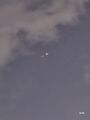
Closest Conjunction of Jupiter and Mars in 2024 (Cape Town, SMH).
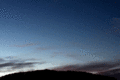
Jupiter, Mars and Pleiades at Dawn (SMH 2024).
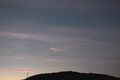
Jupiter, Mars, Pleiaden in a slightly cloudy morning twilight (SMH 2024).
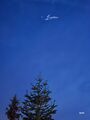
Jupiter at Dusk, slightly cloudy, still visible (bright). (SMH 2025)
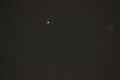
Jupiter in Taurus, north of the Hyades & east of the Pleiades (SMH, in early 2025).
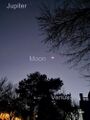
Jupiter and Venus in comparison to the young lunar crescent (Providence 2025).


Concordance, Etymology, History
Kurtik with Hilder, Hoffmann, Horowitz, Kim
= mul (d)Šul-pa-e3-a, lit. "A youngster appears with brilliance"; = Jupiter [Gössmann[1] 383].
See also
- (Kurtik a19) AL.TAR,
- (Kurtik a28) dAMAR.UTU,
- (Kurtik e01) E-pa2-e, for this reading also [BPO 2[2], 2-3; Lambert 1987a[3], 94-95].
mulE-pa2-e only occurs one time in a Boghazkoi version 'Prayer to the Gods of the Night' and is almost certainly a simplified miswriting for the name of Jupiter Šul-pa2-e
Earlier it read of "E-pa2-e": mule-ku-e and was identified with mulAŠ.GAN2 = ikû "Field". [HBA[4], 60; Weidner 1957-59[5], 73], see for example [Gössmann[1] 117; AHw[6], 370; Van der Toorn 1985[7], 129:43].
| Sources | Identifications |
|---|---|
Lexical texts.
|
|
"Prayers to the Gods of the Night."
|
|
| A Hittite Prayer to the Gods of the Night. | |
| EAE.
See. [BPO 2[2], II 14c; BPO 3[16], 288; Borger 1973[17], LB 1321 r. 14′, 18′; Verderame 2002[18], 249; Van Soldt 1995[19], Tablet 25 I 10; Largement 1957[20] 242:33a; SpTU III[21], 101:23, 28, 30] as well as [Biggs 1987[22], 10 r. 10]. |
|
| "Three Stars Each (Astrolabes)".
Astrolabe B.
|
|
BM 82923.
|
|
MUL.APIN.
|
|
| "Reports."
See. [SAA 8[27], 352b]. |
|
| Šumma Sîn ina tāmartīšu.
See. [Koch-Westenholz 1999[28], 154:19, 159:85-86]. |
|
"Great Star List and Miscellenia."
|
|
List of 12 names of Marduk.
|
|
| Late Astrology. |
Additional
II. Deity.
Shulpae's name already occurs in the list of gods from Fara [Krebernik 1986[32], 190:49]. According to one tradition, he was considered the husband of the "mother goddess" Ninhursag, who bore three children with him, including dLI9.SI4 (see Kurtik L07). Shulpae is not a very significant deity, who apparently had an obscure and unfavorable character [Black-Green 1992[33], 173; Tallqvist 1938[34], 267-8]. In AN: dAnum (I 187, IV 269) he is identified with the god dMaškin.ge6.lu2.ḫar.ra.na, who is defined as an "evil god" (DINGIR lim-nu-um) [CT[35] 25, 22:42; Litke 1998[36], 41:187 + note]. In the Old Babylonian periods, Shulpae’s astral meaning, Jupiter, coincides with that of Marduk’s own astral definition. Among his epithets are eṭlu ša elât šamê uštappâ "the youth who appears with splendor in the heights of the heavens" [Tallqvist 1938[34], 468]. On some Old Babylonian seal impressions, one can see a star next to the anthropomorphic image of Shulpae [Braun-Holzinger 1996[37], Nr. 1148, 1150]. The connection of Shulpae with Jupiter may be explained by his role as Marduk's vizier, which seems to be asserted in the poorly preserved text of the Astrolabe. For the astronomical meaning of the name, as recorded in Neo-Assyrian texts: Shulpae is Jupiter during heliacal risings [SAA 8[27], 147:7; BPO 3[16], 230, K.3124:5′], see (Kurtik a28) dAMAR.UTU, IV 8.
Prayers and rituals.
- (1) Old Babylonian incantations: mul dšul.pa.e3.a gub.ba.me.eš "(Before) the star of Shulpae, they (the priests?) stood up" [CT[35] 42, 6 iii 20; Falkenstein 1963[38], 33], see also [CT[35] 42, 6 iii 36].
- (2) A ritual against an epidemic [TuL[39], 163, 34:13].
III. Astrology.
(1) The Moon in Neomenia and Shulpae; DIŠ 30 ina UD.1.KAM ina IGI.LA2-šu2 SI-šu2 ša2 15 GAM-ma mulŠUL.PA.˹E3˺ [...] "If the Moon’s right horn bends (much) on the 1st day (of the month) during its appearance, Shulpae [...]" [Verderame 2002[18], 28, Tav. I: §20]; DIŠ 30 ina UD.1.KAM ina IGI.LA2-šu2 SI-šu2 ša2 2,30 e-du-ud-ma mulŠUL.PA.˹E3˺ [...] "If the Moon’s left horn is pointed (much) on the 1st day (of the month) during its appearance, Shulpae [...]" [ibid.[18], Tav. I: §22]; [DIŠ mulŠUL].PA.E3 ina A2-šu2 GUB MU.3.KAM KUR2 KUR KU2 LUGAL GAL U[Š2...] "[If (during the Moon's appearance) Shul]pae is on her side: within three years the enemy will devour the country, the great king will die [...]" [Verderame 2002[18], 183, Text VIa1: v. 4′], variant apodosis: MU.3.KAM KUR2 KUR-Gu-ti-i KUR.NIM.MAki [KU2...] "Within three years, enemy countries, the Gutians and the Elamites, [will devour ...]" [ibid.[18], 183, Text VIa1: v. 5′].
(2) The Moon appears on the 30th day and Jupiter stands before it; diš 30 ina ud-30-kam igi-ma dšul.pa.e3 ana igi-šu2 ki.ta-ma gub-iz ina iti.bi an.mi gar-ma lugal uriki uš2 / 30 ina igi.lal-šu2 ud-30-kam ki.ta-ma igi-ma "If the Moon appears on the 30th day and Shulpae stands low before it: there will be an eclipse this month, the king of Akkad will die; (it means): The moon (stands) low during its appearance on the 30th day" [Koch-Westenholz 1999[28], 154:19-20].
(3) Jupiter standing with the Moon; diš 30 nu igi-ma 3 ud.sakar.meš igi.meš sal.kur2 ina kur du3.a.bi gar-[an] / ud-14-kam ina nab-ṭe-e igi.meš-ma kimin dšul.pa.e3 ki 30 gub-ma "If the Moon is not visible, but it is visible for 3 months: there will be warfare in the whole country. (This means): on the 14th day they are visible on the horizon, var: Shulpae stands with the Moon" [Koch-Westenholz 1999[28], 159:85-86].
(4) The Moon is surrounded by a halo and Shulpae stands in it; DIŠ 30 TUR3 NIGIN2-ma dŠUL.PA.E3 ina ŠA3-šu2 GUB-iz / LUGAL MAR.TU ŠU2-tu2 DU3-ma a-bi-ik-ti KUR KUR KUR2-šu2 GAR-an "If the Moon is surrounded by a halo and Shulpae stands in it: the king of the Western country will show universal power, he will strike, and defeat his enemy countries" [SAA 8[27], 147 r. 6-7], see also [ibid.[27], 93:1-4, 398:3-6].
(5) Connections between Moon-Jupiter; ˹DIŠ˺ d30 mulŠUL.PA.E3.A i-rim / LUGAL LUGAL.MEŠ KUR2.MEŠ ŠUII-su KUR-ad2 "If the Moon covers Shulpae: the king of hostile kings will seize with his hand" [SAA 8[27], 4:4-7] [SAA 8[27], 438:4-5].
(6) The movement of Venus relative to Shulpae; DIŠ mulDil-bat dŠul-pa-e3 ik-[š]u-dam-m[a] ˹UŠ KI?.MIN˺ ana dŠul-pa-e3 iq-rib-ma / DU bi-ib-lu KUR ub-bal A.KAL DU-kam "If Venus reaches Shulpae and meets (Shulpae), var.: comes close to Shulpae and stops: the flood will carry away the earth, high water will come"; DIŠ mulDil-bat dŠul-pa-e3 ik-šu-dam-ma ˹it˺-ten2-tu-u A.KAL KUR TUM3 "If Venus reaches Šul-pa-e3 and they follow each other: high water will carry away the earth"; DIŠ mulDil-bat ana dMIN ik-šu-dam-ma DIB-˹iq˺-[šu2] A.˹KAL gap-šu DU˺-[ak] "If Venus reaches ditto(= Shulpae) and passes [it]: a powerful flood will com[e]"; DIŠ mulDil-bat u dMIN TE.MEŠ BALA LUGAL MA[R]ki ša2 NAM.GILIM.MA "If Venus and ditto(=Shulpae) converge: reign of destruction, (pertaining) to the king of Amur[ru]"; DIŠ mulDil-bat ana dMIN is-niq KUR UR.[BI] ŠEŠ ŠEŠ-šu2 KUR2-ir "If Venus passes near ditto (=Shulpae): (this sign concerns) the country as a whol[e], brother will feud against his brother" [BPO 3[16], 44, VAT 10218:51-55], see also [SAA 8[27], 212:1-6, 214:3-6; Biggs 1987[22], 10: r. 10; BPO 3[16], BM 75228:1; 71, K.3144 ii 1-6; 92, K.2226+:3 ii]; [DIŠ EŠ4.DA]R? MUL.ME ana dŠul-pa-e3 TE ta-lit-ti ina KUR LA2 ... "[If the Goddes]s? of the stars comes close to Shulpae: growth of (livestock) in the country will decrease..." [BPO 3[16], 217,K.3601+: r. 12]. See also (Kurtik b06) PAN, V 9, (Kurtik k24) KU6, V 17, (Kurtik u31) UZ3, VI 1.
(7) Venus and Jupiter in "balance"; DIŠ mulDil-bat u dŠul-pa-e3 iš-taq-lu-ma ina bi-ri-šu2-nu Sin DU-iz AB.SIN2 GUN-sa3 LA2-ṭa "If Venus and Shulpae are in "balance" and the Moon stands between them: the furrow will diminish its recoil" [BPO 3, 44, VAT 10218:57]; DIŠ mulDil-bat u dŠul-pa-e3 iš-taq-lu-ma UŠ.MEŠ BE BAL LUGAL MAR.TUki "If Venus and Shulpae are in 'balance' and they meet: end of the dynasty of the King of Amurru.." [BPO 3[16], 44, VAT 10218:59], see also [BPO 3[16], 68, BM 75228:2; 92, K.2226+:2 ii; 180, K.229 rev. ii 12E]. According to D. Pingree and E. Rainer, ištaqlu "equilibrium of one with the other" refers to a situation where two luminaries are in opposite quadrants in the sky [BPO 3[16], 5].
(8) Venus, Schulpae, and Regulus; see (Kurtik L14) LUGAL, IV 3.
(9) Venus passes Jupiter during sunrise; UD EŠ4.DAR ina GAL MAN KUR-ma dŠul-pa-e3 DIB-iq ŠA3.GAR GAR "If Ishtar rises at sunset and passes Shulpae: there will be famine" [BPO 3[16], 175, K.229+:46], see also [ibid.[16], 186, K.3191:15′].
(10) Venus, Jupiter, and a planet surround the Moon; DIŠ 30 ina IGI.LA2-šu2 mulDil-bat dŠUL.PA.E3 dUDU.IDIM u3 mul[...] / URU ZAG.MU SIG-am KUR2 NIGIN-ma ŠU-su KUR-ad šal-pu2-tim KUR D[U3.A.BI GAR ...] "If the moon, during its appearance, (and) Venus, Jupiter, a planet and a star [... (surround it?)]: the enemy will surround and capture with his hand one important city on the frontier, misfortune for the whole country [...]" [Verderame 2002[18], 162, Text Vu: v. 8′-9′], see also. [ibid.[18], 196: §21′; Leibovici 1957[40], 23:33; SpTU II[41], 40 r. 18].
(11) A planet approaches Shulpae; DIŠ mulUDU.IDIM ana dŠUL.PA.E3.A TE ŠUB-ti3 si-si-i SIG5? bu-lim ZAḪ2 "If a planet (= Mars?) approaches Shulpae: the downfall of good? horses; the downfall of cattle" [TU[42], 16:33; Largement 1957[20], 242:33a].
(12) Mars stands behind Shulpae; see (Kurtik ts02) Ṣalbatānu, III 24.
(13) The evil star and Shulpae; see (Kurtik h08) ḪUL, III 2.
(14) Mars connection with Jupiter; see (Kurtik s04) SA5, II 4.
(15) The Raven approaches Shulpae; see (Kurtik u11) UGA, VI 16.
Historical Dictionaries
| Kurtik (2022) | Gössmann (1950) |
|---|---|
Kurtik e01 mulE-pa2-e |
|
| возможно, от Šul-pa2-e, Юпитер [BPO 2, 2–3; Lambert 1987a, 94–95].
I. Источники. Хеттская молитва ночным богам. mulE-pa2-e [KUB IV, 47 r. 43; BPO 2, 2:5; Van der Toorn 1985, 129:43]. Ранее читалось как mule-ku-e и отождествлялось с mulAŠ.GAN2 = ikû «Поле» [HBA, 60; Weidner 1957–59, 73], см., например, [G. 117; AHw, 370; Van der Toorn 1985, 129:43]. |
|
Kurtik sh25 ŠUL.PA.E3 |
|
| = mul (d)Šul-pa-e3-a, букв. «С блеском появляющийся юноша»; = Юпитер [G. 383]. См. также a19AL.TAR, a28dAMAR.UTU, e01E-pa2-e.
I. Источники. Лексич. тексты. (1) Одноязычные шумерские списки звезд: mulŠul.pa.e3.a [Emar VI/4, 154:108]. (2) Серия Urra XXII: mulšul.bi.en = Šul-be [Emar VI/4, 151:158], mulal.tar = šul-pa-e3, mulšul.pa.e3.a = ŠU (=šul-pa-e3) [MSL XI, 31, Section 11 col. v 6a, 7; Weidner 1959–60, 112, VAT 9430:23–24], mulud.al.tar = dŠul-pa-e3-a [SpTU III, 228, 114A v 53; Bloch–Horowitz 2015, 110:310ʹ], [mulin.d]ub?.an.na = dŠul-pa-e3-a [Cavigneaux 1979, 134,17:17]. (3) Серия Antagal (G 305): dda.pi.nu = dšul-pa-e3-a [MSL XVII, 229]. (4) Серия AN:dAnum (II 47): dU4.AL.TAR = dŠul.pa.e3 [Litke 1998, 72]. «Молитвы ночным богам». (1) Хеттская молитва, см. e02E-pa2-e. (2) Новоассирийская молитва: mulŠUL.PA.E3 [Oppenheim 1959, 282:11]. ЕАЕ. См. [BPO 2, II 14c; BPO 3, 288; Borger 1973, LB 1321 r. 14′, 18′; Verderame 2002, 249; Van Soldt 1995, Tablet 25 I 10; Largement 1957 242:33a; SpTU III, 101:23, 28, 30], а также [Biggs 1987, 10 r. 10]. «Астролябии». Astrolabe B. (1) Список (12´3): mul gal nam-ru ša ina zi im.[xx] / gub mulšu.pa uš.uš ki.gub ku[r2.kur2] / mulŠul-pa-e3 sukkal da[mar.utu] «Большая блестящая звезда, которая там, где восходит […] ветер, стоит, (это) Шупа, (которая) место (свое) постоянно из[меняет]: Шульпаэ, посланник М[ардука]» (B iii 21–23). (2) Список (3´12): itišu … mulŠul-pa-e3 šu-ut d[En-lil2] «Месяц дуузу: …Шульпаэ (на пути) [Энлиля] (восходит)» (C iii 4). (3) Список (восход–заход=6m): восход — дуузу, заход — тебету [KAV 218, C 19, 32; Horowitz 2014, 39–40], см. k10KAK.SI.SA2. BM 82923. Месяц дуузу, звезды Энлиля: mul[ŠUL.PA.E3 // 55 // …] «[Шульпаэ // 55 // …]» [Walker–Hunger 1977, 30:12]. MUL.APIN. Планеты «на пути Луны»: KASKAL dSin DU-ku dŠul-pa-e3-a DU-ak «Юпитер проходит (тот же) путь, что Луна проходит» (II i 2) [MA, 70]. «Рапорты». См. [SAA 8, 352b]. Šumma Sîn ina tāmartīšu. См. [Koch Westenholz 1999, 154:19, 159:85–86]. «Большой список звезд». Список 7 планет: dšul.pa.e3 на третьем месте после Луны и Солнца [Mesop.Astrol., App. B: 242]. Список 12 имен Мардука. ina itibar2 dšul.pa.e3 = damar.utu «В месяце нисану Шульпаэ = Мардук» [IIIR, 53,2:2]. Поздняя астрология. Предсказательный текст [SpTU IV, 159], см. a21ALLA. II. Божество. Имя Шульпаэ встречается уже в списке богов из Фары [Krebernik 1986, 190:49]. Согласно одной из традиций, он считался мужем «богини-матери» Нинхурсаг, которая родила от него троих детей, в том числе dLI9.SI4 (см. L07). Шульпаэ — не очень значительное божество с неясным и, по-видимому, неблагоприятным характером [Black–Green 1992, 173; Tallqvist 1938, 267–8]. В AN:dAnum (I 187, IV 269) он отождествляется с богом dMaškin.ge6.lu2.ḫar.ra.na, который определяется как «злой бог» (DINGIR lim-nu-um) [CT 25, 22:42; Litke 1998, 41:187 + note]. Со старовавилонского периода Шульпаэ отождествляется с Мардуком в его астральном значении Юпитера. Среди его эпитетов: eṭlu ša elât šamê uštappâ «Юноша, который в высоте небесной появляется с блеском» [Tallqvist 1938, 468]. На некоторых старовавилонских печатях рядом с его антропоморфным изображением можно увидеть звезду [Braun-Holzinger 1996, Nr. 1148, 1150]. Связь Шульпаэ с Юпитером, возможно, объясняется его ролью визиря Мардука, что как будто утверждается в плохо сохранившемся тексте «Астролябии». Астрономический смысл названия, зафиксированный в новоассирийских текстах: Шульпаэ — это Юпитер во время его гелиакического восхода [SAA 8, 147:7; BPO 3, 230, K.3124:5′], см. a28dAMAR.UTU, IV 8. Молитвы и ритуалы. (1) Старовавилонское заклинание: mul dšul.pa.e3.a gub.ba.me.eš «(Перед) звездой Шульпаэ они (жрецы?) встали» [CT 42, 6 iii 20; Falkenstein 1963, 33], см. также [CT 42, 6 iii 36]. (2) Ритуал против эпидемии [TuL, 163, 34:13]. III. Астрология. (1) Луна в неомению и Шульпаэ; DIŠ 30 ina UD.1.KAM ina IGI.LA2-šu2 SI-šu2 ša2 15 GAM-ma mulŠUL.PA.˹E3˺ […] «Если Луна в 1-й день (месяца) при своем появлении свой правый рог (очень) изогнула и Шульпаэ […]» [Verderame 2002, 28, Tav. I: §20]; DIŠ 30 ina UD.1.KAM ina IGI.LA2-šu2 SI-šu2 ša2 2,30 e-du-ud-ma mulŠUL.PA.˹E3˺ […] «Если Луна в 1-й день (месяца) при своем появлении свой левый рог (очень) заострила и Шульпаэ […]» [ibid., Tav. I: §22]; [DIŠ mulŠUL].PA.E3 ina A2-šu2 GUB MU.3.KAM KUR2 KUR KU2 LUGAL GAL U[Š2…] «[Если (при появлении Луны) Шуль]паэ на ее стороне стоит: в течение трех лет враг будет пожирать страну, великий царь ум[рет…]» [Verderame 2002, 183, Text VIa1: v. 4′], вариант аподосиса: MU.3.KAM KUR2 KUR.Gu-ti-i KUR.NIM.MAki [KU2…] «В течение трех лет враг страну гутиев и Элам [будет пожирать …]» [ibid., 183, Text VIa1: v. 5′]. (2) Луна появляется в 30-й день и перед ней Юпитер стоит; diš 30 ina ud-30-kam igi-ma dšul.pa.e3 ana igi-šu2 ki.ta-ma gub-iz ina iti.bi an.mi gar-ma lugal uriki uš2 / 30 ina igi.lal-šu2 ud-30-kam ki.ta-ma igi-ma «Если Луна появляется в 30-й день и Шульпаэ стоит низко перед ней: в этом месяце будет затмение, царь Аккада умрет; (это означает): Луна при своем появлении в 30-й день (стоит) низко, когда она появляется» [Koch-Westenholz 1999, 154:19–20]. (3) Юпитер с Луной стоит; diš 30 nu igi-ma 3 ud.sakar.meš igi.meš sal.kur2 ina kur du3.a.bi gar-[an] / ud-14-kam ina nab-ṭe-e igi.meš-ma kimin dšul.pa.e3 ki 30 gub-ma «Если Луна не видна, но видны 3 месяца: буд[ут] военные действия во всей стране. (Это означает): в 14-й день они видны на горизонте, вар.: Шульпаэ стоит с Луной» [Koch-Westenholz 1999, 159:85–86]. (4) Луна окружена гало и в нем Шульпаэ; DIŠ 30 TUR3 NIGIN2-ma dŠUL.PA.E3 ina ŠA3-šu2 GUB-iz / LUGAL MAR.TU ŠU2-tu2 DU3-ma a-bi-ik-ti KUR KUR2-šu2 GAR-an «Если Луна окружена гало и Шульпаэ стоит в нем: царь Западной страны проявит вселенскую силу и поражение стране врага своего нанесет» [SAA 8, 147 r. 6–7], см. также [ibid., 93:1–4, 398:3–6]. (5) Cоединения Луны с Юпитером; ˹DIŠ˺ d30 mulŠUL.PA.E3.A i-rim / LUGAL LUGAL.MEŠ KUR2.MEŠ ŠUII-su KUR-ad2 «Если Луна покрывает Шульпаэ: царь враждебных царей рукою своею захватит» [SAA 8, 438:4–5]. (6) Движение Венеры относительно Шульпаэ; DIŠ mulDil-bat dŠul-pa-e3 ik-[š]u-dam-m[a] ˹UŠ KI?.MIN˺ ana dŠul-pa-e3 iq-rib-ma / DU bi-ib-lu KUR ub-bal A.KAL DU-kam «Если Венера достигает Шульпаэ и встречается (с ним), вар.: подходит близко к Шульпаэ и останавливается: наводнение унесет землю, высокая вода придет»; DIŠ mulDil-bat dŠul-pa-e3 ik-šu-dam-ma ˹it˺-ten2-tu-u A.KAL KUR TUM3 «Если Венера достигает Шульпаэ и они следуют друг за другом: высокая вода землю унесет»; DIŠ mulDil-bat ana dMIN ik-šu-dam-ma DIB-˹iq˺-[šu2] A.˹KAL gap-šu DU˺-[ak] «Если Венера достигает ditto(= Шульпаэ) и проходит [его]: мощное наводнение прид[ет]»; DIŠ mulDil-bat u dMIN TE.MEŠ BALA LUGAL MA[R]ki ša2 NAM.GILIM.MA «Если Венера и ditto(=Шульпаэ) сближаются: царствование разрушения, (относящееся) к царю Амур[ру]»; DIŠ mulDil-bat ana dMIN is-niq KUR UR.[BI] ŠEŠ ŠEŠ-šu2 KUR2-ir «Если Венера проходит около ditto (=Шульпаэ): (этот знак касается) страны в цел[ом], брат со своим братом враждовать будут» [BPO 3, 44, VAT 10218:51–55], см. также [SAA 8, 212:1–6, 214:3–6; Biggs 1987, 10: r. 10; BPO 3, BM 75228:1; 71, K.3144 ii 1–6; 92, K.2226+:3 ii]; [DIŠ EŠ4.DA]R? MUL.ME ana dŠul-pa-e3 TE ta-lit-ti ina KUR LA2 … «[Если Богин]я? звезд подходит близко к Шульпаэ: прирост поголовья (в стадах) в стране сократится …» [BPO 3, 217,K.3601+: r. 12]. См. также b06BAN, V 9, k24KU6, V 17, u31UZ3, VI 1. (7) Венера и Юпитер в «равновесии»; DIŠ mulDil-bat u dŠul-pa-e3 iš-taq-lu-ma ina bi-ri-šu2-nu Sin DU-iz AB.SIN2 GUN-sa3 LA2-ṭa «Если Венера и Шульпаэ в «равновесии» и между ними Луна стоит: борозда отдачу свою уменьшит» [BPO 3, 44, VAT 10218:57]; DIŠ mulDil-bat u dŠul-pa-e3 iš-taq-lu-ma UŠ.MEŠ BE BAL LUGAL MAR.TUki «Если Венера и Шульпаэ в «равновесии» и встречаются: конец династии царя Амурру» [BPO 3, 44, VAT 10218:59], см. также [BPO 3, 68, BM 75228:2; 92, K.2226+:2 ii; 180, K.229 rev. ii 12E]. Согласно Д. Пингри и Э. Райнер, ištaqlu «равновесие одного с другим» означает ситуацию, когда два светила находятся в противоположных квадрантах неба [BPO 3, 5]. (8) Венера, Шульпаэ и Регул; см. L14LUGAL, IV 3. (9) Венера проходит Юпитер при восходе Солнца; UD EŠ4.DAR ina GAL MAN KUR-ma dŠul-pa-e3 DIB-iq ŠA3.GAR GAR «Если Иштар восходит при заходе Солнца и проходит Шульпаэ: будет голод» [BPO 3, 175, K.229+:46], см. также [ibid., 186, K.3191:15′]. (10) Венера, Юпитер и планета окружают Луну; DIŠ 30 ina IGI.LA2-šu2 mulDil-bat dŠUL.PA.E3 dUDU.IDIM u3 mul[…] / URU ZAG.MU SIG-am KUR2 NIGIN-ma ŠU-su KUR-ad šal-pu2-tim KUR D[U3.A.BI GAR …] «Если Луна при своем появлении (и) Венера, Юпитер, планета и звезда [… (окружают ее?)]: враг окружит и рукой своей захватит один важный город на границе, несчастье для в[сей] страны […]» [Verderame 2002, 162, Text Vu: v. 8′–9′], см. также. [ibid., 196: §21′; Leibovici 1957, 23:33; SpTU II, 40 r. 18]. (11) Планета к Шульпаэ приближается; DIŠ mulUDU.IDIM ana dŠUL.PA.E3.A TE ŠUB-ti3 si-si-i SIG5? bu-lim ZAḪ2 «Если планета (= Марс?) к Шульпаэ приближается: падеж хороших? лошадей; падеж скота» [TU, 16:33; Largement 1957, 242:33a]. (12) Марс идет позади Шульпаэ; см. ts02Ṣalbatānu, III 24. (13) Злая звезда и Шульпаэ; см. h08ḪUL, III 2. (14) Соединение Марса c Юпитером; см. s04SA5, II 4. (15) Ворон приближается к Шульпаэ; см. u11UGA, VI 16. |
Example |
References
- ↑ 1.0 1.1 Gössmann P.F. Planetarium Babylonicum, Rom, 1950 (A. Deimel. Šumerisches Lexikon 4/2).
- ↑ 2.0 2.1 2.2 Reiner E., Pingree D. Enuma Anu Enlil, Tablets 50-51. Undena Publications, Malibu, 1981 (Babylonian Planetary Omens: Part Two).
- ↑ Lambert W.G. Babylonian Astrological Omens and Their Stars / JAOS. 1987. V. 107. Р. 93-96.
- ↑ Weidner E. Handbuch der babylonischen Astronomie. Bd. I. Leipzig, 1915.
- ↑ Weidner E. mul gir2.tab = zuqaqîpi // AfO. 1957-1958. Bd. 18. S. 393-394].
- ↑ Soden von W. Akkadisches Handwörterbuch. Wiesbaden, 1985.
- ↑ 7.0 7.1 K. van der Toorn. Sin and Sanction in Israel and Mesopotamia. A Comparative Study. Maastricht, Van Gorcum, 1985.
- ↑ D. Arnaud. Texte de la bibliothèque, transcriptions et traductions, 1987. (= Emar 6/4).
- ↑ Materials for the Sumerian Lexicon. Vol. XI. The Series HAR-ra = hubullu. Tablets XX-XXIV. Ed. by E.Reiner with the coll. of M.Civil. Roma, 1974.
- ↑ Bloch Y. and W. Horowitz (2015): “Urra = hubullu XXII: The Standard Recension,” with Y. Bloch, Journal of Cuneiform Studies 67: 71-125.
- ↑ Cavigneaux A. // Baghdader Mitteilungen. 1979. Bd. X. S. 132-134.
- ↑ Cavigneaux, A. The Series Erim-ḫuš = anantu and An-ta-gál = šaqû. Pontificium Institutum Biblicum. 1985.
- ↑ Litke R.L. A Reconstruction of the Assyro-Babylonian God-Lists, AN:dA-nu-um and AN:Anu ša2 amēli. New Haven, 1998 (Texts from the Babylonian Collection, Vol. 3).
- ↑ Oppenheim A.L. A New Prayer to the “Gods of the Night” // Analecta biblica. 1959. Vol. 12. P. 282-301.
- ↑ Keilschrifturkunden aus Boghazköi (Berlin). KBo
- ↑ 16.0 16.1 16.2 16.3 16.4 16.5 16.6 16.7 16.8 16.9 Reiner E., Pingree D. Babylonian Planetary Omens. Part Three. Groningen, STYX Publications. 1998.
- ↑ Borger R. Keilschrifttexte verschiedenen Inhalts / Symbolae Biblicae et Mesopotamicae. Festschrift Th. de Liagre Böhl. Ed. M.A.Beek et al. Leiden, 1973. Р. 38-55.
- ↑ 18.0 18.1 18.2 18.3 18.4 18.5 18.6 Verderame L. Enūma Anu Enlil Tablets 1-13 // Under One Sky. Astronomy and Mathematics in the Ancient Near East. Ed. J.M.Steele – A.Imhausen. Münster, Ugarit-Verlag 2002. P. 447- 455.
- ↑ Soldt W.H. van. Solar Omens of Enuma Anu Enlil: Tablets 23(24) – 29(30). Istanbul, 1995.
- ↑ 20.0 20.1 Largement R. Contribution à l’Etudes des Astres errants dans l’Astrologie chaldéenne // ZA. 1957. Bd. 18. S.235-264. Abbreviated ACh.
- ↑ Špätbabylonische Texte aus Uruk. Teil III / Bearb. von Weiher E. von. Berlin, 1988.
- ↑ 22.0 22.1 Biggs R.D. Babylonian Prophecies, Astrology, and A New Source for "Prophecy Text B" / Fs. Reiner. P. 1-14.
- ↑ Schroeder O. Keilschrifttexte aus Assur verschiedenen Inhalts. Leipzig, 1920.
- ↑ Horowitz, W. (2014), The three stars each: the Astrolabes and related texts, Archiv für Orientforschung AfO Beiheft, 33.
- ↑ Walker C.B.F., Hunger H. Zwölfmaldrei // MDOG. 1977. Bd. 109. S. 27-34.
- ↑ Hunger, H. and Steele, J. M. (2019). The Babylonian Astronomical Compendium MUL.APIN, Routledge, NY
- ↑ 27.0 27.1 27.2 27.3 27.4 27.5 27.6 Hunger H. Astrological Reports to Assyrian Kings. Helsinki, 1992 (State Archives of Assyria, VIII).
- ↑ 28.0 28.1 28.2 Koch-Westenholz U. The Astrological Commentary Šumma Sîn ina tāmartīšu Tablet 1 // Res Orientales. 1999. Vol. XII. P.149-165.
- ↑ Koch-Westenholz U. Mesopotamian Astrology. Copenhagen, Museum Tusculanum Press. 1995.
- ↑ Rawlinson H. The Cuneiform Inscriptions of Western Asia. Vol. I-V. London, 1861-1909. (cited as I R, II R, etc.).
- ↑ URUK. Špätbabylonische Texte aus dem Planquadrat U 18. Teil IV / Bearb. von Weiher E. von. Mainz am Rhein, 1993.
- ↑ Krebernik M. Die Götterlisten aus Fāra // ZA. 1986. Bd. 76, Halbband II. S. 161-204.
- ↑ Black J., Green A. Gods, Demons and Symbols of Ancient Mesopotamia. An Illustrated Dictionary. London, British Museum Press, 1992.
- ↑ 34.0 34.1 Tallqvist K. Akkadische Götterepitheta. Helsingforsiae, 1938.
- ↑ 35.0 35.1 35.2 Cuneiform Texts from Babylonian Tablets in the British Museum.
- ↑ Litke R.L. A Reconstruction of the Assyro-Babylonian God-Lists, AN:dA-nu-um and AN:Anu ša2 amēli. New Haven, 1998 (Texts from the Babylonian Collection, Vol. 3).
- ↑ Braun-Holzinger E.A. Altbabylonische Götter und ihre Symbole // BaM . 1996. Bd. 27. S.235-359, Tafel 1-42.
- ↑ Falkenstein A. Sumerische religiöse Texte // ZA. 1963. Bd. XXI. S. 11-67.
- ↑ Ebeling E. Tod und Leben nach den Vorstellungen der Babilonier. Berlin-Leipzig, 1931.
- ↑ M. Leibovici, Un Texte Astrologique d'Uruk, Revue d'Assyriologie et d'archéologie orientale, Vol. 51, No. 1, pp. 21-27, 1957.
- ↑ Špätbabylonische Texte aus Uruk. Teil II / Bearb. von Weiher E. von. Berlin, 1983.
- ↑ Thureau-Dangin F. Tablettes d’Uruk. Paris, 1922 (= TCL 6).