GAM3: Difference between revisions
DavidHilder (talk | contribs) No edit summary |
DavidHilder (talk | contribs) No edit summary |
||
| (18 intermediate revisions by 3 users not shown) | |||
| Line 1: | Line 1: | ||
{{DISPLAYTITLE:<sup>mul / d</sup>GAM<sub>3</sub>}} |
{{DISPLAYTITLE:<sup>mul / d</sup>GAM<sub>3</sub>}} |
||
[[File:Crook stellarium.jpg|thumb|Gamlu, The Crook, in Stellarium (CC BY J. Gullberg and S. Hoffmann).]] |
|||
<sup>mul / d</sup>GAM<sub>3</sub> (𒀯𒆛) = ''gamlu'', 'The Crook,' is an ancient Mesopotamian asterism the corresponds to [[Capella]] with the eastern half of classical [[Auriga]]. The Uranology Text E (MLC 1884) places 'The Crook' in the hand of 'The Old Man' ([[Perseus]]), and speaks of a number of its component parts including its head which is in the shape of a ram's head, its handle, and its shaft. The remaining stars and star-clusters of Auriga that are not part of 'The Crook' may be understood as groups of sheep standing in the background of the image. The asterism is also identified as Marduk's star (Jupiter or Mercury) in Kislev (Month IX). |
|||
== Concordance, Etymology, History<ref>[[Mesopotamian (All Terms)|Planetarium Babylonicum 2.0]], All Skies Encyclopaedia.</ref> == |
|||
<sup>mul / d</sup>GAM<sub>3</sub> (𒀯𒆛) = ''gamlu'', 'The Crook,' is an ancient Mesopotamian asterism the corresponds to [[Capella]] with the eastern half of classical [[Auriga]]. The Uranology Text E (MLC 1884) places 'The Crook' in the hand of 'The Old Man' ([[Perseus]]), and speaks of a number of its component parts including its head which is in the shape of a ram's head, its handle, and its shaft. The remaining stars and star-clusters of Auriga that are not part of 'The Crook' may be understood as groups of sheep standing in the background of the image. |
|||
Variant readings: |
|||
* <sup>mul</sup>ZUBI; |
|||
== Dictionary == |
|||
* = <sup>mul</sup>''gamlu'' "staff (with a crooked handle)"; |
|||
* = ''gamlu'' “throwing stick”. <sup>mul</sup>GÀM (EN 4l).<ref>Hoffmann, S. M. and Krebernik, M. (2023). What do deities tell us about the celestial positioning system, in: R. Rollinger, I. Madreiter, M. Lang, C. Pappi (eds.). The Intellectual Heritage of the Ancient Near East, Papers held at the 64th Rencontre Assyriologique International and 12th Melammu Symposium July 16-20 2018, Innsbruck. Austrian Academy of Sciences Press, 539-579</ref> |
|||
=== Krebernik (2023) === |
|||
= ''gamlu'' “throwing stick”. <sup>mul</sup>GÀM (EN 4l). |
|||
===Kurtik with Hilder, Hoffmann, Horowitz, Kim=== |
|||
Variant readings: <sup>mul</sup>ZUBI; = <sup>mul</sup>''gamlu'' "staff (with a crooked handle)"; |
|||
Var. designations: |
Var. designations: |
||
* 1) a constellation in Ascendant (Auriga), |
* 1) a constellation in Ascendant (Auriga), |
||
* 2) ziqpu XVI (α Aurigae, Capella) [AHw<ref>''von Soden, W''. Akkadisches Handwörterbuch. Wiesbaden, 1985.</ref>, 279a; CAD<ref>''The Assyrian Dictionary of the Oriental Institute of the University of Chicago.'' Chicago and Glückstadt, 1956 - 2010</ref> G, 35b; Gössmann<ref name=":0">''Gössmann P.F''. Planetarium Babylonicum, Rom, 1950 (A. Deimel. Šumerisches Lexikon 4/2).</ref> 64; Schaumberger 1952<ref name=":1">''Schaumberger J. ''Die Ziqpu-Gestirne nach neuen Keilschrifttexten // ZA. 50 (N.F. 16), 214-229.</ref>, 228]. |
|||
* 2) ziqpu XVI (α Aurigae, Capella) [AHw, 279a; CAD G, 35b; G. 64; Schaumberger 1952, 228]. |
|||
==== Sources and Identification(s) ==== |
|||
{| class="wikitable" |
{| class="wikitable" |
||
|- |
|- |
||
| Line 23: | Line 23: | ||
Urra XXII series: |
Urra XXII series: |
||
* <sup>mul</sup>GÀM = [''gam-lu''] [ |
* <sup>mul</sup>GÀM = [''gam-lu''] [Bloch-Horowitz 2015<ref>Bloch, Y. and W. Horowitz (2015): “Urra = hubullu XXII: The Standard Recension,” , Journal of Cuneiform Studies 67: 71-125.</ref>, 107:291ʹ], Cavigneaux 1981<ref>''Cavigneaux A.'' Textes scolaires du temple de Nabû ša Harê. Texts from Babylon I. Baghdad, 1981.</ref>, 105: col. iii 14;],. |
||
| |
|||
| Example |
|||
|- |
|- |
||
|'''EAE.''' |
|'''EAE.''' |
||
See. [BPO 2, III 9a, 29a, VI 4-4a, VIII 2, 5, XVI 6, 13; BPO 3, K.3111+:7]. |
See. [BPO 2<ref name=":2">''Reiner E., Pingree D''. Enuma Anu Enlil, Tablets 50-51. Malibu, Undena Publications, 1981 (Babylonian Planetary Omens: Part Two).</ref>, III 9a, 29a, VI 4-4a, VIII 2, 5, XVI 6, 13; BPO 3<ref name=":3">''Reiner E., Pingree D''. Babylonian Planetary Omens. Part Three. Groningen, STYX Publications. 1998.</ref>, K.3111+:7]. |
||
| |
|||
|Example |
|||
|- |
|- |
||
|'''Three Stars Each.''' |
|'''Three Stars Each.''' |
||
| Line 34: | Line 34: | ||
* ˹diš˺ ''ina'' <sup>iti</sup>ne <sup>mul</sup>gam<sub>3</sub> // <sup>mul</sup>sipa.zi.[an.na] // ''u'' <sup>mul</sup>AN.U<sub>2</sub>.GI.E // <sup>mul</sup>AN.TA.GUB.[BA] / <sup>mul</sup>ur.gi<sub>7</sub> // <sup>mul</sup>dingir.tuš.a.[meš] / u <sup>mul</sup>''Pa-bil-sag'' // <sup>mul</sup>A[N. T]A.Š[U.UR.RA] |
* ˹diš˺ ''ina'' <sup>iti</sup>ne <sup>mul</sup>gam<sub>3</sub> // <sup>mul</sup>sipa.zi.[an.na] // ''u'' <sup>mul</sup>AN.U<sub>2</sub>.GI.E // <sup>mul</sup>AN.TA.GUB.[BA] / <sup>mul</sup>ur.gi<sub>7</sub> // <sup>mul</sup>dingir.tuš.a.[meš] / u <sup>mul</sup>''Pa-bil-sag'' // <sup>mul</sup>A[N. T]A.Š[U.UR.RA] |
||
** "In the month of ab: the Staff, the True Shepherd [Anu], / and AN.U<sub>2</sub>.GI.E — The upward stan[ding] Asterism. / The Hound, the Sitting Gods and Pabilsag— The up[ward]ly fla[ring] star" (Rev. 37-40) [Donbaz-Koch 1995, 64, 66]. |
** "In the month of ab: the Staff, the True Shepherd [Anu], / and AN.U<sub>2</sub>.GI.E — The upward stan[ding] Asterism. / The Hound, the Sitting Gods and Pabilsag— The up[ward]ly fla[ring] star" (Rev. 37-40) [Donbaz-Koch 1995<ref>''Donbaz V., Koch J.'' Ein Astrolab der dritten Generation: Nv. 10 // JCS 47, 63-83.</ref>, 64, 66]. |
||
| |
| |
||
|- |
|- |
||
|'''MUL.APIN''' |
|'''MUL.APIN''' |
||
* (1) ... "The Crook, ''Gamlu''" (I i 4) |
* (1) ... "The Crook, ''Gamlu''" (I i 4) |
||
* (2) Dates of heliacal risings: ''ina'' <sup>iti</sup>BAR<sub>2</sub> UD 20 KAM <sup>mul</sup>GAM<sub>3</sub> IGI.LA<sub>2</sub> "On the 20th of Nisan the Staff becomes visible" (I ii 37); for a quote from MUL.APIN see. [LABS, 62:17-18]. |
* (2) Dates of heliacal risings: ''ina'' <sup>iti</sup>BAR<sub>2</sub> UD 20 KAM <sup>mul</sup>GAM<sub>3</sub> IGI.LA<sub>2</sub> "On the 20th of Nisan the Staff becomes visible" (I ii 37); for a quote from MUL.APIN see. [LABS<ref name=":4">''A. Sachs, T. Pinches, J. Strassmaier,'' Late Babylonian Astronomical and Related Texts, London, 1955.</ref>, 62:17-18]. |
||
* (3) Simultaneous daily sunrises and sunsets: (I iii 28), see (Kurtik b06) [[BAN]]. |
* (3) Simultaneous daily sunrises and sunsets: (I iii 28), see (Kurtik b06) [[BAN]]. |
||
* (4) Intervals between dates of heliacal risings: TA KUR ša<sub>2</sub> <sup>mul</sup>KU<sub>6</sub> 35 UD<sup>meš</sup> ''ana'' KUR ''ša''<sub>2</sub> <sup>mul</sup>GAM<sub>3</sub> / TA KUR ''ša''<sub>2</sub> <sup>mul</sup>GAM<sub>3</sub> 10 UD<sup>meš</sup> ''ana'' KUR ''ša''<sub>2</sub> MUL.MUL "35 days from the rising of the Fish to the rising of the Staff. 10 days from the rising of the Staff to the rising of the Star Cluster" (I iii 43-44). |
* (4) Intervals between dates of heliacal risings: TA KUR ša<sub>2</sub> <sup>mul</sup>KU<sub>6</sub> 35 UD<sup>meš</sup> ''ana'' KUR ''ša''<sub>2</sub> <sup>mul</sup>GAM<sub>3</sub> / TA KUR ''ša''<sub>2</sub> <sup>mul</sup>GAM<sub>3</sub> 10 UD<sup>meš</sup> ''ana'' KUR ''ša''<sub>2</sub> MUL.MUL "35 days from the rising of the Fish to the rising of the Staff. 10 days from the rising of the Staff to the rising of the Star Cluster" (I iii 43-44). |
||
* (5) List of ziqpu-stars: <sup>mul</sup>GAM<sub>3</sub> after <sup>mul</sup>ŠU.GI before <sup>mul</sup>MAŠ.TAB.BA.GAL.GAL (I iv 5). |
* (5) List of ziqpu-stars: <sup>mul</sup>GAM<sub>3</sub> after <sup>mul</sup>ŠU.GI before <sup>mul</sup>MAŠ.TAB.BA.GAL.GAL (I iv 5). |
||
* (6) Culminations simultaneous with heliacal risings: ina <sup>iti</sup>BAR<sub>2</sub> UD 20 KAM ... / ''ku-ma-ru ša''<sub>2</sub> <sup>mul</sup>UD.KA.DUḪ.A ''ina'' MURUB<sub>4</sub> AN-''e'' / ''ina'' IGI''-it'' GABA-''ka'' GUB-''ma'' <sup>mul</sup>GAM<sub>3</sub> KUR-''ḫa'' "20th of Nisan...the shoulder of the Demon with the Gaping Mouth stands in the middle of heaven / opposite your chest, and the staff is rising" (I iv 13-14). |
* (6) Culminations simultaneous with heliacal risings: ina <sup>iti</sup>BAR<sub>2</sub> UD 20 KAM ... / ''ku-ma-ru ša''<sub>2</sub> <sup>mul</sup>UD.KA.DUḪ.A ''ina'' MURUB<sub>4</sub> AN-''e'' / ''ina'' IGI''-it'' GABA-''ka'' GUB-''ma'' <sup>mul</sup>GAM<sub>3</sub> KUR-''ḫa'' "20th of Nisan...the shoulder of the Demon with the Gaping Mouth stands in the middle of heaven / opposite your chest, and the staff is rising" (I iv 13-14). |
||
* (7) Stars "in the way of the moon": <sup>mul</sup>GAM<sub>3</sub>, after <sup>mul</sup>ŠU.GI, before <sup>mul</sup>MAŠ.TAB.BA.GAL.GAL (I iv 34), see (Kurtik s20) ''[[Sîn]]'' [MA, 19, 40, 51, 55, 59, 61, 68]. |
* (7) Stars "in the way of the moon": <sup>mul</sup>GAM<sub>3</sub>, after <sup>mul</sup>ŠU.GI, before <sup>mul</sup>MAŠ.TAB.BA.GAL.GAL (I iv 34), see (Kurtik s20) ''[[Sîn]]'' [MA<ref name=":5">Hunger, H. and J. M. Steele (2019). The Babylonian Astronomical Compendium MUL.APIN, Routledge, NY</ref>, 19, 40, 51, 55, 59, 61, 68]. |
||
|[[File:Crook stellarium.jpg|thumb|Gamlu, The Crook, in Stellarium (CC BY J. Gullberg and S. Hoffmann).]] |
|||
| |
|||
|- |
|- |
||
| '''"Letters" and "Reports."''' |
| '''"Letters" and "Reports."''' |
||
See. [LABS, 160:13, 62 e. 18; ARAK, 115 r. 4, 170 r. 1]. |
See. [LABS<ref name=":4" />, 160:13, 62 e. 18; ARAK<ref name=":6">''Hunger H.'' Astrological Reports to Assyrian Kings. Helsinki, 1992 (State Archives of Assyria, VIII).</ref>, 115 r. 4, 170 r. 1]. |
||
| |
| |
||
|- |
|- |
||
|'''"The Great Star List and Miscellenia".''' |
|'''"The Great Star List and Miscellenia".''' |
||
* (1) 7 tikpu-stars: <sup>mul</sup>gam<sub>3</sub>; |
* (1) 7 tikpu-stars: <sup>mul</sup>gam<sub>3</sub>; |
||
* (2) ''gam-lum'', in an unclear sense [Mesop.Astrol., App. B:161, 222; Weidner 1959-60, 107-108]. |
* (2) ''gam-lum'', in an unclear sense [Mesop.Astrol.<ref name=":7">''Koch-Westenholz U''. Mesopotamian Astrology. Copenhagen, Museum Tusculanum Press. 1995.</ref>, App. B:161, 222; Weidner 1959-60<ref>''Weidner E. '' Ein astrologischer Sammeltext aus der Sargonidenzeit // AfO. 1959-1960. Bd. 19. S. 105-113.</ref>, 107-108]. |
||
* (3) The star of Marduk in Month IX (Kislev). See [[AMAR.UTU]]. |
|||
| |
| |
||
|- |
|- |
||
|List of stars VR 46, 1:3, 49. |
|List of stars VR 46, 1:3, 49. |
||
* (1) <sup>mul</sup>gam<sub>3</sub> = <sup>giš</sup>tukul ''ša''<sub>2</sub> šu<sup>II</sup> <sup>d</sup>amar.utu "The staff is a weapon in the hands of Marduk"; |
* (1) <sup>mul</sup>gam<sub>3</sub> = <sup>giš</sup>tukul ''ša''<sub>2</sub> šu<sup>II</sup> <sup>d</sup>amar.utu "The staff is a weapon in the hands of Marduk"; |
||
* (2) <sup>mul</sup>udu.nita<sub>2</sub> = sag.du <sup>mul</sup>gam<sub>3</sub> "Star-Baran = Top of the Staff". [HBA, 51-52; Wee 2016, 162-3]. |
* (2) <sup>mul</sup>udu.nita<sub>2</sub> = sag.du <sup>mul</sup>gam<sub>3</sub> "Star-Baran = Top of the Staff". [HBA<ref name=":8">''Weidner E.'' Handbuch der babylonischen Astronomie. Bd. I. Leipzig, 1915.</ref>, 51-52; Wee 2016<ref>Wee, J. (2016). Virtual Moons over Babylonia: The Calendar Text System, Its Micro-Zodiac of 13, and the Making of Medical Zodiology. The Circulation of Astronomical Knowledge in the Ancient World, ed. J. M. Steele, 139–229.</ref>, 162-3]. |
||
| |
| |
||
|- |
|- |
||
| Line 65: | Line 66: | ||
* (1) AO 6478: |
* (1) AO 6478: |
||
** a) [2½ MA.NA KI. LA<sub>2</sub>] | ½ DANNA ''i-n''[''a qaq-q'']''a-ri'' | 27 IGI DANNA ''ina'' AN-[''e''] / TA <sup>mul</sup>''na-aṣ-ra-pi'' | EN <sup>mul</sup>[GAM<sub>3</sub>] |
** a) [2½ MA.NA KI. LA<sub>2</sub>] | ½ DANNA ''i-n''[''a qaq-q'']''a-ri'' | 27 IGI DANNA ''ina'' AN-[''e''] / TA <sup>mul</sup>''na-aṣ-ra-pi'' | EN <sup>mul</sup>[GAM<sub>3</sub>] |
||
*** "[2½ min. weight], 150 o[n the lan]d, 27000 miles in the sky / From Natsrapu to the [Staff]," |
*** "[2½ min. weight], 150 o[n the lan]d, 27000 miles in the sky / From Natsrapu to the [Staff]," |
||
** b) [1⅔ MA. NA MIN(=''šuqultu'')] | 10 UŠ i-na KI.MIN(=''ina qaqqari'') | 18 IGI DANNA ''i-na'' KI.MIN(=''ina šamê'') | TA <sup>mul</sup>GAM<sub>3</sub> | EN <sup>mul</sup>KIŠIB GAM<sub>3</sub> |
** b) [1⅔ MA. NA MIN(=''šuqultu'')] | 10 UŠ i-na KI.MIN(=''ina qaqqari'') | 18 IGI DANNA ''i-na'' KI.MIN(=''ina šamê'') | TA <sup>mul</sup>GAM<sub>3</sub> | EN <sup>mul</sup>KIŠIB GAM<sub>3</sub> |
||
*** "[1⅔ weight mines], 100 on earth, 18000 miles in the sky / From the Staff to the Hand on the Staff". [Thureau-Dangin 1913, 217:1-4; TU, 21 r. 1-4; HBA, 133; Schaumberger 1952, 228-229]. |
*** "[1⅔ weight mines], 100 on earth, 18000 miles in the sky / From the Staff to the Hand on the Staff". [Thureau-Dangin 1913<ref>''Thureau-Dangin F.'' Distances entre étoiles fixes // RA. 1913. Vol 13. P.215-225.</ref>, 217:1-4; TU<ref name=":9">''Thureau-Dangin F''. Tablettes d’Uruk. Paris, 1922 (= TCL 6).</ref>, 21 r. 1-4; HBA<ref name=":8" />, 133; Schaumberger 1952<ref name=":1" />, 228-229]. |
||
* (2) VAT 16437: ½ DANNA ''a-na'' <sup>mul</sup>''gam-l''[''u''] "150 to the Staff." [Schaumberger 1952, 224-225:11]. |
* (2) VAT 16437: ½ DANNA ''a-na'' <sup>mul</sup>''gam-l''[''u''] "150 to the Staff." [Schaumberger 1952<ref name=":1" />, 224-225:11]. |
||
* (3) VAT 16436: <sup>múl</sup>GAM<sub>3</sub> <sup>d</sup>BAD // 1 // 14 IGI 4 ME KUŠ<sub>3</sub> "Marduk's staff // 1 (star) // 14400 cubits." [Schaumberger 1952, 226-227:8]. |
* (3) VAT 16436: <sup>múl</sup>GAM<sub>3</sub> <sup>d</sup>BAD // 1 // 14 IGI 4 ME KUŠ<sub>3</sub> "Marduk's staff // 1 (star) // 14400 cubits." [Schaumberger 1952<ref name=":1" />, 226-227:8]. |
||
* (4) BM 38369+: |
* (4) BM 38369+: |
||
** a) TA <sup>m[u]l</sup>ŠU.GI EN <sup>mul</sup>GAM<sub>3</sub> [...] "From the Old Man to the Staff [...]", |
** a) TA <sup>m[u]l</sup>ŠU.GI EN <sup>mul</sup>GAM<sub>3</sub> [...] "From the Old Man to the Staff [...]", |
||
** b) TA <sup>mul</sup>GAM<sub>3</sub> EN <sup>mul</sup>MAŠ.TAB.BA.GAL...[GAL...] "From the Staff to the Great Twi[ns]..." [Horowitz 1994a, 91-92:8-9]. |
** b) TA <sup>mul</sup>GAM<sub>3</sub> EN <sup>mul</sup>MAŠ.TAB.BA.GAL...[GAL...] "From the Staff to the Great Twi[ns]..." [Horowitz 1994a<ref>''Horowitz W.'' Two New Ziqpu-Star Texts and Stellar Circles // JCS. 1994. Vol. 46. P. 89-98.</ref>, 91-92:8-9]. |
||
* (5) Sippar Planisphere: ½ DANNA ''ana'' <sup>mul</sup>''gam-lu'' "½ mile(150) to the Staff. [Horowitz-al-Rawi 2001, 171-173:16]; for a parallel see BM 61677 [ibid., 180:8']. See also (Kurtik k21) [[KIŠIB]]. |
* (5) Sippar Planisphere: ½ DANNA ''ana'' <sup>mul</sup>''gam-lu'' "½ mile(150) to the Staff. [Horowitz-al-Rawi 2001<ref name=":10">''Horowitz W., al-Rawi F.N.H''. Tablets from the Sippar Library IX. A Ziqpu-Star Planisphere // Iraq. 2001. V. LXIII. P. 171-181.</ref>, 171-173:16]; for a parallel see BM 61677 [ibid.<ref name=":10" />, 180:8']. See also (Kurtik k21) [[KIŠIB]]. |
||
| |
| |
||
|- |
|- |
||
|'''Dalbanna-text.''' |
|'''Dalbanna-text.''' |
||
* §U. <sup>mul</sup>gam<sub>3</sub> <sup>mul</sup>gir<sub>3</sub> zag šu.gi <sup>mul</sup>gir<sub>3</sub> gub<sub>3</sub> ˹maš.tab.ba˺ [x x 3 mul.meš] gu si.sa<sub>2</sub> dub<sub>2</sub>.ba 2 dal.ba.[an].na min [x x] "Staff (ζ, η Aur), the right foot of the Old Man (ρ Per), the left foot [x x] of Gemini (μ Gem): [...3 stars]. Straight, tight rope. 2 inter[va]ls, ditto [x x]." [Walker 1995, 34; ASM, 107]; according to [Koch 1995, 60, 77], <sup>mul</sup>gir<sub>3</sub> gub<sub>3</sub> ˹maš.tab.ba˺ [x] = <sup>mul</sup>gir<sub>3</sub> gub<sub>3</sub> ˹maš.tab.ba˺ [gal.gal] "Left leg of [Great] Twins" (μ Gem). |
* §U. <sup>mul</sup>gam<sub>3</sub> <sup>mul</sup>gir<sub>3</sub> zag šu.gi <sup>mul</sup>gir<sub>3</sub> gub<sub>3</sub> ˹maš.tab.ba˺ [x x 3 mul.meš] gu si.sa<sub>2</sub> dub<sub>2</sub>.ba 2 dal.ba.[an].na min [x x] "Staff (ζ, η Aur), the right foot of the Old Man (ρ Per), the left foot [x x] of Gemini (μ Gem): [...3 stars]. Straight, tight rope. 2 inter[va]ls, ditto [x x]." [Walker 1995, 34; ASM<ref name=":11">''Hunger H., Pingree D.'' Astral Sciences in Mesopotamia. Leiden-Boston-Köln, 1999.</ref>, 107]; according to [Koch 1995<ref>''Koch J.'' Der Dalbanna-Sternenkatalog // WO. 1995. Bd. 26. S. 43-85.</ref>, 60, 77], <sup>mul</sup>gir<sub>3</sub> gub<sub>3</sub> ˹maš.tab.ba˺ [x] = <sup>mul</sup>gir<sub>3</sub> gub<sub>3</sub> ˹maš.tab.ba˺ [gal.gal] "Left leg of [Great] Twins" (μ Gem). |
||
| |
| |
||
|- |
|- |
||
|'''Uranology''' (Beaulieu et al. 2018<ref name=":12">Beaulieu, P.-A., Frahm, E., Horowitz, W. & Steele, J. (2018), The Cuneiform Uranology Texts: Drawing the Constellations, American Philosophical Society Press, Philadelphia, USA.</ref>, 63-64) |
|||
|'''Uranology''' (Beaulieu et al. 2018, 63-64) |
|||
* r'1'–2' (traces only) |
* r'1'–2' (traces only) |
||
* 3' [A hu]man figure it is, dress[ed], |
* 3' [A hu]man figure it is, dress[ed], |
||
* 4' bearded, set with a kurkurru. |
* 4' bearded, set with a kurkurru. |
||
| Line 96: | Line 97: | ||
|- |
|- |
||
|'''Late astrology.''' |
|'''Late astrology.''' |
||
* (1) W 23313/3: [DIŠ KI <sup>mul</sup>ZUB]I U<sub>3</sub>...[TU...] "If (he), when the Staff (culminates), is born..." [SpTU V, 265:x+1]. |
* (1) W 23313/3: [DIŠ KI <sup>mul</sup>ZUB]I U<sub>3</sub>...[TU...] "If (he), when the Staff (culminates), is born..." [SpTU V, 265:x+1]. |
||
* (2) AO 6483: [...: <sup>múl</sup>zubi] ''e''<sub>3</sub>-''a'' nig<sub>2</sub>.tuk uš<sub>2</sub> giš[...] "(If the child is born when) [... the Staff] appears: he will be healthy, death by we[apons](?)" [TU, 14 r. 36; Sachs 1952, 67, 70]. |
* (2) AO 6483: [...: <sup>múl</sup>zubi] ''e''<sub>3</sub>-''a'' nig<sub>2</sub>.tuk uš<sub>2</sub> giš[...] "(If the child is born when) [... the Staff] appears: he will be healthy, death by we[apons](?)" [TU<ref name=":9" />, 14 r. 36; Sachs 1952<ref>''Sachs A.'' Babylonian Horoscopes // JCS. 1952. V. 6. P. 49-75.</ref>, 67, 70]. |
||
| |
|||
|- |
|||
! |
|||
==== Kurtik (2022, n01) ==== |
|||
! |
|||
|- |
|||
|Var. reading: |
|||
* <sup>ul</sup>NAD<sub>3</sub>; = "bed-star"; the name of Jupiter in the month of kislimu [Gössmann<ref name=":0" /> 291]. Only in IIIR, 53, 2, see (Kurtik a28) [[AMAR.UD|<sup>d</sup>AMAR.UTU]]. Likely a scribe's error; instead of NA<sub>2</sub> it should be GAM<sub>3</sub><sup>(?)</sup>. |
|||
* XVIX. K. 3384 (Reiner-Pigree, BPO 3, 1998<ref name=":3" />, 262-63 Group G) + K. 5990 (IIIR<ref name=":13">''Rawlinson H.'' The Cuneiform Inscriptions of Western Asia. Vol. I-V. London, 1861-1909. (cited as I R, II R, etc.)''.''</ref> 43, 2 = ACh Ištar<ref>''Ch. Virolleaud'', L'astrologie chaldéenne S(in); Shamasz; Isht(ar); Adad; S/Supp. = Supplément; SS / 2.Supp. = Second Supplément (Paris 1905 - 1912)</ref> VIII |
|||
* 11<reverse only>) |
|||
Venus -Names; |
|||
* see also BM 45697 (81-7-6, 102) (LBAT<ref name=":4" /> 1564), BM 37391, and maybe BM 32314. |
|||
Text has MA sign form of TIM and NA. |
|||
| |
| |
||
|} |
|} |
||
See also (Kurtik m16) [[MAŠ.TAB.BA]]. |
See also (Kurtik m16) [[MAŠ.TAB.BA]]. |
||
[[File:GAM3 CH Screenshot 2025-11-28 172016.png|thumb|Convex Hull for the stars inside GAM3 (CC BY Youla Azkarrula).]] |
|||
====Stars within the Constellation Area==== |
|||
{| class="wikitable sortable mw-collapsible" |
|||
|+ |
|||
! id |
|||
! Label |
|||
! HIP |
|||
! description |
|||
! Vmag |
|||
|- |
|||
| 1 |
|||
| [[Capella]] |
|||
| HIP 24608 |
|||
| Constellation lines (Vertex) |
|||
| 0.08 |
|||
|- |
|||
| 2 |
|||
| [[Menkalinan]] |
|||
| HIP 28360 |
|||
| Constellation lines (Vertex) |
|||
| 1.9 |
|||
|- |
|||
| 3 |
|||
| [[Mahasim]] |
|||
| HIP 28380 |
|||
| Constellation lines (Vertex) |
|||
| 2.62 |
|||
|- |
|||
| 4 |
|||
| ν Aurigae |
|||
| HIP 27673 |
|||
| Inside the Hull |
|||
| 3.95 |
|||
|- |
|||
| 5 |
|||
| - |
|||
| HIP 27319 |
|||
| Inside the Hull |
|||
| 6.292 |
|||
|- |
|||
| 6 |
|||
| - |
|||
| HIP 27777 |
|||
| Inside the Hull |
|||
| 6.39 |
|||
|} |
|||
===Additional=== |
===Additional=== |
||
==== |
==== Deity. ==== |
||
<sup>d</sup>''gamlu'' — a shepherd's staff and/or weapon characterized by its curvature. Marduk and other deities possessed suchobjects [AHw, 279; Tallqvist 1938, 310]. Immediately after <sup>múl</sup>GAM<sub>3</sub> in VAT 16436:9 follows <sup>múl</sup>KIŠIB GAM<sub>3</sub> <sup>d</sup>DAM.KI.NUN.NA "the hand on the staff of Damkinunna". [Schaumberger 1952, 226-227], most likely a variant of the name of the Sumerian goddess <sup>d</sup>Dam.ki.na (var.: <sup>d</sup>Dam.ki.an.na, <sup>d</sup>Dam.gal.nun.an.na, <sup>d</sup>Dam.gal.nun.na), considered the wife of Ea [Litke 1998, 88; Tallqvist 1938, 280]. For ''gamlu'' as a divine symbol and as a tool of the caster see also [Wiggermann 1992, 61-62]. |
<sup>d</sup>''gamlu'' — a shepherd's staff and/or weapon characterized by its curvature. Marduk and other deities possessed suchobjects [AHw<ref>''von Soden, W''. Akkadisches Handwörterbuch. Wiesbaden, 1985.</ref>, 279; Tallqvist 1938<ref name=":14">''Tallqvist K''. Akkadische Götterepitheta. Helsingforsiae, 1938.</ref>, 310]. Immediately after <sup>múl</sup>GAM<sub>3</sub> in VAT 16436:9 follows <sup>múl</sup>KIŠIB GAM<sub>3</sub> <sup>d</sup>DAM.KI.NUN.NA "the hand on the staff of Damkinunna". [Schaumberger 1952<ref name=":1" />, 226-227], most likely a variant of the name of the Sumerian goddess <sup>d</sup>Dam.ki.na (var.: <sup>d</sup>Dam.ki.an.na, <sup>d</sup>Dam.gal.nun.an.na, <sup>d</sup>Dam.gal.nun.na), considered the wife of Ea [Litke 1998<ref>''Litke R.L''. A Reconstruction of the Assyro-Babylonian God-Lists, AN:<sup>d</sup>A-nu-um and AN:Anu ša<sub>2</sub> amēli. New Haven, 1998 (Texts from the Babylonian Collection, Vol. 3).</ref>, 88; Tallqvist 1938<ref name=":14" />, 280]. For ''gamlu'' as a divine symbol and as a tool of the caster see also [Wiggermann 1992, 61-62]. |
||
==== |
==== Symbol. ==== |
||
A staff with a rounded handle in the form of a ram's head, at least for certain in the case of the asterism. The symbol is known from the Old Babylonian time on the seals, and later on the kudurru [Seidl 1968, 165-167; Van Buren 1945, 149-151], where it was depicted often next to a goat-fish, which suggests its connection with the god Ea. |
A staff with a rounded handle in the form of a ram's head, at least for certain in the case of the asterism. The symbol is known from the Old Babylonian time on the seals, and later on the kudurru [Seidl 1968<ref>''Seidl U.'' Die babylonischen Kudurru-Reliefs // BaM. 1968, Bd. 4. S. 1-220.</ref>, 165-167; Van Buren 1945<ref>''Van Buren E.D''. Symbols of the Gods in Mesopotamian Art. Roma, 1945.</ref>, 149-151], where it was depicted often next to a goat-fish, which suggests its connection with the god Ea. |
||
==== |
==== Previous Identification. ==== |
||
Constellation: |
Constellation: |
||
= Auriga [ |
= [[Auriga]] [Gössmann<ref name=":0" /> 64; Weidner 1957-59<ref>''Weidner E.'' mul gir<sub>2</sub>.tab = ''zuqaqîpi'' // AfO. 1957-1958. Bd. 18. S. 393-394].</ref>, 78; MA<ref name=":5" />, 137; Mesop.Astrol.<ref name=":7" />, 207, App. C; ASM<ref name=":11" />, 272; Horowitz 2014<ref>Horowitz, W. (2014), The three stars each: the Astrolabes and related texts, Archiv für Orientforschung AfO Beiheft, 33.</ref>, 246; Beaulieu et al. 2018<ref name=":12" />, 72]. |
||
Ziqpu XVI: |
Ziqpu XVI: |
||
= α Aurigae (Capella) [Schaumberger 1952, 229; MA, 142; ASM, 88]. |
= α Aurigae ([[Capella]]) [Schaumberger 1952<ref name=":1" />, 229; MA<ref name=":5" />, 142; ASM, 88]. |
||
Ziqpu XVII: |
Ziqpu XVII: |
||
= β Aurigae [Schaumberger 1952, 229; Pingree-Walker 1988, 319, note 15], see also (Kurtik k21) [[KIŠIB]]. |
= β Aurigae ([[Menkalinan]]) [Schaumberger 1952<ref name=":1" />, 229; Pingree-Walker 1988<ref>''Pingree D., Walker C.'' A Babylonian Star-Catalogue: BM 78161 / Fs. Sachs, 313-322.</ref>, 319, note 15], see also (Kurtik k21) [[KIŠIB]].<gallery> |
||
File:Papke Ori+Crook.jpg|Gamlu as part of SIPA.ZI.AN.NA's shepherd's staff; interpretation by Papke (1989). |
|||
File:White-Gavin2014 GamluGrook.jpg|Gamlu, The Crook, in the reconstruction by Gavin White (2014). |
|||
File:Ori+shepherdStaff stellarium.jpg|The True Shepherd of Anu with a staff reaching to Auriga (CC BY SMH in Stellarium with drawing by R. Perdok, LWL Planetarium Münster 2016). |
|||
File:Crook stellarium.jpg|Crook as a standalone constellation (Stellarium CC BY J. Gullberg and SMH). |
|||
</gallery>Papke (1989) is wrong, as his Shepherd has only the leg formed by the stars of Ori which is rather nonsensical image. A much more fitting representation of the Gamlu-Crook as Shepherd's Staff was designed by LWL Planetarium Münster, Germany, in 2016: their figure of the shepherd fits the stars of Orion and the shepherd's staff only appears strangly long. |
|||
White (2014) gives three images: A sketch of the Greek shepherd in Auriga just called "Crook" which is not justified by any text, a Babylonian "bison-man" which is (a) in our mind a wrong wording because bisons live only in North America and not in Mesopotamia, and (b) also not attested in any text: The constellation of the "bison-man" (GU.ALIM) occurs only in the dal.ba.an.na text, and needs to be identified with a different area in the sky. White's last version of "Gamlu" as a simply throwing stick is correct: Our drawing differs, but the object can be considered in more than one way. |
|||
==== V. Parts of the constellation and individual stars. ==== |
|||
(1) kišib gam<sub>3</sub> "Handle on the Staff", see (Kurtik k21) [[KIŠIB]],. Beaulieu et al. 2018, 64) |
|||
==== Parts of the constellation and individual stars. ==== |
|||
(1) kišib gam<sub>3</sub> "Handle on the Staff", see (Kurtik k21) [[KIŠIB]]. Beaulieu et al. 2018<ref name=":12" />, 64) |
|||
(2) sag.du <sup>mul</sup>gam<sub>3</sub> "Top of the Staff", see list of stars in VR 46.1, also (Kurtik u10) [[UDU.NITA2|UDU.NITA<sub>2</sub>]]. |
(2) sag.du <sup>mul</sup>gam<sub>3</sub> "Top of the Staff", see list of stars in VR 46.1, also (Kurtik u10) [[UDU.NITA2|UDU.NITA<sub>2</sub>]]. |
||
==== |
==== Astrology. ==== |
||
===== Identifications: ===== |
===== Identifications: ===== |
||
(1) = Jupiter; <sup>mul</sup>GAM<sub>3</sub> — the name of Marduk (<sup>d</sup>AMAR.UTU = Jupiter) in the month Kislimu [ |
(1) = Jupiter; <sup>mul</sup>GAM<sub>3</sub> — the name of Marduk (<sup>d</sup>AMAR.UTU = Jupiter) in the month Kislimu [IIIR<ref name=":13" /> 53, 2:10; CT<ref>''Cuneiform Texts from Babylonian Tablets in the British Museum.''</ref> 26, 49, S. 777:10], see also [HBA<ref name=":8" />, 24]; <sup>mul d</sup>AMAR.UTU ''a-na'' <sup>mul</sup>GAM<sub>3</sub> ''i-qab-bi'' "The asterism of Marduk — so said of the Staff". [BPO 2<ref name=":2" />, III 29a + Parallels]; see also: ''Ga''<sub>2</sub>-''am''<sub>3</sub>-''lum lum-''[''m'']''un'': <sup>d</sup>''Sag-me-gar u''<sub>2</sub>-''ta-an-na-at-ma'' "(Constellation) ominous Staff, (it means): the luster of Jupiter is weak" [SpTU I<ref>''Špätbabylonische Texte aus Uruk.'' Teil I / Bearb. von H.Hunger. Berlin, 1976.</ref>, 84:14], and also [Brown 2000<ref>''Brown D.'' Mesopotamian Planetary Astronomy-Astrology. Groningen, STYX Publication, 2000.</ref>, 61]. |
||
(2) = Mars(?); so considered by Bezold, quoted by Gesman [Bezold 1920, 122:175; |
(2) = Mars(?); so considered by Bezold, quoted by Gesman [Bezold 1920<ref>Antike Beobachtungen farbiger Sterne von Franz Boll. Mit einem Beitrag von Carl Bezold // Abhandlungen der Bayerische Akademie der Wissenschaften. Philos.- philolog.-hist. Kl. 1920. Bd. 30. S. 1-164.</ref>, 122:175; Gössmann<ref name=":0" />, III, A 2 ], but we find no confirmation in the texts. |
||
===== Predictions: ===== |
===== Predictions: ===== |
||
(3) General astrological meaning; [<sup>mul</sup>GAM<sub>3</sub> ''ana'' BALA TIL.L]A / <sup>mul</sup>GAM<sub>3</sub> ''lum-mu-un'' BALA ḪA.[A] / [DIŠ <sup>mul</sup>GAM<sub>3</sub> ''zi-mu-šu uṣ-ṣa-na-l'']''a-mu'' BALA ḪA.A''-ma'' MAN-''ma'' DU<sub>6</sub>+DU-''a'' "[Staff (to predict) the end of a dynasty]. / The staff is evil: the dynasty will perish. / If the staff becomes dark]: a dynasty will perish and another will arise. [BPO 2, VI 4-4b + Parallels]. |
(3) General astrological meaning; [<sup>mul</sup>GAM<sub>3</sub> ''ana'' BALA TIL.L]A / <sup>mul</sup>GAM<sub>3</sub> ''lum-mu-un'' BALA ḪA.[A] / [DIŠ <sup>mul</sup>GAM<sub>3</sub> ''zi-mu-šu uṣ-ṣa-na-l'']''a-mu'' BALA ḪA.A''-ma'' MAN-''ma'' DU<sub>6</sub>+DU-''a'' "[Staff (to predict) the end of a dynasty]. / The staff is evil: the dynasty will perish. / If the staff becomes dark]: a dynasty will perish and another will arise. [BPO 2<ref name=":2" />, VI 4-4b + Parallels]. |
||
(4) Radiation in the Staff; [DIŠ <sup>d</sup>G]AM<sub>3</sub> ŠE.ER.ZI ''na-ši'' / SUDUŠ AŠ.TE GIN-''an'' "If the Staff emits radiations: the foundation of the throne remains solid" [ARAK, 170 r. 1-2]; for parallels see. [ibid., 115 r. 4; BPO 2, XVI 13; LABS, 160:13]; perhaps the reference here is to the rising of Jupiter near the Ascendant, cf. [Brown 2000, 61]. |
(4) Radiation in the Staff; [DIŠ <sup>d</sup>G]AM<sub>3</sub> ŠE.ER.ZI ''na-ši'' / SUDUŠ AŠ.TE GIN-''an'' "If the Staff emits radiations: the foundation of the throne remains solid" [ARAK<ref name=":6" />, 170 r. 1-2]; for parallels see. [ibid.<ref name=":6" />, 115 r. 4; BPO 2<ref name=":2" />, XVI 13; LABS<ref name=":4" />, 160:13]; perhaps the reference here is to the rising of Jupiter near the Ascendant, cf. [Brown 2000, 61]. |
||
(5) Jupiter approaches the Staff; DIŠ <sup>d</sup>SAG.ME.GAR ''ana'' <sup>mul</sup>GAM<sub>3</sub> TE ERUB KUR.URI<sup>ki</sup> S[I.SA<sub>2</sub>] "If Jupiter approaches the staff: the harvest of Akkad will be abundant" [BPO 2, III 9a + Parallels]. |
(5) Jupiter approaches the Staff; DIŠ <sup>d</sup>SAG.ME.GAR ''ana'' <sup>mul</sup>GAM<sub>3</sub> TE ERUB KUR.URI<sup>ki</sup> S[I.SA<sub>2</sub>] "If Jupiter approaches the staff: the harvest of Akkad will be abundant" [BPO 2<ref name=":2" />, III 9a + Parallels]. |
||
(6) The Old Man and the Staff; DIŠ <sup>mul</sup>ŠU.GI ''gam-lum'' TAK<sub>4</sub>-''ib'' [...] "If the Old Man leaves the Staff behind [...] [BPO 3, K.2111+:7], see also (Kurtik sh16) [[ŠU.GI]], VI 15, and Uranology above. |
(6) The Old Man and the Staff; DIŠ <sup>mul</sup>ŠU.GI ''gam-lum'' TAK<sub>4</sub>-''ib'' [...] "If the Old Man leaves the Staff behind [...] [BPO 3<ref name=":3" />, K.2111+:7], see also (Kurtik sh16) [[ŠU.GI]], VI 15, and Uranology above. |
||
==Historical Dictionaries== |
==Historical Dictionaries== |
||
| Line 210: | Line 284: | ||
|- |
|- |
||
|аккадская параллель к mulGAM3(=ZUBI) «Посох», см. g06GAM3. |
|аккадская параллель к mulGAM3(=ZUBI) «Посох», см. g06GAM3. |
||
| |
|||
|- |
|||
! |
|||
=== Kurtik (2022, n01) === |
|||
! |
|||
|- |
|||
|вар. чтения: <sup>ul</sup>NAD<sub>3</sub>; = «Звезда-ложе»; имя Юпитера в месяце кислиму [G. 291]. Только в IIIR, 53, 2, см. a28<sup>d</sup>AMAR.UTU. Возможно, это ошибка переписчика; вместо NA<sub>2</sub> должно быть GAM<sub>3</sub>(?). |
|||
| |
| |
||
|} |
|} |
||
| Line 222: | Line 303: | ||
[[Category:Cuneiform]] |
[[Category:Cuneiform]] |
||
[[Category:Constellation]] |
[[Category:Constellation]] |
||
[[Category:Aur]] |
|||
Latest revision as of 21:21, 1 January 2026

mul / dGAM3 (𒀯𒆛) = gamlu, 'The Crook,' is an ancient Mesopotamian asterism the corresponds to Capella with the eastern half of classical Auriga. The Uranology Text E (MLC 1884) places 'The Crook' in the hand of 'The Old Man' (Perseus), and speaks of a number of its component parts including its head which is in the shape of a ram's head, its handle, and its shaft. The remaining stars and star-clusters of Auriga that are not part of 'The Crook' may be understood as groups of sheep standing in the background of the image. The asterism is also identified as Marduk's star (Jupiter or Mercury) in Kislev (Month IX).
Concordance, Etymology, History[1]
Variant readings:
- mulZUBI;
- = mulgamlu "staff (with a crooked handle)";
- = gamlu “throwing stick”. mulGÀM (EN 4l).[2]
Var. designations:
- 1) a constellation in Ascendant (Auriga),
- 2) ziqpu XVI (α Aurigae, Capella) [AHw[3], 279a; CAD[4] G, 35b; Gössmann[5] 64; Schaumberger 1952[6], 228].
Sources and Identification(s)
| Sources | Identifications |
|---|---|
| Lexical texts.
Urra XXII series: |
|
| EAE.
See. [BPO 2[9], III 9a, 29a, VI 4-4a, VIII 2, 5, XVI 6, 13; BPO 3[10], K.3111+:7]. |
|
| Three Stars Each.
Text Nv. 10.
|
|
MUL.APIN
|
|
| "Letters" and "Reports."
See. [LABS[12], 160:13, 62 e. 18; ARAK[14], 115 r. 4, 170 r. 1]. |
|
| "The Great Star List and Miscellenia". | |
| List of stars VR 46, 1:3, 49. | |
Lists of ziqpu stars.
|
|
Dalbanna-text.
|
|
Uranology (Beaulieu et al. 2018[25], 63-64)
|
|
Late astrology.
|
|
Kurtik (2022, n01) |
|
Var. reading:
Venus -Names;
Text has MA sign form of TIM and NA. |
See also (Kurtik m16) MAŠ.TAB.BA.

Stars within the Constellation Area
| id | Label | HIP | description | Vmag |
|---|---|---|---|---|
| 1 | Capella | HIP 24608 | Constellation lines (Vertex) | 0.08 |
| 2 | Menkalinan | HIP 28360 | Constellation lines (Vertex) | 1.9 |
| 3 | Mahasim | HIP 28380 | Constellation lines (Vertex) | 2.62 |
| 4 | ν Aurigae | HIP 27673 | Inside the Hull | 3.95 |
| 5 | - | HIP 27319 | Inside the Hull | 6.292 |
| 6 | - | HIP 27777 | Inside the Hull | 6.39 |
Additional
Deity.
dgamlu — a shepherd's staff and/or weapon characterized by its curvature. Marduk and other deities possessed suchobjects [AHw[29], 279; Tallqvist 1938[30], 310]. Immediately after múlGAM3 in VAT 16436:9 follows múlKIŠIB GAM3 dDAM.KI.NUN.NA "the hand on the staff of Damkinunna". [Schaumberger 1952[6], 226-227], most likely a variant of the name of the Sumerian goddess dDam.ki.na (var.: dDam.ki.an.na, dDam.gal.nun.an.na, dDam.gal.nun.na), considered the wife of Ea [Litke 1998[31], 88; Tallqvist 1938[30], 280]. For gamlu as a divine symbol and as a tool of the caster see also [Wiggermann 1992, 61-62].
Symbol.
A staff with a rounded handle in the form of a ram's head, at least for certain in the case of the asterism. The symbol is known from the Old Babylonian time on the seals, and later on the kudurru [Seidl 1968[32], 165-167; Van Buren 1945[33], 149-151], where it was depicted often next to a goat-fish, which suggests its connection with the god Ea.
Previous Identification.
Constellation:
= Auriga [Gössmann[5] 64; Weidner 1957-59[34], 78; MA[13], 137; Mesop.Astrol.[15], 207, App. C; ASM[23], 272; Horowitz 2014[35], 246; Beaulieu et al. 2018[25], 72].
Ziqpu XVI:
= α Aurigae (Capella) [Schaumberger 1952[6], 229; MA[13], 142; ASM, 88].
Ziqpu XVII:
= β Aurigae (Menkalinan) [Schaumberger 1952[6], 229; Pingree-Walker 1988[36], 319, note 15], see also (Kurtik k21) KIŠIB.
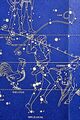
Gamlu as part of SIPA.ZI.AN.NA's shepherd's staff; interpretation by Papke (1989).
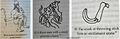
Gamlu, The Crook, in the reconstruction by Gavin White (2014).
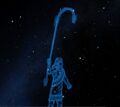
The True Shepherd of Anu with a staff reaching to Auriga (CC BY SMH in Stellarium with drawing by R. Perdok, LWL Planetarium Münster 2016).
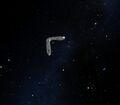
Crook as a standalone constellation (Stellarium CC BY J. Gullberg and SMH).


Papke (1989) is wrong, as his Shepherd has only the leg formed by the stars of Ori which is rather nonsensical image. A much more fitting representation of the Gamlu-Crook as Shepherd's Staff was designed by LWL Planetarium Münster, Germany, in 2016: their figure of the shepherd fits the stars of Orion and the shepherd's staff only appears strangly long.
White (2014) gives three images: A sketch of the Greek shepherd in Auriga just called "Crook" which is not justified by any text, a Babylonian "bison-man" which is (a) in our mind a wrong wording because bisons live only in North America and not in Mesopotamia, and (b) also not attested in any text: The constellation of the "bison-man" (GU.ALIM) occurs only in the dal.ba.an.na text, and needs to be identified with a different area in the sky. White's last version of "Gamlu" as a simply throwing stick is correct: Our drawing differs, but the object can be considered in more than one way.
Parts of the constellation and individual stars.
(1) kišib gam3 "Handle on the Staff", see (Kurtik k21) KIŠIB. Beaulieu et al. 2018[25], 64)
(2) sag.du mulgam3 "Top of the Staff", see list of stars in VR 46.1, also (Kurtik u10) UDU.NITA2.
Astrology.
Identifications:
(1) = Jupiter; mulGAM3 — the name of Marduk (dAMAR.UTU = Jupiter) in the month Kislimu [IIIR[27] 53, 2:10; CT[37] 26, 49, S. 777:10], see also [HBA[17], 24]; mul dAMAR.UTU a-na mulGAM3 i-qab-bi "The asterism of Marduk — so said of the Staff". [BPO 2[9], III 29a + Parallels]; see also: Ga2-am3-lum lum-[m]un: dSag-me-gar u2-ta-an-na-at-ma "(Constellation) ominous Staff, (it means): the luster of Jupiter is weak" [SpTU I[38], 84:14], and also [Brown 2000[39], 61].
(2) = Mars(?); so considered by Bezold, quoted by Gesman [Bezold 1920[40], 122:175; Gössmann[5], III, A 2 ], but we find no confirmation in the texts.
Predictions:
(3) General astrological meaning; [mulGAM3 ana BALA TIL.L]A / mulGAM3 lum-mu-un BALA ḪA.[A] / [DIŠ mulGAM3 zi-mu-šu uṣ-ṣa-na-l]a-mu BALA ḪA.A-ma MAN-ma DU6+DU-a "[Staff (to predict) the end of a dynasty]. / The staff is evil: the dynasty will perish. / If the staff becomes dark]: a dynasty will perish and another will arise. [BPO 2[9], VI 4-4b + Parallels].
(4) Radiation in the Staff; [DIŠ dG]AM3 ŠE.ER.ZI na-ši / SUDUŠ AŠ.TE GIN-an "If the Staff emits radiations: the foundation of the throne remains solid" [ARAK[14], 170 r. 1-2]; for parallels see. [ibid.[14], 115 r. 4; BPO 2[9], XVI 13; LABS[12], 160:13]; perhaps the reference here is to the rising of Jupiter near the Ascendant, cf. [Brown 2000, 61].
(5) Jupiter approaches the Staff; DIŠ dSAG.ME.GAR ana mulGAM3 TE ERUB KUR.URIki S[I.SA2] "If Jupiter approaches the staff: the harvest of Akkad will be abundant" [BPO 2[9], III 9a + Parallels].
(6) The Old Man and the Staff; DIŠ mulŠU.GI gam-lum TAK4-ib [...] "If the Old Man leaves the Staff behind [...] [BPO 3[10], K.2111+:7], see also (Kurtik sh16) ŠU.GI, VI 15, and Uranology above.
Historical Dictionaries
Kurtik (2022, a6) |
Gössmann (1950) |
|---|---|
| вар. чтения: mulZUBI; = mulgamlu «Посох (с кривой ручкой)»; 1) созвездие в Возничем (Auriga), 2) ziqpu XVI (α Aurigae, Капелла) [AHw, 279a; CAD G, 35b; G. 64; Schaumberger 1952, 228].
I. Источники. Лексич. тексты. Серия Urra XXII: mul˹zubi˺ = [gam-lu] [Cavigneaux 1981, 105: col. iii 14; Bloch–Horowitz 2015, 107:291ʹ]. EAE. См. [BPO 2, III 9a, 29a, VI 4–4a, VIII 2, 5, XVI 6, 13; BPO 3, K.3111+:7]. MUL.APIN. (1) Звезды Энлиля (№ 4): mulGAM3 dGam-lum «Посох» (I i 4). (2) Даты гелиакических восходов: ina itiBAR2 UD 20 KAM mulGAM3 IGI.LA2 «20-го нисану Посох становится видимым» (I ii 37); цитата из MUL.APIN см. [LABS, 62:17–18]. (3) Одновременные суточные восходы и заходы: (I iii 28), см. b06BAN. (4) Интервалы между датами гелиакических восходов: TA KUR ša2 mulKU6 35 UDmeš ana KUR ša2 mulGAM3 / TA KUR ša2 mulGAM3 10 UDmeš ana KUR ša2 MUL.MUL «35 дней от восхода Рыбы до восхода Посоха. 10 дней от восхода Посоха до восхода Звезд» (I iii 43–44). (5) Список ziqpu-звезд: mulGAM3 после mulŠU.GI перед mulMAŠ.TAB.BA.GAL.GAL (I iv 5). (6) Кульминации, одновременные гелиакическим восходам: ina itiBAR2 UD 20 KAM ... / ku-ma-ru ša2 mulUD.KA.DUḪ.A ina MURUB4 AN-e / ina IGI-it GABA-ka GUB-ma mulGAM3 KUR-ḫa «20-го нисану...плечо Демона с Разинутой Пастью стоит в середине неба / напротив твоей груди, и Посох восходит» (I iv 13–14). (7) Звезды «на пути Луны»: mulGAM3, после mulŠU.GI, перед mulMAŠ.TAB.BA.GAL.GAL (I iv 34), см. s20Sîn [MA, 19, 40, 51, 55, 59, 61, 68]. «Письма» и «Рапорты». См. [LABS, 160:13, 62 e. 18; ARAK, 115 r. 4, 170 r. 1]. «Большой список звезд». (1) 7 tikpu-звезд: mulgam3; (2) gam-lum, в неясном значении [Mesop.Astrol., App. B:161, 222; Weidner 1959–60, 107–108]. Список звезд VR 46, 1:3, 49. (1) mulgam3 = gištukul ša2 šuII damar.utu «Посох ― оружие в руках Мардука»; (2) muludu.nita2 = sag.du mulgam3 «Звезда–Баран = Вершина Посоха» [HBA, 51–52; Wee 2016, 162–3]. Списки ziqpu-звезд. (1) AO 6478: a) [2½ MA.NA KI.LA2] | ½ DANNA i-n[a qaq-q]a-ri | 27 IGI DANNA ina AN-[e] / TA mulna-aṣ-ra-pi | EN mul[GAM3] «[2½ мины веса], 150 н[а зем]ле, 27000 миль на небе / От Нацрапу до [Посоха]», b) [1⅔ MA.NA MIN(=šuqultu)] | 10 UŠ i-na KI.MIN(= ina qaqqari) | 18 IGI DANNA i-na KI.MIN(=ina šamê) | TA mulGAM3 | EN mulKIŠIB GAM3 «[1⅔ мины веса], 100 на земле, 18000 миль на небе / От Посоха до Руки на Посохе» [Thureau-Dangin 1913, 217:1–4; TU, 21 r. 1–4; HBA, 133; Schaumberger 1952, 228–229]. (2) VAT 16437: ½ DANNA a-na mulgam-l[u] «150 до Посоха» [Schaumberger 1952, 224–225:11]. (3) VAT 16436: múlGAM3 dBAD // 1 // 14 IGI 4 ME KUŠ3 «Посох Мардука // 1 (звезда) // 14400 локтей» [Schaumberger 1952, 226–227:8]. (4) BM 38369+: a) TA m[u]lŠU.GI EN mulGAM, [...] «От Старика до Посоха [...]», b) TA mulGAM3 EN mulMAŠ.TAB.BA.GAL.[GAL...] «От Посоха до Больших Близне[цов...]» [Horowitz 1994a, 91–92:8–9]. (5) Sippar Planisphere: ½ DANNA ana mulgam-lu «½ мили(150) до Посоха» [Horowitz–al-Rawi 2001, 171–173:16]; параллель см. в BM 61677 [ibid., 180:8']. См. также k21KIŠIB. Dalbanna-текст. §U. mulgam3 mulgir3 zag šu.gi mulgir3 gub3 ˹maš.tab.ba˺ [x x 3 mul.meš] gu si.sa2 dub2.ba 2 dal.ba.[an].na min [x x] «Посох (ζ, η Aur), правая нога Старика (ρ Per), левая нога [x x] Близнецов (μ Gem): […3 звезды]. Прямая туго натянутая веревка. 2 интер[ва]ла, ditto [x x]» [Walker 1995, 34; ASM, 107]; согласно [Koch 1995, 60, 77], mulgir3 gub3 ˹maš.tab.ba˺ [x x] = mulgir3 gub3 ˹maš.tab.ba˺ [gal.gal] «Левая нога [Больших] Близнецов» (μ Gem). Текст Nv. 10. ˹diš˺ ina itine mulgam3 // mulsipa.zi.[an.na] // u mulAN.U2.GI.E // mulAN.TA.GUB.[BA] / mulur.gi7 // muldingir.tuš.a.[meš] / u mulPa-bil-sag // mulA[N.T]A.Š[U.UR.RA] «В месяце абу: Посох, Праведный Пастух [Ану], / и AN.U2.GI.E — Наверху стоя[щая] звезда. / Пес, Сидящие боги и Пабилсаг — На[вер]ху вспы[хивающая] звезда» (Rev. 37–40) [Donbaz–Koch 1995, 64, 66]. Поздняя астрология. (1) W 23313/3: [DIŠ KI mulZUB]I U3.[TU…] «Если (он), когда Посох (кульминирует), родился…» [SpTU V, 265:x+1]. (2) AO 6483: […: múlzubi] e3-a nig2.tuk uš2 giš[…] «(Если ребенок родился, когда) [… Посох] появляется: он будет здоровым, смерть от ор[ужия](?)» [TU, 14 r. 36; Sachs 1952, 67, 70]. См. также m16MAŠ.TAB.BA. II. Божество. dgamlu ― оружие (kakku) или какой-то другой предмет (посох!), которому свойственна кривизна; имелся не только у Мардука [AHw, 279; Tallqvist 1938, 310]. Непосредственно за múlGAM3 в VAT 16436:9 следует múlKIŠIB GAM3 dDAM.KI.NUN.NA «Рука на Посохе Дамкинунны» [Schaumberger 1952, 226–227]. dDAM.KI.NUN.NA, возможно, есть вариант имени шумерской богини dDam.ki.na (вар.: dDam.ki.an.na, dDam.gal.nun.an.na, dDam.gal.nun.na), считавшейся супругой Эа [Litke 1998, 88; Tallqvist 1938, 280]. О gamlu как божественном символе и как инструменте заклинателя см. также [Wiggermann 1992, 61–62]. III. Символ. Посох с закругленной ручкой в виде бараньей головы(?). Символ известен со старовавилонского времени на печатях, а позднее на кудурру [Seidl 1968, 165–167; Van Buren 1945, 149–151], где изображался нередко рядом с козой-рыбой, что свидетельствует о его связи с богом Эа. IV. Отождествление. Созвездие: = Auriga [G. 64; Weidner 1957–59, 78; MA, 137; Mesop.Astrol., 207, App. C; ASM, 272; Horowitz 2014, 246; Beaulieu et al. 2018, 72]. Ziqpu XVI: = α Aurigae (Capella) [Schaumberger 1952, 229; MA, 142; ASM, 88]. Ziqpu XVII: = β Aurigae [Schaumberger 1952, 229; Pingree–Walker 1988, 319, note 15], см. также k21KIŠIB. V. Части созвездия и отдельные звезды. (1) kišib gam3 «Рука на Посохе», см. k21KIŠIB. (2) sag.du mulgam3 «Вершина Посоха», см. список звезд в VR 46,1, а также u10UDU.NITA2. V. Астрология. Отождествления: (1) = Юпитер; mulGAM3 ― имя Мардука (dAMAR.UTU = Юпитер) в месяце кислиму [III R 53, 2:10; CT 26, 49, S. 777:10], см. также [HBA, 24]; mul dAMAR.UTU a-na mulGAM3 i-qab-bi «Звезда Мардука ― так говорят о Посохе» [BPO 2, III 29a + Parallels]; cм. также: Ga2-am3-lum lum-[m]un: dSag-me-gar u2-ta-an-na-at-ma «(Созвездие) Посох зловещее, (это означает): блеск Юпитера слабый» [SpTU I, 84:14], а также [Brown 2000, 61]. (2) = Марс(?); так считает Бецольд, которого цитирует Гесман [Bezold 1920, 122:175; G., III, A 2 ], однако подтверждений в текстах не находим. Предсказания: (3) Общее астрологическое значение; [mulGAM3 ana BALA TIL.L]A / mulGAM3 lum-mu-un BALA ḪA.[A] / [DIŠ mulGAM3 zi-mu-šu uṣ-ṣa-na-l]a-mu BALA ḪA.A-ma MAN-ma DU6+DU-a «[Посох (для предсказания) конца династии]. / (Если) Посох зловещий: династия погибнет. / [Если при своем появлении Посох становится темны]м: династия погибнет и другая возникнет» [BPO 2, VI 4–4b + Parallels]. (4) Излучение в Посохе; [DIŠ dG]AM3 ŠE.ER.ZI na-ši / SUDUŠ AŠ.TE GIN-an «Если Посох излучение несет: основание трона останется прочным» [ARAK, 170 r. 1–2]; параллели см. [ibid., 115 r. 4; BPO 2, XVI 13; LABS, 160:13]; возможно, здесь речь идет о восходе Юпитера вблизи Возничего, см. [Brown 2000, 61]. (5) Юпитер приближается к Посоху; DIŠ dSAG.ME.GAR ana mulGAM3 TE ERUB KUR.URIki S[I.SA2] «Если Юпитер приближается к Посоху: урожай Аккада будет обильным» [BPO 2, III 9a + Parallels]. (6) Старик и Посох; DIŠ mulŠU.GI gam-lum TAK4-ib [...] «Если Старик оставляет Посох позади [...] [BPO 3, K.2111+:7], см. также sh16ŠU.GI, VI 15. |
Example |
Kurtik (2022, a7) |
|
| аккадская параллель к mulGAM3(=ZUBI) «Посох», см. g06GAM3. | |
Kurtik (2022, n01) |
|
| вар. чтения: ulNAD3; = «Звезда-ложе»; имя Юпитера в месяце кислиму [G. 291]. Только в IIIR, 53, 2, см. a28dAMAR.UTU. Возможно, это ошибка переписчика; вместо NA2 должно быть GAM3(?). |
References
- ↑ Planetarium Babylonicum 2.0, All Skies Encyclopaedia.
- ↑ Hoffmann, S. M. and Krebernik, M. (2023). What do deities tell us about the celestial positioning system, in: R. Rollinger, I. Madreiter, M. Lang, C. Pappi (eds.). The Intellectual Heritage of the Ancient Near East, Papers held at the 64th Rencontre Assyriologique International and 12th Melammu Symposium July 16-20 2018, Innsbruck. Austrian Academy of Sciences Press, 539-579
- ↑ von Soden, W. Akkadisches Handwörterbuch. Wiesbaden, 1985.
- ↑ The Assyrian Dictionary of the Oriental Institute of the University of Chicago. Chicago and Glückstadt, 1956 - 2010
- ↑ 5.0 5.1 5.2 5.3 Gössmann P.F. Planetarium Babylonicum, Rom, 1950 (A. Deimel. Šumerisches Lexikon 4/2).
- ↑ 6.0 6.1 6.2 6.3 6.4 6.5 6.6 Schaumberger J. Die Ziqpu-Gestirne nach neuen Keilschrifttexten // ZA. 50 (N.F. 16), 214-229.
- ↑ Bloch, Y. and W. Horowitz (2015): “Urra = hubullu XXII: The Standard Recension,” , Journal of Cuneiform Studies 67: 71-125.
- ↑ Cavigneaux A. Textes scolaires du temple de Nabû ša Harê. Texts from Babylon I. Baghdad, 1981.
- ↑ 9.0 9.1 9.2 9.3 9.4 Reiner E., Pingree D. Enuma Anu Enlil, Tablets 50-51. Malibu, Undena Publications, 1981 (Babylonian Planetary Omens: Part Two).
- ↑ 10.0 10.1 10.2 Reiner E., Pingree D. Babylonian Planetary Omens. Part Three. Groningen, STYX Publications. 1998.
- ↑ Donbaz V., Koch J. Ein Astrolab der dritten Generation: Nv. 10 // JCS 47, 63-83.
- ↑ 12.0 12.1 12.2 12.3 A. Sachs, T. Pinches, J. Strassmaier, Late Babylonian Astronomical and Related Texts, London, 1955.
- ↑ 13.0 13.1 13.2 Hunger, H. and J. M. Steele (2019). The Babylonian Astronomical Compendium MUL.APIN, Routledge, NY
- ↑ 14.0 14.1 14.2 Hunger H. Astrological Reports to Assyrian Kings. Helsinki, 1992 (State Archives of Assyria, VIII).
- ↑ 15.0 15.1 Koch-Westenholz U. Mesopotamian Astrology. Copenhagen, Museum Tusculanum Press. 1995.
- ↑ Weidner E. Ein astrologischer Sammeltext aus der Sargonidenzeit // AfO. 1959-1960. Bd. 19. S. 105-113.
- ↑ 17.0 17.1 17.2 Weidner E. Handbuch der babylonischen Astronomie. Bd. I. Leipzig, 1915.
- ↑ Wee, J. (2016). Virtual Moons over Babylonia: The Calendar Text System, Its Micro-Zodiac of 13, and the Making of Medical Zodiology. The Circulation of Astronomical Knowledge in the Ancient World, ed. J. M. Steele, 139–229.
- ↑ Thureau-Dangin F. Distances entre étoiles fixes // RA. 1913. Vol 13. P.215-225.
- ↑ 20.0 20.1 Thureau-Dangin F. Tablettes d’Uruk. Paris, 1922 (= TCL 6).
- ↑ Horowitz W. Two New Ziqpu-Star Texts and Stellar Circles // JCS. 1994. Vol. 46. P. 89-98.
- ↑ 22.0 22.1 Horowitz W., al-Rawi F.N.H. Tablets from the Sippar Library IX. A Ziqpu-Star Planisphere // Iraq. 2001. V. LXIII. P. 171-181.
- ↑ 23.0 23.1 Hunger H., Pingree D. Astral Sciences in Mesopotamia. Leiden-Boston-Köln, 1999.
- ↑ Koch J. Der Dalbanna-Sternenkatalog // WO. 1995. Bd. 26. S. 43-85.
- ↑ 25.0 25.1 25.2 Beaulieu, P.-A., Frahm, E., Horowitz, W. & Steele, J. (2018), The Cuneiform Uranology Texts: Drawing the Constellations, American Philosophical Society Press, Philadelphia, USA.
- ↑ Sachs A. Babylonian Horoscopes // JCS. 1952. V. 6. P. 49-75.
- ↑ 27.0 27.1 Rawlinson H. The Cuneiform Inscriptions of Western Asia. Vol. I-V. London, 1861-1909. (cited as I R, II R, etc.).
- ↑ Ch. Virolleaud, L'astrologie chaldéenne S(in); Shamasz; Isht(ar); Adad; S/Supp. = Supplément; SS / 2.Supp. = Second Supplément (Paris 1905 - 1912)
- ↑ von Soden, W. Akkadisches Handwörterbuch. Wiesbaden, 1985.
- ↑ 30.0 30.1 Tallqvist K. Akkadische Götterepitheta. Helsingforsiae, 1938.
- ↑ Litke R.L. A Reconstruction of the Assyro-Babylonian God-Lists, AN:dA-nu-um and AN:Anu ša2 amēli. New Haven, 1998 (Texts from the Babylonian Collection, Vol. 3).
- ↑ Seidl U. Die babylonischen Kudurru-Reliefs // BaM. 1968, Bd. 4. S. 1-220.
- ↑ Van Buren E.D. Symbols of the Gods in Mesopotamian Art. Roma, 1945.
- ↑ Weidner E. mul gir2.tab = zuqaqîpi // AfO. 1957-1958. Bd. 18. S. 393-394].
- ↑ Horowitz, W. (2014), The three stars each: the Astrolabes and related texts, Archiv für Orientforschung AfO Beiheft, 33.
- ↑ Pingree D., Walker C. A Babylonian Star-Catalogue: BM 78161 / Fs. Sachs, 313-322.
- ↑ Cuneiform Texts from Babylonian Tablets in the British Museum.
- ↑ Špätbabylonische Texte aus Uruk. Teil I / Bearb. von H.Hunger. Berlin, 1976.
- ↑ Brown D. Mesopotamian Planetary Astronomy-Astrology. Groningen, STYX Publication, 2000.
- ↑ Antike Beobachtungen farbiger Sterne von Franz Boll. Mit einem Beitrag von Carl Bezold // Abhandlungen der Bayerische Akademie der Wissenschaften. Philos.- philolog.-hist. Kl. 1920. Bd. 30. S. 1-164.