Srengenge
Sungenge is an Oceanic name from Bali (Indonesia). The lintang of srěngenge is found in intersection of Saniscara (Saturday, in saptawara) and Pon (in pancawara) in a series of palelintangan. Lintang srěngenge means Sun.[1]
Etymology and History
Sungenge (IPA: [suˈŋə.ŋə]), is balinese term for marigold tree, common sunflower and Sun.
Spelling Variants
- sangenge
- sěngenge
- sungenge
- ngarang srěngenge
- matahari
- matan ai
- matanai

Origin of Constellation
Sungenge is the name of a flower, Kembang Sungenge, which refers to the Kipahit, the Tree Marigold (Tithonia diversiflora). This type of flower grows wild and relies solely on nature for its growth. The appearance of this flower is truly captivating, especially in the morning when the sun rises above the crown. It does resemble the sun.[3] However, in the Centhini series, Kembang Sungenge also refers to the common sunflower (Helianthus annuus).[4] This type of flower is used in traditional medicine throughout Indonesia. Although both flowers belong to the same family, Asteraceae, they have distinct morphologies.
| Characteristics | Helianthus annuus (Common Sunflower) | Tithonia diversiflora (Mexican Sunflower/Kipahit/Tree Marigold) |
|---|---|---|
| Plant Type | Annual herb (generally grows from seed every year) | Perennial upright shrub (woody and lives for many years) |
| Height | Generally reaches 1.5 - 3 meters. | Can grow taller, up to approximately 5 meters, making it widely used by farmers as a fence to prevent pests and diseases from entering fields. |
| Leaves | Oval to heart-shaped, covered with coarse hairs, and generally unlobed in cultivated varieties. | Leaves are alternate, often with 3-7 pointed lobes (cage-shaped), with serrated edges. |
| Flower Center | The flower disc (center) is orange-brown to dark brown. | The flower disc is bright yellow or orange. |
| Flower Arrangement | Cultivated varieties typically have a single large flower head at the end of the stem, while wild varieties may branch. | Inflorescences are compound, often appearing at the tips of twigs and on long stalks, with multiple flower heads per plant. The flowers are medium-sized, with 7 to 13 petals surrounding hundreds of stamens. |
| Native Habitat | Native to the western United States, Canada, and northern Mexico | Native to Mexico and Central America |
In short, cultivated H. annuus is better known as a single herbaceous plant with very large flowers, while T. diversiflora is a taller woody shrub with numerous smaller flowers and lobed leaves.
Transfer and Transformation of the Constellation
Mythology / Religion
In art, Kembang Sungenge are often depicted as motifs in temple carvings, songket, and endek. Furthermore, the leaves of the sungenge flower (kipahit/wild sunflower) are used as an ingredient in making botanical pesticides, along with lemongrass and galangal.[5]
In the Bungaya Traditional Village community in Karangasem Regency, Kembang Sungenge are used to make "sumbu" in the Usaba Sumbu ceremony, held annually during Sasih Sada (the tenth month of the Balinese calendar). This is because Kembang Sungenge are known as symbols of the Sun God.
Image Variants
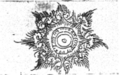
Lintang Sangenge (CC-BY Alfred Maaß, (1929), Astrologische Kalender der Balinesen)
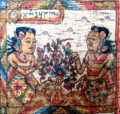
Lintang Sungenge in the cloth (CC-BY UPTD Museum Bali)
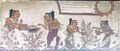
Lintang Aran Sungenge (CC-BY Youla Azkarrula taken in the ceiling of Taman Gili Klungkung Palace Bali)


Cultural Beliefs
Numerology (Neptu/Urip)
Saniscara (Saturday, in saptawara) has a value of 9 and Pon (in pancawara) has a value of 7. Thus, the total urip on this lintang is 16.[6]
Astrological Characteristics
Not dying from a serious illness, can live to old age, long life, loved by great and powerful people. But unfortunately, they like to show off and elevate themselves so that many people are annoyed by it.[6]
Matching Gemstones
Cempaka (yellow sapphire).[6]
Weblinks
All HIP Stars within this constellation
Balinese realize that the Sun is a star, so they refer to the Sun as lintang Srěngenge.
References
- References (general)
- ↑ Maass, Alfred, “Astrologische Kalender der Balinesen,” in Koninklijk Bataviaasch Genootschap van Kunsten en Wetenschappen, Feestbundel bij gelegenheid van zijn 150 jarig bestaan 1778-1928, 2 vols. (Weltevreden, 1929), Vol. 2, 126-157.
- ↑ Ramadhan,Nugraha, Martinsyah,Rachmad Hersi, & Jamsari, "Growth and Yield of Sunflower (Helianthus Annus L.) on Recent Field in Upland of Alahan Panjang" Jurnal Galung Tropika, (2022) Vol. 11 No. 1, 45-52 https://doi.org/10.31850/jgt.v11i1.870
- ↑ Andani, Ni Made Sri, "Bunga Matahari Liar: Cemerlangnya Si Kembang Tegalan." (2011) https://nimadesriandani.wordpress.com/2011/09/24/bunga-matahari-liar-cemerlangnya-si-kembang-tegalan/#more-2069
- ↑ Badan Pengawas Obat dan Makanan Republik Indonesia, "SERIAL THE POWER OF OBAT ASLI INDONESIA: RAMUAN OBAT TRADISIONAL INDONESIA SERAT CENTHINI, BUKU JAMPI DAN KITAB TIBB" (2016) https://api.minio.jatimprov.go.id/dinkes-mmb/ebooks/Serat%20CenthinI.pdf
- ↑ Dinas Pertanian, "Temu Teknis Inovasi Pertanian Tingkat Provinsi Bali "Teknologi Budidaya, Panen, Pasca Panen, dan Pengolahan Bawang Merah " BPP Abiansemal." (2019) https://distan.bulelengkab.go.id/informasi/detail/berita/temu-teknis-inovasi-pertanian-tingkat-provinsi-bali-teknologi-budidaya-panen-pasca-panen-dan-pengolahan-bawang-merah-bpp-abiansemal-99
- ↑ 6.0 6.1 6.2 Tim Kajian Palelintangan, “Gabungan Kajian Palelintangan,” Museum Bali (2021), 1-149.





.jpg)