Laweyan
Laweyan is an Oceanic name from Bali (Indonesia). The lintang of laweyan is found in intersection of Rědite (Sunday, in saptawara) and Kliwon (in pancawara) in a series of palelintangan. Lintang laweyan means a headless demon constellation.[1]
Etymology and History
Laweyan (IPA: /lawɛjan/[lawɛjan] is Balinese term.
Spelling Variants
- lawean
- kawanda
- gowang
- gumawang
Origin of Constellation
In relation to Palelintangan, Děpat is referred to as Rahu, which in Vedic tradition is the lunar ascending node. Meanwhile, Rahu, in Indian tradition, was adapted into Balinese mythology as Kala Rau (the giant Rau). The plot centers on the beheading of Kala Rau, who disguised himself as the god Kuwera to obtain the water of immortality, which grants immortality and defeats the evil giants of Balidwipa (the island of Bali). His disguise was revealed, and the god Vishnu threw his chakra into Kala Rau's neck. Kala Rau's body split in two. His head floated into the sky and became Rau. His body was thrown by the gods to Earth and became a mortar. This body became Ketu in the Indian Vedic tradition. Out of hatred for the moon goddess who had rejected his love, Rau's head swallowed the moon, causing an eclipse. The people of Balidwipa mourned the loss of the moon, so they pounded the mortar in an attempt to save the goddess Ratih. It was believed that pounding the mortar (Kala Rau's body) would hurt her, causing the moon to escape through his neck and return to the sky.[2]
In essence, Rahu-Ketu and Děpat -Laweyan are distinct. Kala Rau's origins are not from the meditation of the goddess Durga, as Děpat and Laweyan do, but from the descendants of Wipracitti and Singhika. However, it seems that in the case of Palelintangan, they associate Laweyan with Ketu, thus giving the impression that lintang Laweyan is the same as Ketu, symbolized by the lunar descending node.
Transfer and Transformation of the Constellation
Mythology / Religion
Laweyan is a spirit creature that takes the form of a headless human. Some also say that Laweyan is just a body, lacking a head, arms, or legs. Laweyan is a creature created by the Goddess Durga from human corpses whose heads have been separated from their bodies, or from corpses that only have the torso remaining.
It is said that if a corpse has been buried for a long time and has not been cremated, Goddess Durga will send Laweyan, along with several other spirits such as Jerangkong (a living skull), Kemangmang (a head demon), Bangke Maong (a rotting corpse), and others, to visit the deceased's family through dreams. They will remind the family that the corpse is in their current condition, similar to theirs, so that the deceased can receive a proper cremation ceremony.
According to those who have seen him, Laweyan often appears on the streets around cemeteries. When viewed from behind, Laweyan appears to be an ordinary human walking with his head down, with long hair, a bare chest, and only a sarong. However, when he turns around, he has no head, and his face is on his chest, while his long hair grows from his neck.
Laweyan rarely reveals himself to humans intentionally, except when we have committed a crime, when he has the right to disturb us by frightening us, and even then only to remind us of our mistakes.
Image Variants
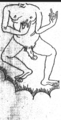
Lintang Kawanda (CC-BY Alfred Maaß, (1929), Astrologische Kalender der Balinesen)
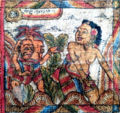
Lintang Goang in the cloth (CC-BY UPTD Museum Bali)
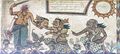
Lintang Gowang (CC-BY Youla Azkarrula taken in the ceiling of Taman Gili Klungkung Palace Bali)


Cultural Beliefs
Numerology (Neptu/Urip)
Rědite (Sunday, in saptawara) has a value of 5 and Kliwon (in pancawara) has a value of 8. Thus, the total urip on this lintang is 13.[3]
Astrological Characteristics
Generally, they are patient, polite, good at debating, but they unknowingly like torturing themselves, do not want to listen to advice, gamblers, and are mischievous. Avoid jobs that are of bad quality, because there is danger lurking. If born a good woman takes care of the child, because there is a tendency for her child to die.[3]
Matching Gemstones
Kecubung (amethyst), Cempaka (yeloow saphire ), Ijo Rangreng (peros).[3]
Weblinks
All HIP Stars within this constellation
Balinese take the lunar descending node as their lintang, which also in the same case for Ketu in Vedic Jyotish.
References
- References (general)
- ↑ Maass, Alfred, “Astrologische Kalender der Balinesen,” in Koninklijk Bataviaasch Genootschap van Kunsten en Wetenschappen, Feestbundel bij gelegenheid van zijn 150 jarig bestaan 1778-1928, 2 vols. (Weltevreden, 1929), Vol. 2, 126-157.
- ↑ Setyowati, Melinda, "Mitos Kala Rau," Sastra lisan (2017) https://www.scribd.com/document/401379597/Mitos-Kala-Rau
- ↑ 3.0 3.1 3.2 Tim Kajian Palelintangan, “Gabungan Kajian Palelintangan,” Museum Bali (2021), 1-149.