Depat

Děpat is an Oceanic name from Bali (Indonesia). The lintang of děpat is found in intersection of Saniscara (Saturday, in saptawara) and Umanis (in pancawara) in a series of palelintangan. Lintang děpat means demon without body constellation.[1]
Etymology and History
Děpat (IPA: /dəpat/ [ɖəpat]) is Balinese term.
Spelling Variants
- Dpat
- d'pat
- kumangmang
- běgoong
- běgong
Origin of Constellation
In relation to Palelintangan, Děpat is referred to as Rahu, which in Vedic tradition is the lunar ascending node. Meanwhile, Rahu, in Indian tradition, was adapted into Balinese mythology as Kala Rau (the giant Rau). The central plot revolves around the beheading of Kala Rau because he disguised himself as the god Kuwera in order to obtain tirta amerta, which can grant one immortality and defeat the evil giants of Balidwipa (the island of Bali). His disguise was blown, and the god Vishnu threw his chakra into Kala Rau's neck. Kala Rau's body split in two. His head floated in the sky and was named Rau. The rest of his body was thrown to Earth by the gods and turned into a mortar. This body became Ketu in the Indian Vedic tradition. Out of hatred for the moon goddess who had rejected his love, Rau's head (Rahu) swallowed the moon, causing an eclipse. The people of Balidwipa, grieving the loss of the Moon, began to beat the mortar in an attempt to save the goddess Ratih. Beating the mortar (Kala Rau's body) was believed to hurt her, causing the moon to escape through her neck and return to the sky.[2]
In essence, Rahu-Ketu and Děpat-Laweyan are distinct. Kala Rau's origins are not from the asceticism of the goddess Durga, like Děpat and Laweyan, but rather from the descendants of Wipracitti and Singhika. However, in the Palelintangan tradition, they apparently associate Děpat with Rahu. This suggests that lintang Depat is the same as Rahu, symbolized as the lunar ascending node.
Transfer and Transformation of the Constellation
Mythology / Religion
The term Kumangmang is more commonly known in folklore, but in the Palelintang and lontar manuscripts, this constellation is often referred to as Depat. Depat, Kumangmang, and Begoong refer to the same entity: a ghost with no body, arms, or legs, merely a reddish-flaming head.
In Balinese belief, Kumangmang is believed to be a "rencang," or follower of Ida Bhatara Pengulun Setra. Like other Balinese spirits, mentioned in various ancient Balinese lontar manuscripts, Kumangmang was created through meditation of the goddess Durga.
A human corpse, with only its head remaining, transforms into Kumangmang, while its body becomes the ghost Laweyan. This ghost also serves as a footstool for Goddess Durga when she descends to Earth. There are many versions of Kumangmang's form in each region of Bali. Kumangmang appears as a flying head with hair shrouded in flames, or as a human head rolling on the ground like a ball. This spirit often appears at noon, dusk, and midnight.
Kumangmang often appears in deserted places such as fields, rice paddies, and of course, cemeteries. He is known for his mischief and likes to disturb people who go to the rice fields or gardens at noon. Kemangmang often hangs from trees by his hair, or lies in thickets of weeds. He is also said to trick people by transforming into large fruits such as jackfruit, durian, pumpkin, watermelon, etc.
Kemangmang usually transforms into an old coconut that has been eaten by a squirrel, known in Bali as "pongpongan." Sometimes, when someone goes to the rice paddies at night, Kumangmang will follow them, rolling around, bumping into their feet. When the person looks down, Kumangmang will smile broadly and stick out his tongue. Despite its frightening appearance, the Kumangmang is easy to exorcise: by striking it with a piece of wood, it disappears.[3]
Because it is so common and easy to find, Balinese people in ancient times did not classify it as a spirit, but rather as an animal or pest. In the past, this creature was often considered a pest because of its habit of disturbing people with its crickets sound.
Farmers and landowners in Bali believe that this creature is actually a benevolent guardian of the fields. According to local beliefs, giving food to this creature can help protect crops from harm. This tradition of sharing food is not only done out of respect but also to maintain a harmonious relationship with the astral beings considered to be the guardians of the fields.[4]
Image Variants
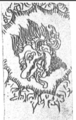
Lintang Depat (CC-BY Alfred Maaß, (1929), Astrologische Kalender der Balinesen)
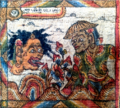
Lintang Dpat in the cloth (CC-BY UPTD Museum Bali)
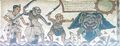
Lintang Dpat (CC-BY Youla Azkarrula taken in the ceiling of Taman Gili Klungkung Palace Bali)


Cultural Beliefs
Numerology (Neptu/Urip)
Saniscara (Saturday, in saptawara) has a value of 9 and Umanis (in pancawara) has a value of 5. Thus, the total urip on this lintang is 14.[5]
Astrological Characteristics
Always the scapegoat, he knows how to harm people, his evil plans always succeed brilliantly, he loves luxury, firmly defends his friends, unfortunately he really likes to interfere in other people's affairs so that in his life he has many enemies.[5]
Matching Gemstones
Mirah (ruby), Nila (sapphire).[5]
Weblinks
All HIP Stars within this constellation
Balinese take the lunar ascending node as their lintang, which also in the same case for Rahu in Vedic Jyotish.
References
- References (general)
- ↑ Maass, Alfred, “Astrologische Kalender der Balinesen,” in Koninklijk Bataviaasch Genootschap van Kunsten en Wetenschappen, Feestbundel bij gelegenheid van zijn 150 jarig bestaan 1778-1928, 2 vols. (Weltevreden, 1929), Vol. 2, 126-157.
- ↑ Setyowati, Melinda, "Mitos Kala Rau," Sastra lisan (2017) https://www.scribd.com/document/401379597/Mitos-Kala-Rau
- ↑ Suryadinatha, Andre, "Misteri Kumangmang Hantu Kepala dari Bali", calonarangtaksu
- ↑ Telusur Bali, "Mengenal Kumangmang,Hantu di Bali yang Ditemukan di Areal Perkebunan saat Malam," (2024) https://telusur.balitrekker.com/mengenal-kemangmang-hantu-di-bali-yang-ditemukan-di-areal-perkebunan-saat-malam/
- ↑ 5.0 5.1 5.2 Tim Kajian Palelintangan, “Gabungan Kajian Palelintangan,” Museum Bali (2021), 1-149.