Tarandus

Tarandus is a late variant of the Early Modern European constellation Rangifer, the Reindeer.
It was adopted as a modern IAU-star name in December 2025.
Concordance, Etymology, History

"Tarandus" is a name variant of Rangifer used in Urania's Mirror 1825 and Chambers 1877. Rangifer, the Reindeer, is an extinct constellation first introduced by Pierre-Charles Le Monnier in 1743 in the book La Théorie des Comètes. He had joined the 1736-1737 expeditions by Pierre-Louis Moreau de Maupertuis to Lapland, which improved the measurement of the length of a degree of latitude and convincingly demonstrated the oblateness of the Earth. In these northernmost areas of Europe, where the Sami people live, Le Monnier learned about their Indigenous constellation of a reindeer in the sky, called Sarvvis. He squeezed its memory into a free space close to the equatorial north pole of the apparent celestial sphere.
Carl Linnaeus (1758) dubbed the reindeer species of the Eurasian tundra "cervus tarandus", and Charles Hamilton Smith (1827) introduced the genus name Rangifer. Species and subspecies of Rangifer are called reindeer in Eurasia and caribou in North America.
Mythology
There is no specific mythology to this recent invention.

IAU Working Group on Star Names
The name was discussed and adopted by the IAU WGSN in 2025.
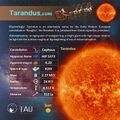
Tarandus profile card (CC BY Sadegh Faghanpour for IAU-WGSN).
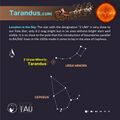
Tarandus stick figure (CC BY Sadegh Faghanpour for IAU-WGSN).
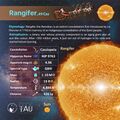
Rangifer profile card (CC BY Sadegh Faghanpour for IAU-WGSN).
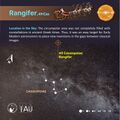
Rangifer stick figure (CC BY Sadegh Faghanpour for IAU-WGSN).

Sarvvis profile card (CC BY Sadegh Faghanpour for IAU-WGSN).
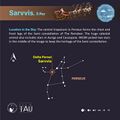
Sarvvis stick figure (CC BY Sadegh Faghanpour for IAU-WGSN).
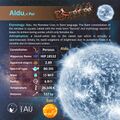
Aldu profile card (CC BY Sadegh Faghanpour for IAU-WGSN).
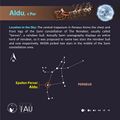
Aldu stick figure (CC BY Sadegh Faghanpour for IAU-WGSN).


Weblinks
Reference
- References (general)
- References (early modern)
- Ian Ridpath's website (Star Tales )