Purvaṣādha (पूर्व आषाढा)
Purva Ashadha


Purvaṣādha (पूर्व आषाढा) is an Indian name, used by the Indian Vedic tradition. Most of these names are roughly 3000 years old. They pre-date Hinduism but were taken over by it. Typically identified with δ and ε Sagittarii.
Etymology and History
Name Variants
- Purvaṣādha
- Purva Ashadha
- Jaladaivata,
- Jalarksha
- Apya,
- Toya,
Origin of Constellation
Ashadha means The Invincible and refers to two asterisms in Sagittarius. The First (Purva A.) is depicted as a group of two stars marking a horn or stinger. They are identified with δ and ε Sagittarii, the "arrow" of the Greek and Babylonian archer. The identification of δ is certain because of given coordinates in the 2nd millennium but instead of ε Sgr it could also be γ Sgr (at the tip of the arrow): the three stars form a racognizable pattern.
Stars within the Constellation Area
| id | Label | IAU design. | description | Vmag |
|---|---|---|---|---|
| 1 | Kaus Australis | HIP 90185 | Constellation lines (Vertex) | 1.81 |
| 2 | Kaus Media | HIP 89931 | Constellation lines (Vertex) | 2.668 |
| 3 | Alnasl | HIP 88635 | Constellation lines (Vertex) | 2.99 |
| 4 | η Sagittarii | HIP 89642 | Constellation lines (Vertex) | 3.11 |
| 5 | 37 G. Sgr | HIP 89020 | Inside the hull | 5.65 |
| 6 | RS Sgr | HIP 89637 | Inside the hull | 6.03 |
Transfer and Transformation of the Constellation
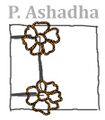
Purva Ashadha, 10th century
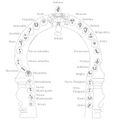
Display of all 28th nakshatras in silver arch with candles in Tirupperunthurai (Athmanathaswamy temple) near Aranthangi, India, 10th century CE. (SMH 2025).

Display of all 28th nakshatras in a door frame in Tirupperunthurai (Athmanathaswamy temple) near Aranthangi, India, 10th century CE. (SMH 2025).

reconstructed by Jones (1720)


Mythology
mnemonic tales and cultural significance
Weblinks
References
- References (general)