Mrigashira: Difference between revisions
No edit summary |
No edit summary |
||
| Line 18: | Line 18: | ||
The asterism is described in a Treatise on the Sun (Surya Siddhānta) that dates between the 4th and 9th century CE, but also (with all other nakshatras) in the Athavaveda from the early first millennium BCE. Yet, images are preserved in temples only from the past millennium. |
The asterism is described in a Treatise on the Sun (Surya Siddhānta) that dates between the 4th and 9th century CE, but also (with all other nakshatras) in the Athavaveda from the early first millennium BCE. Yet, images are preserved in temples only from the past millennium. |
||
====Stars within the Constellation Area==== |
|||
{| class="wikitable sortable mw-collapsible" |
|||
|+ |
|||
|- |
|||
!id |
|||
!Label |
|||
!IAU design. |
|||
!description |
|||
!Vmag |
|||
|- |
|||
|1 |
|||
|Cl Collinder 69 |
|||
|Cl Collinder 69 |
|||
| Inside the hull |
|||
|2.8 |
|||
|- |
|||
|2 |
|||
|Meissa A |
|||
|HIP 26207 |
|||
|Constellation lines (Vertex) |
|||
|3.47 |
|||
|- |
|||
|3 |
|||
|Meissa |
|||
|HIP 26207 |
|||
|Constellation lines (Vertex) |
|||
| 3.66 |
|||
|- |
|||
|4 |
|||
|ϕ 2 Orionis |
|||
|HIP 26366 |
|||
|Constellation lines (Vertex) |
|||
|4.09 |
|||
|- |
|||
|5 |
|||
| ϕ 1 Orionis |
|||
|HIP 26176 |
|||
|Constellation lines (Vertex) |
|||
|4.41 |
|||
|} |
|||
===Transfer and Transformation of the Constellation=== |
===Transfer and Transformation of the Constellation=== |
||
<gallery> |
<gallery> |
||
Latest revision as of 17:09, 14 December 2025

Mṛgaśira (मृगशिर) is an Indian name, used by the Indian Vedic tradition. Most of these names are roughly 3000 years old. They pre-date Hinduism but were taken over by it. The asterism has three stars and, thus, refers to the group φ1,2 and λ Orionis.
Etymology and History
Name Variants
- Mrigashira,
- Mṛgaśira,
- Somya,
- Āgrahāyaṇī
Origin of Constellation
Mṛgaśira, Somya means "the deer's head"; it is a composite of two Sanskrit words, mṛga (मृग), deer, and śira (शिर), top of the head. The depiction in temples is here mapped to the three stars in Orion, but it may also be possible that The Deer as a constelllation had originally been larger and the three stars just formed a pattern on the top of its head (like they indicate the head of the Greek hero who is drawn in a larger star pattern).
Also known as āgrahāyaṇī.
The asterism is described in a Treatise on the Sun (Surya Siddhānta) that dates between the 4th and 9th century CE, but also (with all other nakshatras) in the Athavaveda from the early first millennium BCE. Yet, images are preserved in temples only from the past millennium.
Stars within the Constellation Area
| id | Label | IAU design. | description | Vmag |
|---|---|---|---|---|
| 1 | Cl Collinder 69 | Cl Collinder 69 | Inside the hull | 2.8 |
| 2 | Meissa A | HIP 26207 | Constellation lines (Vertex) | 3.47 |
| 3 | Meissa | HIP 26207 | Constellation lines (Vertex) | 3.66 |
| 4 | ϕ 2 Orionis | HIP 26366 | Constellation lines (Vertex) | 4.09 |
| 5 | ϕ 1 Orionis | HIP 26176 | Constellation lines (Vertex) | 4.41 |
Transfer and Transformation of the Constellation
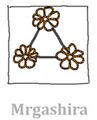
Mrgashira 10th century CE
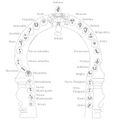
Display of all 28th nakshatras in silver arch with candles in Tirupperunthurai (Athmanathaswamy temple) near Aranthangi, India, 10th century CE. (SMH 2025).

Display of all 28th nakshatras in a door frame in Tirupperunthurai (Athmanathaswamy temple) near Aranthangi, India, 10th century CE. (SMH 2025).

Mrgashira, Tibetean

Mrgashira, Chinese

male red deer

Mrgashira as reconstructed by Jones (1720)


,_Munich,_Germany_-_20060530.jpg)

Mythology
mnemonic tales and cultural significance
Weblinks
References
- References (general)