Custos Messium: Difference between revisions
No edit summary |
No edit summary |
||
| Line 1: | Line 1: | ||
This constellation was invented in Early Modern Time by the French astronomer Joseph Jérôme de Lalande (1732–1807). Custos Messium is recognized as an 'extinct constellation' that fell into obscurity after the early 19th century. |
This constellation was invented in Early Modern Time by the French astronomer Joseph Jérôme de Lalande (1732–1807). Custos Messium is recognized as an 'extinct constellation' that fell into obscurity after the early 19th century. |
||
== |
==Concordance, Etymology, History== |
||
=== Origin of Constellation === |
=== Origin of Constellation === |
||
Revision as of 11:14, 14 December 2025
This constellation was invented in Early Modern Time by the French astronomer Joseph Jérôme de Lalande (1732–1807). Custos Messium is recognized as an 'extinct constellation' that fell into obscurity after the early 19th century.
Concordance, Etymology, History
Origin of Constellation

Ian Ridpath writes:[1]
This far-northern constellation was introduced by the French astronomer Joseph Jérôme de Lalande (1732–1807) on his celestial globe of 1775, and was described by him in an accompanying pamphlet titled Explication des nouveaux globes céleste et terrestre (see this review from the Journal des Sçavans of 1776 November). The name Custos Messium is a punning reference to his countryman Charles Messier, the famed comet hunter, and in fact the constellation was often known simply as Messier, particularly in France. Its brightest star was the present-day 50 Cassiopeiae, of 4th magnitude.
(...)
Lalande chose this previously anonymous area of sky because it was here that the comet of 1774 (now known as C/1774 P1) was first seen. The comet was extensively observed by Messier but, ironically, was not discovered by him – the discoverer in this case was actually another Frenchman, Jacques Laibats-Montaigne (1716–88).
The British scientist Thomas Young (1773–1829) renamed the figure the Vineyard Keeper on his chart of the northern hemisphere sky published in 1807 in A Course of Lectures on Natural Philosophy and the Mechanical Arts, but even this was not enough to broaden its appeal and it withered into obscurity.
John Barentine (2016),[2] has a chapter on Custos Messium in Chapter 7, Figure 8.10 of his book shows Custos Messium outlined in a modern star map.
Stars inside the Constellation Area

Some of the naked eye stars within the region of sky covered by Custos Messium include (in order of apparent V magnitude):
| label | HIP | HD | description | IAU-name | Vmag |
|---|---|---|---|---|---|
| 50 Cas | HIP 9598 | HD 12216 | 3.95 | ||
| BE Cam | HIP 17884 | HD 2347 | 4.39 | ||
| 48 Cas | HIP 9480 | HD 12111 | 4.49 | ||
| gam Cam | HIP 17959 | HD 23401 | 4.59 | ||
| BK Cam | HIP 15520 | HD 20336 | 4.74 | ||
| ome Cas | HIP 9009 | HD 11529 | 4.97 | ||
| 42 Cas | HIP 8016 | HD 10250 | 5.18 | ||
| 49 Cas | HIP 9763 | HD 12339 | 5.22 | ||
| 47 Cas | HIP 9727 | HD 12230 | 5.27 | ||
| 40 Cas | HIP 7650 | HD 9774 | 5.28 | ||
| 23 Cas | HIP 3721 | HD 4382 | 5.42 | ||
| 21 Cas | HIP 3572 | HD 4161 | 5.64 | ||
| 38 Cas | HIP 7078 | HD 9021 | 5.82 | ||
| SU Cas | HIP 13367 | HD 17463 | 5.94 | ||
| RZ Cas | HIP 13133 | HD 17138 | 6.26 | ||
| 54 Cas | HIP 10031 | HD 12800 | 6.57 |
The only star brighter than 4th magnitude in Custos Messium is 50 Cas (HIP 9598, HD 12216) a V=3.95 magnitude A2V main sequence star at distance 48 parsecs.
Transfer and Transformation of the Constellation
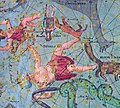
Custos Messium in Bode (1782)
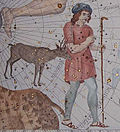
Custos Messium in Bode (1801)
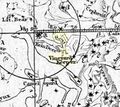
Custos Messium as Vineyard Keeper in Young (1807): A Course of Lectures on Natural Philosophy and the Mechanical Arts.

Sidney Hall’s (1831)

Custos Messium and Rangifer Constellation Position on a modern map (CC BY Ultima Thulean, SA)


Mythology
no mythology.
IAU Working Group on Star Names
The name "Custos" (Latin for "guard") has been proposed as a proper name for a star in the vicinity of Custos Messium to be discussed by WGSN.
Weblinks
References
- ↑ Ian Ridpath, Star Tales (online edition) on Custos Messium.
- ↑ John Barentine (2016), "The Lost Constellations: A History of Obsolete, Extinct, or Forgotten Star Lore.", Springer