Ru: Difference between revisions
(lema) |
|||
| Line 4: | Line 4: | ||
==Etymology and History== |
==Etymology and History== |
||
Ru (IPA:[ˈrhu]) means arrow. |
|||
=== Spelling Variants === |
=== Spelling Variants === |
||
| Line 15: | Line 15: | ||
=== Origin of Constellation === |
=== Origin of Constellation === |
||
Ru is a variant word for arrow used in ancient texts. Ru is an arrow with a typical metal tip that possesses great destructive power. This concept was brought to Bali from Indian literature, such as the Arjunawiwaha text, the Ramayana, and so on. In Sanskrit texts such as the Mahabharata epic, arrows have various shapes and different names. Many of them indicate various types of arrowheads.<ref>Jákl, JiŘí (2025) "Archery and target-shooting in pre-Islamic Java; What can be known?," Wacana, Journal of the Humanities of Indonesia: Vol. 26: No. 3, Article 8. DOI: 10.17510/wacana.v26i3.1895</ref> |
|||
In the Sarasamuscaya Sloka 120, evil is analogized to an arrow:<ref>Tirta, I Made Danu, "Wacika Parisudha : Membangun Hita Melalui Kata", Ditjen BIMAS Hindu Kementrian Agama RI (2023) https://bimashindu.kemenag.go.id/video/wacika-parisudha-membangun-hita-melalui-kata</ref><blockquote>“Ikang ujar ahala-tan pahi lawan hru, songkabnya sakatempuhan denya juga alara, resep ri hati, tatankenengpanhan turu ring rahina wengi ikang wwang denya, matangnyat, tan inujaraken ika de sang dhira purusa, sang ahning maneb manah nira”.</blockquote>Translation: |
|||
"Words that contain evil intentions are no different from arrows, which are released; everything they hit hurts; these words sink into the heart, making it impossible to eat or sleep during the day and night, therefore these words are not spoken by people who are virtuous and powerful, nor by people who remain pure in heart." |
|||
=== Transfer and Transformation of the Constellation === |
=== Transfer and Transformation of the Constellation === |
||
== Mythology / Religion == |
== Mythology / Religion == |
||
=== Hru types in old manuscript === |
|||
Some of manuscript mentioned arrow as hru: |
|||
==== Rāmāyaṇa 9.78 ==== |
|||
God Indra is said to be afraid of sharp arrows (hrūnya tīkṣṇa) shot by Rāvaṇa’s giant archers. |
|||
==== Rāmāyaṇa 20.54; Arjunavivāha 8.11 ==== |
|||
An arrow as big as mountain (hrū vuṅkal savukir). |
|||
==== Arjunavivāha 8.14 ==== |
|||
Name for the 'Destroyer Arrow' (hrū sambartaka). |
|||
==== Arjunavivāha 9.1 ==== |
|||
An arrow with the head of a snake is shot to Arjuna by Rudra God. |
|||
==== Sumanasāntaka 150.1 ==== |
|||
The arrows shot by the king of Magadha are represented as "mountains, feathered with blazing blades" (hrū-arrows) |
|||
==== Sumanasāntaka 151.1 ==== |
|||
King Aṅga charges his arrows (hrū) with mantras to fire all kinds of divine missiles. |
|||
=== Image Variants === |
=== Image Variants === |
||
Revision as of 08:18, 9 December 2025

Ru is an Oceanic name from Bali (Indonesia). The lintang of ru is found in intersection of Saniscara (Saturday, in saptawara) and Paing (in pancawara) in a series of palelintangan. Lintang ru means arrow constellation.[1]
Etymology and History
Ru (IPA:[ˈrhu]) means arrow.
Spelling Variants
- hru
- panah
- jurit mati
- kapěrang
- panah rhu
- sajaka
Origin of Constellation
Ru is a variant word for arrow used in ancient texts. Ru is an arrow with a typical metal tip that possesses great destructive power. This concept was brought to Bali from Indian literature, such as the Arjunawiwaha text, the Ramayana, and so on. In Sanskrit texts such as the Mahabharata epic, arrows have various shapes and different names. Many of them indicate various types of arrowheads.[2]
In the Sarasamuscaya Sloka 120, evil is analogized to an arrow:[3]
“Ikang ujar ahala-tan pahi lawan hru, songkabnya sakatempuhan denya juga alara, resep ri hati, tatankenengpanhan turu ring rahina wengi ikang wwang denya, matangnyat, tan inujaraken ika de sang dhira purusa, sang ahning maneb manah nira”.
Translation:
"Words that contain evil intentions are no different from arrows, which are released; everything they hit hurts; these words sink into the heart, making it impossible to eat or sleep during the day and night, therefore these words are not spoken by people who are virtuous and powerful, nor by people who remain pure in heart."
Transfer and Transformation of the Constellation
Mythology / Religion
Hru types in old manuscript
Some of manuscript mentioned arrow as hru:
Rāmāyaṇa 9.78
God Indra is said to be afraid of sharp arrows (hrūnya tīkṣṇa) shot by Rāvaṇa’s giant archers.
An arrow as big as mountain (hrū vuṅkal savukir).
Name for the 'Destroyer Arrow' (hrū sambartaka).
An arrow with the head of a snake is shot to Arjuna by Rudra God.
Sumanasāntaka 150.1
The arrows shot by the king of Magadha are represented as "mountains, feathered with blazing blades" (hrū-arrows)
Sumanasāntaka 151.1
King Aṅga charges his arrows (hrū) with mantras to fire all kinds of divine missiles.
Image Variants
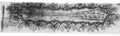
Lintang Hru (CC-BY Alfred Maaß, (1929), Astrologische Kalender der Balinesen)
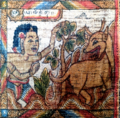
Lintang Ru in the cloth (CC-BY UPTD Museum Bali)
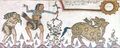
Lintang Sayaka (CC-BY Youla Azkarrula taken in the ceiling of Taman Gili Klungkung Palace Bali)


Cultural Beliefs
Numerology (Neptu/Urip)
Saniscara (Saturday, in saptawara) has a value of 9 and Paing (in pancawara) has a value of 9. Thus, the total urip on this lintang is 18.[4]
Astrological Characteristics
Respected by people and they have many servants. Loved by great and influential people. Do not be a soldier, avoid physical combat (fighting) and avoid the battlefield. Easily angered but quickly calm down, easily regret and they are forgiving and kind although a bit greedy.[4]
Matching Gemstones
Kecubung (amethyst), Biduri Bulan (Moon stone), mirah (ruby).[4]
Weblinks
All HIP Stars within this constellation
Stars within the Constellation Area
| id | Label | IAU design. | description | Vmag |
|---|---|---|---|---|
| 1 | Altair | HIP 97649 | within constellation lines | 0.76 |
| 2 | Tarazed | HIP 97278 | within constellation lines | 2.72 |
| 3 | Okab | HIP 93747 | within constellation lines | 2.99 |
| 4 | Antinous | HIP 99473 | within constellation lines | 3.22 |
| 5 | δ Aquilae | HIP 95501 | within constellation lines | 3.36 |
| 6 | λ Aquilae | HIP 93805 | within constellation lines | 3.43 |
| 7 | Alshain | HIP 98036 | Inside the Hull | 3.71 |
| 8 | η Aquilae | HIP 97804 | Inside the Hull | 3.8 |
| 9 | ι Aquilae | HIP 96468 | Inside the Hull | 4.36 |
| 10 | μ Aquilae | HIP 96229 | Inside the Hull | 4.45 |
| 11 | ν Aquilae | HIP 95585 | Inside the Hull | 4.72 |
| 12 | 36 Aql | HIP 95937 | Inside the Hull | 5.03 |
| 13 | 18 Aql | HIP 93867 | Inside the Hull | 5.086 |
| 14 | 21 Aql | HIP 94477 | Inside the Hull | 5.15 |
| 15 | - | HIP 95447 | Inside the Hull | 5.15 |
| 16 | σ Aquilae | HIP 96665 | Inside the Hull | 5.17 |
| 17 | 19 Aql | HIP 94068 | Inside the Hull | 5.23 |
| 18 | 23 Aql | HIP 94885 | Inside the Hull | 5.28 |
| 19 | ω 1 Aquilae | HIP 94834 | Inside the Hull | 5.283 |
| 20 | 27 Aql | HIP 95073 | Inside the Hull | 5.451 |
| 21 | 28 Aql | HIP 94982 | Inside the Hull | 5.518 |
| 22 | 22 Aql | HIP 94727 | Inside the Hull | 5.569 |
| 23 | 58 Aql | HIP 97980 | Inside the Hull | 5.631 |
| 24 | 45 Aql | HIP 96807 | Inside the Hull | 5.637 |
| 25 | 62 Aql | HIP 98844 | Inside the Hull | 5.68 |
| 26 | 35 Aql | HIP 95793 | Inside the Hull | 5.783 |
| 27 | 42 G. Aql | HIP 95222 | Inside the Hull | 5.811 |
| 28 | 49 G. Aql | HIP 95732 | Inside the Hull | 5.839 |
| 29 | υ Aquilae | HIP 97229 | Inside the Hull | 5.91 |
| 30 | 64 Aql | HIP 99171 | Inside the Hull | 5.968 |
| 31 | - | HIP 96481 | Inside the Hull | 5.975 |
| 32 | ω 2 Aquilae | HIP 95002 | Inside the Hull | 6.012 |
| 33 | - | HIP 95898 | Inside the Hull | 6.042 |
| 34 | V923 Aql | HIP 95929 | Inside the Hull | 6.082 |
| 35 | R Aql | HIP 93820 | Inside the Hull | 6.09 |
| 36 | 34 G. Aql | HIP 94833 | Inside the Hull | 6.174 |
| 37 | 101 G. Aql | HIP 98385 | Inside the Hull | 6.18 |
| 38 | 52 G. Aql | HIP 95812 | Inside the Hull | 6.245 |
| 39 | 37 G. Aql | HIP 94916 | Inside the Hull | 6.311 |
| 40 | 25 G. Aql | HIP 94149 | Inside the Hull | 6.321 |
| 41 | 44 G. Aql | HIP 95253 | Inside the Hull | 6.346 |
| 42 | 67 G. Aql | HIP 96630 | Inside the Hull | 6.358 |
| 43 | 61 G. Aql | HIP 96351 | Inside the Hull | 6.368 |
| 44 | 24 Aql | HIP 94913 | Inside the Hull | 6.404 |
| 45 | 75 G. Aql | HIP 97144 | Inside the Hull | 6.428 |
| 46 | V1339 Aql | HIP 97607 | Inside the Hull | 6.478 |
| 47 | V450 Aql | HIP 96204 | Inside the Hull | 6.48 |
| 48 | - | HIP 94478 | Inside the Hull | 6.49 |
| 49 | - | HIP 93990 | Inside the Hull | 6.5 |
References
- References (general)
- ↑ Maass, Alfred, “Astrologische Kalender der Balinesen,” in Koninklijk Bataviaasch Genootschap van Kunsten en Wetenschappen, Feestbundel bij gelegenheid van zijn 150 jarig bestaan 1778-1928, 2 vols. (Weltevreden, 1929), Vol. 2, 126-157.
- ↑ Jákl, JiŘí (2025) "Archery and target-shooting in pre-Islamic Java; What can be known?," Wacana, Journal of the Humanities of Indonesia: Vol. 26: No. 3, Article 8. DOI: 10.17510/wacana.v26i3.1895
- ↑ Tirta, I Made Danu, "Wacika Parisudha : Membangun Hita Melalui Kata", Ditjen BIMAS Hindu Kementrian Agama RI (2023) https://bimashindu.kemenag.go.id/video/wacika-parisudha-membangun-hita-melalui-kata
- ↑ 4.0 4.1 4.2 Tim Kajian Palelintangan, “Gabungan Kajian Palelintangan,” Museum Bali (2021), 1-149.