Rangifer: Difference between revisions
Ericmamajek (talk | contribs) No edit summary |
|||
| (15 intermediate revisions by 2 users not shown) | |||
| Line 1: | Line 1: | ||
[[File:Reindeer LeMonnier1743 hi.png|thumb|Reindeer in Le Monnier (1743), see also: [https://www.e-rara.ch/zut/content/zoom/694976 rara Zurich]]] |
|||
''Rangifer'' - the reindeer - is an extinct constellation first introduced by Pierre-Charles Le Monnier in 1743 in the book ''La Théorie des Comètes''. |
|||
''Rangifer'', the Reindeer, is an extinct constellation first introduced by Pierre-Charles Le Monnier in 1743 in the book ''La Théorie des Comètes''. |
|||
==Concordance, Etymology, History== |
|||
[[File:Elk Sami stellarium.jpg|thumb|Sarva, The Elk, in Sami uranography (Stellarium).]] |
|||
[[File:Sidney Hall - Urania's Mirror - Camelopardalis, Tarandus and Custos Messium.jpg|thumb|Rangifer in Sidney Hall (1825) plate 2 in ''Urania's Mirror'']] |
|||
[[File:Bode custom rengifer.jpg|thumb|Rangifer and Custom Messium (Bode 1801)]] |
|||
The constellation is discussed at length on Ian Ridpath's Star Tales<ref name=":0">Ian Ridpath (online edition), Star Tales, http://www.ianridpath.com/startales/rangifer.html</ref> and John Barentine (2016)<ref>John Barentine's (2016) "''The Lost Constellations: A History of Obsolete, Extinct, or Forgotten Star Lore.''" Springer</ref>, Chapter 20 (p.307). Le Monnier was part of the 1736-1737 expeditions by Pierre-Louis Moreau de Maupertuis to Lapland which improved the measurement of the length of a degree of latitude and convincingly demonstrated the oblateness of the Earth. The reindeer and placement of the constellation just below the north celestial pole appear to commemorate the expedition and achievement. |
|||
=== Origin of Constellation === |
|||
The constellation is discussed at length on Ian Ridpath's Star Tales website (http://www.ianridpath.com/startales/rangifer.html) and Chapter 20 (p.307) of John Barentine's (2016) "''The Lost Constellations: A History of Obsolete, Extinct, or Forgotten Star Lore.''" |
|||
Ridpath<ref name=":0" /> elaborates: <blockquote>A faint, far-northern constellation introduced in 1743 on a star chart published by the Frenchman Pierre-Charles Le Monnier (1715–99) in his book ''La Théorie des Comètes''. The chart showed the track of the comet of 1742 through the north polar region of the sky and Le Monnier was inspired to place a new constellation representing a reindeer on the comet’s course, close to the north celestial pole between [[Cepheus]] and [[Camelopardalis]]. Le Monnier chose a reindeer as a reminder of his trip to Lapland in 1736–37 with the expedition of Pierre Louis de Maupertuis to measure the length of a degree of latitude in the far north. (The Sami people of northern Scandinavia also visualized a reindeer called [[Sarvvis]], or Sarva, among the stars, but theirs was much bigger, incorporating Auriga, [[Perseus]], [[Cassiopeia]], and [[Cepheus]].)</blockquote><blockquote>The same chart was republished in 1746 in Le Monnier’s book Institutions astronomiques but with no further explanation of the new constellation that appeared on it. Le Monnier seems never to have published a list of its stars, but Bode in his catalogue ''Allgemeine Beschreibung und Nachweisung der Gestirne'' of 1801 assigned it 46 stars of 5th to 7th magnitude plus one deep-sky object, the galaxy NGC 1184. Most of these are now within the borders of northern Cepheus.</blockquote><blockquote>On Le Monnier’s chart the constellation was named ‘''le Réene''’, a spelling that was adopted by his fellow Frenchman Jean Fortin in his ''Atlas Céleste'' of 1776 (with the addition of an accent over the first letter ''e'': Réene). However, the name should more accurately have been ‘le Renne’, and Fortin changed it on his revised edition of 1795. Bode Latinized it as Rangifer on his ''Uranographia'' of 1801. An alternative name found on some maps was Tarandus from the reindeer’s scientific name, Rangifer tarandus. </blockquote>As summarized by Ridpath and Barentine, the constellation of the reindeer appeared by several names during its life during the 18th and 19th centuries: "''Le Reene''" (in Le Monnier 1743), "''le Réene''" (Le Monnier 1746, Fortin 1776), "''le Renne''" (Fortin 1795), "''Rennthier''" (Bode 1876), "''Rangifer''" (Latin name, Bode 1801 Uranographia), "''Tarandus''" (Urania's Mirror 1825, Chambers 1877). |
|||
Carl Linnaeus (1758) dubbed the reindeer species of the Eurasian tundra "''cervus tarandus''", and Charles Hamilton Smith (1827) introduced the genus name ''Rangifer.'' Species and subspecies of ''Rangifer'' are called reindeer in Eurasia and caribou in North America. In a recent review by Lee Harding (2022, ZooKeys (1119): 117–151), 18 species or subspecies are now recognized in North America and 31 in Europe and Asia. "Reindeer" may have its origin from the Old Norse ''hreindýri.'' |
|||
Le Monnier was part of the 1736-1737 expeditions by Pierre-Louis Moreau de Maupertuis to Lapland which improved the measurement of the length of a degree of latitude and convincingly demonstrated the oblateness of the Earth. The reindeer and placement of the constellation just below the north celestial pole appear to commemorate the expedition and achievement. |
|||
Rangifer was comprised of very faint stars, indeed Bode's (1801) catalog, ''Allgemeine Beschreibung und Nachweisung der Gestirne'' listed 47 stars in the constellation, most of which were magnitudes 6 and 7, and only one of 5th magnitude. |
|||
As summarized by Ridpath and Barentine, the constellation of the reindeer appeared by several names during its life during the 18th and 19th centuries: "''Le Reene''" (in Le Monnier 1743), "''le Réene''" (Le Monnier 1746, Fortin 1776), "''le Renne''" (Fortin 1795), "''Rennthier''" (Bode 1876), "''Rangifer''" (Latin name, Bode 1801 Uranographia), "''Tarandus''" (Urania's Mirror 1825, Chambers 1877). |
|||
==== Stars inside the Constellation Area ==== |
|||
Carl Linnaeus (1758) dubbed the reindeer species of the Eurasian tundra "''cervus tarandus''", and Charles Hamilton Smith (1827) introduced the genus name ''Rangifer.'' Species and subspecies of ''Rangifer'' are called reindeer in Eurasia and caribou in North America. In a recent review by Lee Harding (2022, ZooKeys (1119): 117–151), 18 species or subspecies are now recognized in North America and 31 in Europe and Asia. "Reindeer" may have its origin from the Old Norse ''hreindýri.'' |
|||
Barentine (2016, Fig. 8.20) overlays the Urania's Mirror version of the constellation over a modern star map. It appears that the brightest stars in Rangifer were the following: |
|||
{| class="wikitable" |
|||
|+ |
|||
!design. |
|||
!HIP |
|||
!HR |
|||
!Vmag |
|||
|- |
|||
|2 UMi |
|||
|5372 |
|||
|285 |
|||
|4.25 |
|||
|- |
|||
|HD 19275 |
|||
|14862 |
|||
|932 |
|||
|4.92 |
|||
|- |
|||
|OV Cep |
|||
|37391 |
|||
|2609 |
|||
|5.07 |
|||
|- |
|||
|49 Cas |
|||
|9763 |
|||
|592 |
|||
|5.22 |
|||
|- |
|||
|40 Cas |
|||
|7650 |
|||
|456 |
|||
|5.25 |
|||
|- |
|||
|47 Cas |
|||
|9727 |
|||
|581 |
|||
|5.38 |
|||
|} |
|||
The brightest and northernmost (declination 86°) of these Rangifer stars is [https://simbad.u-strasbg.fr/simbad/sim-id?Ident=2+UMi 2 Ursae Minoris], which is actually in modern-day Cepheus. The star marks the tip of the tail in LeMonnier's original drawing and in Bode (1782) but is not part of the figure in Bode (1801). |
|||
[[File:Rangifer wgsnTest Screenshot 2025-12-15 105840.png|thumb|Rangifer stickfigure in Sky Culture Maker (Dec. 2025), CC BY Youla Azkarrula. ]] |
|||
====Stars within the Constellation Area==== |
|||
Rangifer was comprised of very faint stars, indeed Bode's (1801) catalog ''Allgemeine Beschreibung und Nachweisung der Gestirne'' listed 47 stars in the constellation, most of which were magnitudes 6 and 7, and only one of 5th magnitude. |
|||
The stick figure for this list was created with with map in Bode (1801) Uranographia. The original map by Le Monnier (1743) drew the Reindeer in a different way, as it did not have a constellation of Custos Messium. Le Monnier's original map includes the bright star 2 UMi which is brighter than the brighest star in this list: |
|||
{| class="wikitable sortable mw-collapsible" |
|||
|+ |
|||
|- |
|||
!id |
|||
!Label |
|||
!IAU design. |
|||
!description |
|||
!Vmag |
|||
|- |
|||
|1 |
|||
| - |
|||
|HIP 14862 |
|||
|Inside the hull |
|||
|4.834 |
|||
|- |
|||
|2 |
|||
| - |
|||
| HIP 25110 |
|||
|Constellation lines (Vertex) |
|||
| 5.06 |
|||
|- |
|||
|3 |
|||
| - |
|||
|HIP 23265 |
|||
|Constellation lines (Vertex) |
|||
|5.09 |
|||
|- |
|||
|4 |
|||
| 49 Cas |
|||
|HIP 9763 |
|||
|Constellation lines |
|||
|5.22 |
|||
|- |
|||
|5 |
|||
|47 Cas |
|||
|HIP 9727 |
|||
|Constellation lines |
|||
|5.268 |
|||
|- |
|||
|6 |
|||
| - |
|||
|HIP 20776 |
|||
| Inside the hull |
|||
|5.43 |
|||
|- |
|||
|7 |
|||
| - |
|||
|HIP 15547 |
|||
|Constellation lines |
|||
|5.444 |
|||
|- |
|||
|8 |
|||
| - |
|||
|HIP 20982 |
|||
| Inside the hull |
|||
|5.472 |
|||
|- |
|||
|9 |
|||
|V408 Cep |
|||
|HIP 20860 |
|||
|Constellation lines (Vertex) |
|||
|5.507 |
|||
|- |
|||
|10 |
|||
| - |
|||
|HIP 14417 |
|||
|Constellation lines |
|||
| 5.52 |
|||
|- |
|||
| 11 |
|||
| - |
|||
|HIP 5626 |
|||
|Inside the hull |
|||
|5.6 |
|||
|- |
|||
|12 |
|||
| - |
|||
|HIP 16489 |
|||
|Constellation lines (Vertex) |
|||
|5.609 |
|||
|- |
|||
|13 |
|||
| - |
|||
|HIP 19461 |
|||
|Inside the hull |
|||
|5.62 |
|||
|- |
|||
|14 |
|||
| - |
|||
|HIP 13055 |
|||
|Inside the hull |
|||
| 5.781 |
|||
|- |
|||
|15 |
|||
| - |
|||
|HIP 14844 |
|||
|Inside the hull |
|||
|5.907 |
|||
|- |
|||
|16 |
|||
| - |
|||
|HIP 9568 |
|||
|Constellation lines |
|||
|6.046 |
|||
|- |
|||
|17 |
|||
| STF 2 |
|||
| HIP 760 |
|||
|Constellation lines (Vertex) |
|||
| 6.047 |
|||
|- |
|||
|18 |
|||
| - |
|||
| HIP 10054 |
|||
|Inside the hull |
|||
|6.06 |
|||
|- |
|||
| 19 |
|||
| - |
|||
|HIP 6522 |
|||
|Constellation lines |
|||
| 6.064 |
|||
|- |
|||
|20 |
|||
| - |
|||
|HIP 5412 |
|||
|Inside the hull |
|||
|6.23 |
|||
|- |
|||
|21 |
|||
| - |
|||
|HIP 17056 |
|||
|Constellation lines |
|||
|6.247 |
|||
|- |
|||
|22 |
|||
| - |
|||
|HIP 5947 |
|||
|Inside the hull |
|||
|6.261 |
|||
|- |
|||
| 23 |
|||
| - |
|||
|HIP 6261 |
|||
|Constellation lines |
|||
|6.318 |
|||
|- |
|||
| 24 |
|||
| - |
|||
|HR 1230 |
|||
|Inside the hull |
|||
|6.32 |
|||
|- |
|||
|25 |
|||
| - |
|||
|HIP 20039 |
|||
|Constellation lines |
|||
|6.38 |
|||
|- |
|||
|26 |
|||
| - |
|||
|HIP 6378 |
|||
|Inside the hull |
|||
|6.38 |
|||
|- |
|||
| 27 |
|||
| - |
|||
|HIP 10309 |
|||
|Inside the hull |
|||
|6.445 |
|||
|- |
|||
|28 |
|||
| - |
|||
|HIP 2142 |
|||
|Constellation lines |
|||
|6.54 |
|||
|- |
|||
|29 |
|||
| - |
|||
| HIP 9147 |
|||
|Constellation lines |
|||
|6.61 |
|||
|- |
|||
|30 |
|||
| - |
|||
| HIP 8908 |
|||
|Constellation lines |
|||
|6.67 |
|||
|- |
|||
|31 |
|||
| - |
|||
|HIP 3964 |
|||
|Constellation lines |
|||
|6.751 |
|||
|- |
|||
|32 |
|||
| - |
|||
|HIP 13897 |
|||
|Constellation lines |
|||
|6.87 |
|||
|- |
|||
| 33 |
|||
| - |
|||
|HIP 15843 |
|||
|Constellation lines (Vertex) |
|||
|6.92 |
|||
|- |
|||
|34 |
|||
|STT 37AB |
|||
|HIP 10144 |
|||
|Constellation lines |
|||
|6.97 |
|||
|- |
|||
|35 |
|||
| - |
|||
|HIP 3796 |
|||
|Constellation lines |
|||
|7.1 |
|||
|- |
|||
|36 |
|||
| - |
|||
|HIP 6379 |
|||
|Constellation lines |
|||
|7.167 |
|||
|- |
|||
|37 |
|||
| - |
|||
|HIP 6385 |
|||
| Inside the hull |
|||
|7.21 |
|||
|- |
|||
|38 |
|||
| - |
|||
|HIP 15011 |
|||
|Constellation lines |
|||
|7.27 |
|||
|- |
|||
|39 |
|||
| - |
|||
| HIP 6175 |
|||
|Constellation lines |
|||
|7.27 |
|||
|- |
|||
|40 |
|||
| - |
|||
|HIP 15516 |
|||
| Constellation lines |
|||
| 7.34 |
|||
|- |
|||
|41 |
|||
| - |
|||
|HIP 21558 |
|||
|Constellation lines |
|||
|7.36 |
|||
|- |
|||
|42 |
|||
| - |
|||
|HIP 8057 |
|||
|Constellation lines (Vertex) |
|||
|7.58 |
|||
|- |
|||
|43 |
|||
| - |
|||
| HIP 11906 |
|||
|Constellation lines |
|||
|7.66 |
|||
|- |
|||
|44 |
|||
| - |
|||
|HIP 18940 |
|||
|Constellation lines |
|||
|7.71 |
|||
|- |
|||
|45 |
|||
| - |
|||
|HIP 3380 |
|||
|Constellation lines |
|||
|7.9 |
|||
|} |
|||
===Transfer and Transformation of the Constellation=== |
|||
<gallery> |
|||
File:Reindeer LeMonnier1743 hi.png|Le Monnier (1743) |
|||
File:Bode custom rengifer.jpg|Bode (1801) |
|||
File:Sidney Hall - Urania's Mirror - Camelopardalis, Tarandus and Custos Messium.jpg|Hall (1825) |
|||
</gallery> |
|||
==Mythology== |
|||
Barentine (2016, Fig. 8.20) overlays the Urania's Mirror version of the constellation over a modern star map. It appears that the brightest stars in Rangifer were 2 UMi (V=4.25 mag), HR 932 (V=4.92), OV Cep (V=5.07), 49 Cas (V=5.22), 40 Cas (V=5.25), and 47 Cas (V=5.38). |
|||
The brightest and northernmost (declination 86 deg) of these Rangifer stars is 2 Ursa Minoris, which is actually in modern-day Cepheus. |
|||
==Weblinks== |
|||
References: |
|||
*https://en.wikipedia.org/wiki/Rangifer_(constellation) |
|||
http://www.ianridpath.com/startales/rangifer.html |
|||
==References== |
|||
https://en.wikipedia.org/wiki/Rangifer_(constellation) |
|||
*[[References]] (general) |
|||
*[[References (Babylonian)]] |
|||
*[[References (Greco-Roman)|References (ancient Greco-Roman)]] |
|||
*[[References (Medieval and Early Modern)|References (medieval)]] |
|||
[[Category:Eurasia]] |
|||
[[Category:Constellation]] |
|||
[[Category:Eurasia]] |
|||
[[Category:European]] |
|||
[[Category:Modern]] |
|||
[[Category:Cep]][[Category:Cas]] |
|||
<references /> |
|||
Latest revision as of 12:51, 16 December 2025

Rangifer, the Reindeer, is an extinct constellation first introduced by Pierre-Charles Le Monnier in 1743 in the book La Théorie des Comètes.
Concordance, Etymology, History


The constellation is discussed at length on Ian Ridpath's Star Tales[1] and John Barentine (2016)[2], Chapter 20 (p.307). Le Monnier was part of the 1736-1737 expeditions by Pierre-Louis Moreau de Maupertuis to Lapland which improved the measurement of the length of a degree of latitude and convincingly demonstrated the oblateness of the Earth. The reindeer and placement of the constellation just below the north celestial pole appear to commemorate the expedition and achievement.
Origin of Constellation
Ridpath[1] elaborates:
A faint, far-northern constellation introduced in 1743 on a star chart published by the Frenchman Pierre-Charles Le Monnier (1715–99) in his book La Théorie des Comètes. The chart showed the track of the comet of 1742 through the north polar region of the sky and Le Monnier was inspired to place a new constellation representing a reindeer on the comet’s course, close to the north celestial pole between Cepheus and Camelopardalis. Le Monnier chose a reindeer as a reminder of his trip to Lapland in 1736–37 with the expedition of Pierre Louis de Maupertuis to measure the length of a degree of latitude in the far north. (The Sami people of northern Scandinavia also visualized a reindeer called Sarvvis, or Sarva, among the stars, but theirs was much bigger, incorporating Auriga, Perseus, Cassiopeia, and Cepheus.)
The same chart was republished in 1746 in Le Monnier’s book Institutions astronomiques but with no further explanation of the new constellation that appeared on it. Le Monnier seems never to have published a list of its stars, but Bode in his catalogue Allgemeine Beschreibung und Nachweisung der Gestirne of 1801 assigned it 46 stars of 5th to 7th magnitude plus one deep-sky object, the galaxy NGC 1184. Most of these are now within the borders of northern Cepheus.
On Le Monnier’s chart the constellation was named ‘le Réene’, a spelling that was adopted by his fellow Frenchman Jean Fortin in his Atlas Céleste of 1776 (with the addition of an accent over the first letter e: Réene). However, the name should more accurately have been ‘le Renne’, and Fortin changed it on his revised edition of 1795. Bode Latinized it as Rangifer on his Uranographia of 1801. An alternative name found on some maps was Tarandus from the reindeer’s scientific name, Rangifer tarandus.
As summarized by Ridpath and Barentine, the constellation of the reindeer appeared by several names during its life during the 18th and 19th centuries: "Le Reene" (in Le Monnier 1743), "le Réene" (Le Monnier 1746, Fortin 1776), "le Renne" (Fortin 1795), "Rennthier" (Bode 1876), "Rangifer" (Latin name, Bode 1801 Uranographia), "Tarandus" (Urania's Mirror 1825, Chambers 1877).
Carl Linnaeus (1758) dubbed the reindeer species of the Eurasian tundra "cervus tarandus", and Charles Hamilton Smith (1827) introduced the genus name Rangifer. Species and subspecies of Rangifer are called reindeer in Eurasia and caribou in North America. In a recent review by Lee Harding (2022, ZooKeys (1119): 117–151), 18 species or subspecies are now recognized in North America and 31 in Europe and Asia. "Reindeer" may have its origin from the Old Norse hreindýri.
Rangifer was comprised of very faint stars, indeed Bode's (1801) catalog, Allgemeine Beschreibung und Nachweisung der Gestirne listed 47 stars in the constellation, most of which were magnitudes 6 and 7, and only one of 5th magnitude.
Stars inside the Constellation Area
Barentine (2016, Fig. 8.20) overlays the Urania's Mirror version of the constellation over a modern star map. It appears that the brightest stars in Rangifer were the following:
| design. | HIP | HR | Vmag |
|---|---|---|---|
| 2 UMi | 5372 | 285 | 4.25 |
| HD 19275 | 14862 | 932 | 4.92 |
| OV Cep | 37391 | 2609 | 5.07 |
| 49 Cas | 9763 | 592 | 5.22 |
| 40 Cas | 7650 | 456 | 5.25 |
| 47 Cas | 9727 | 581 | 5.38 |
The brightest and northernmost (declination 86°) of these Rangifer stars is 2 Ursae Minoris, which is actually in modern-day Cepheus. The star marks the tip of the tail in LeMonnier's original drawing and in Bode (1782) but is not part of the figure in Bode (1801).

Stars within the Constellation Area
The stick figure for this list was created with with map in Bode (1801) Uranographia. The original map by Le Monnier (1743) drew the Reindeer in a different way, as it did not have a constellation of Custos Messium. Le Monnier's original map includes the bright star 2 UMi which is brighter than the brighest star in this list:
| id | Label | IAU design. | description | Vmag |
|---|---|---|---|---|
| 1 | - | HIP 14862 | Inside the hull | 4.834 |
| 2 | - | HIP 25110 | Constellation lines (Vertex) | 5.06 |
| 3 | - | HIP 23265 | Constellation lines (Vertex) | 5.09 |
| 4 | 49 Cas | HIP 9763 | Constellation lines | 5.22 |
| 5 | 47 Cas | HIP 9727 | Constellation lines | 5.268 |
| 6 | - | HIP 20776 | Inside the hull | 5.43 |
| 7 | - | HIP 15547 | Constellation lines | 5.444 |
| 8 | - | HIP 20982 | Inside the hull | 5.472 |
| 9 | V408 Cep | HIP 20860 | Constellation lines (Vertex) | 5.507 |
| 10 | - | HIP 14417 | Constellation lines | 5.52 |
| 11 | - | HIP 5626 | Inside the hull | 5.6 |
| 12 | - | HIP 16489 | Constellation lines (Vertex) | 5.609 |
| 13 | - | HIP 19461 | Inside the hull | 5.62 |
| 14 | - | HIP 13055 | Inside the hull | 5.781 |
| 15 | - | HIP 14844 | Inside the hull | 5.907 |
| 16 | - | HIP 9568 | Constellation lines | 6.046 |
| 17 | STF 2 | HIP 760 | Constellation lines (Vertex) | 6.047 |
| 18 | - | HIP 10054 | Inside the hull | 6.06 |
| 19 | - | HIP 6522 | Constellation lines | 6.064 |
| 20 | - | HIP 5412 | Inside the hull | 6.23 |
| 21 | - | HIP 17056 | Constellation lines | 6.247 |
| 22 | - | HIP 5947 | Inside the hull | 6.261 |
| 23 | - | HIP 6261 | Constellation lines | 6.318 |
| 24 | - | HR 1230 | Inside the hull | 6.32 |
| 25 | - | HIP 20039 | Constellation lines | 6.38 |
| 26 | - | HIP 6378 | Inside the hull | 6.38 |
| 27 | - | HIP 10309 | Inside the hull | 6.445 |
| 28 | - | HIP 2142 | Constellation lines | 6.54 |
| 29 | - | HIP 9147 | Constellation lines | 6.61 |
| 30 | - | HIP 8908 | Constellation lines | 6.67 |
| 31 | - | HIP 3964 | Constellation lines | 6.751 |
| 32 | - | HIP 13897 | Constellation lines | 6.87 |
| 33 | - | HIP 15843 | Constellation lines (Vertex) | 6.92 |
| 34 | STT 37AB | HIP 10144 | Constellation lines | 6.97 |
| 35 | - | HIP 3796 | Constellation lines | 7.1 |
| 36 | - | HIP 6379 | Constellation lines | 7.167 |
| 37 | - | HIP 6385 | Inside the hull | 7.21 |
| 38 | - | HIP 15011 | Constellation lines | 7.27 |
| 39 | - | HIP 6175 | Constellation lines | 7.27 |
| 40 | - | HIP 15516 | Constellation lines | 7.34 |
| 41 | - | HIP 21558 | Constellation lines | 7.36 |
| 42 | - | HIP 8057 | Constellation lines (Vertex) | 7.58 |
| 43 | - | HIP 11906 | Constellation lines | 7.66 |
| 44 | - | HIP 18940 | Constellation lines | 7.71 |
| 45 | - | HIP 3380 | Constellation lines | 7.9 |
Transfer and Transformation of the Constellation
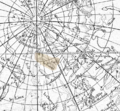
Le Monnier (1743)
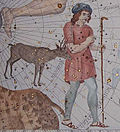
Bode (1801)

Hall (1825)
Mythology
Weblinks
References
- ↑ 1.0 1.1 Ian Ridpath (online edition), Star Tales, http://www.ianridpath.com/startales/rangifer.html
- ↑ John Barentine's (2016) "The Lost Constellations: A History of Obsolete, Extinct, or Forgotten Star Lore." Springer