Uttara Bhadrapada: Difference between revisions
No edit summary |
|||
| (2 intermediate revisions by the same user not shown) | |||
| Line 19: | Line 19: | ||
The two Bhadrapada asterisms equal the Chinese Eastern Wall (壁宿) and Encampment (Ying Shi, Mansion) who also form lunar mansions. |
The two Bhadrapada asterisms equal the Chinese Eastern Wall (壁宿) and Encampment (Ying Shi, Mansion) who also form lunar mansions. |
||
====Stars within the Constellation Area==== |
|||
{| class="wikitable sortable mw-collapsible" |
|||
|+ |
|||
|- |
|||
!id |
|||
! Label |
|||
!IAU design. |
|||
!description |
|||
!Vmag |
|||
|- |
|||
|1 |
|||
|Alpheratz |
|||
|HIP 677 |
|||
|Constellation lines (Vertex) |
|||
|2.06 |
|||
|- |
|||
| 2 |
|||
|Algenib |
|||
| HIP 1067 |
|||
| Constellation lines (Vertex) |
|||
|2.84 |
|||
|} |
|||
===Transfer and Transformation of the Constellation=== |
===Transfer and Transformation of the Constellation=== |
||
<gallery> |
<gallery> |
||
File:UBhadra nakshatras in Temple draw+lbl 4ase.jpg|Uttara Bhadra, 10th century CE |
|||
File:Tibet nakshatra 25.png|Uttara Bhadra, Tibetean |
File:Tibet nakshatra 25.png|Uttara Bhadra, Tibetean |
||
File:壁宿(仏像図彙).png|Uttara Bhadra, Chinese |
File:壁宿(仏像図彙).png|Uttara Bhadra, Chinese |
||
| Line 42: | Line 65: | ||
[[Category:Eurasia]] |
[[Category:Eurasia]] |
||
[[Category:South Asian]] |
[[Category:South Asian]] |
||
[[Category:Zodiac]] |
|||
Latest revision as of 17:29, 14 December 2025


Uttara Bhādrapada (उत्तर भाद्रपदा), The Second Blessed Foot, is an Indian name, used by the Indian Vedic tradition. Most of these names are roughly 3000 years old. They pre-date Hinduism but were taken over by it. Identified with γ Pegasi and α Andromedae.
Etymology and History
Name Variants
- Uttara Bhādrapada
- Uttara Bhadrapada
- Ahirbudhnya,
- Dvitiyabhādra,
- Upāntya
Origin of Constellation
Uttara Bhadrapada literally means "the second of the blessed feet". Together with Purva Bhadrapada, the first of the blessed feet, it forms a super-constellation. Yet, in temples the two asterisms with similar names are depicted in totally different ways. This one is drawn as a anthropomorphic figure with two faces who holds the two stars in their hands. The two stars are likely to be identified with γ Pegasi and α Andromedae.
The two Bhadrapada asterisms equal the Chinese Eastern Wall (壁宿) and Encampment (Ying Shi, Mansion) who also form lunar mansions.
Stars within the Constellation Area
| id | Label | IAU design. | description | Vmag |
|---|---|---|---|---|
| 1 | Alpheratz | HIP 677 | Constellation lines (Vertex) | 2.06 |
| 2 | Algenib | HIP 1067 | Constellation lines (Vertex) | 2.84 |
Transfer and Transformation of the Constellation

Uttara Bhadra, 10th century CE
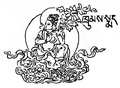
Uttara Bhadra, Tibetean

Uttara Bhadra, Chinese

reconstructed by Jones (1720)


Mythology
mnemonic tales and cultural significance
Weblinks
References
- References (general)