Chitra: Difference between revisions
No edit summary |
No edit summary |
||
| (2 intermediate revisions by the same user not shown) | |||
| Line 1: | Line 1: | ||
{{DISPLAYTITLE:}} |
{{DISPLAYTITLE:Citrā (चित्रा)}} |
||
[[File:14 Chitra draw.png|thumb|Nakshatra 14, Citra, the bright star Spica as drawn in temples with the marker of 180° (a point).]] |
[[File:14 Chitra draw.png|thumb|Nakshatra 14, Citra, the bright star Spica as drawn in temples with the marker of 180° (a point).]] |
||
[[File:13+14 stellarium.gif|thumb|Nakshatras 13 and 14 marked on the Stellarium star chart (WGSN 2025).]] |
[[File:13+14 stellarium.gif|thumb|Nakshatras 13 and 14 marked on the Stellarium star chart (WGSN 2025).]] |
||
Citrā (चित्रा), "the bright one", is an Indian name, used by the Indian Vedic tradition. Most of these names are roughly 3000 years old. They pre-date Hinduism but were taken over by it. |
|||
==Etymology and History== |
== Etymology and History== |
||
'''Name Variants''' |
|||
| ⚫ | Chitra means "the bright one" and is clearly a name for a single star-asterism. In the Indian Vedic coordinate system, the sidereal zodiac, this star marks the point 180° at the ecliptic. As precession continues, the ecliptic latitudes remain always the same, so that a star directly at the ecliptic (like [[Spica]]) at any historical epoch marked and will mark the invisible ecliptic. |
||
* Chitra |
|||
* Tvarshtra |
|||
| ⚫ | |||
| ⚫ | Chitra means "the bright one" and is clearly a name for a single star-asterism. In the Indian Vedic coordinate system, the sidereal zodiac, this star marks the point 180° at the ecliptic. As precession continues, the ecliptic latitudes remain always the same, so that a star directly at the ecliptic (like [[Spica]]) at any historical epoch marked and will mark the invisible ecliptic. |
||
The temple depictions characterise this nakshatra by a point which refers to the important anchor of their frame of reference. |
The temple depictions characterise this nakshatra by a point which refers to the important anchor of their frame of reference. |
||
=== |
====Stars within the Constellation Area==== |
||
{| class="wikitable sortable mw-collapsible" |
|||
|+ |
|||
|- |
|||
!id |
|||
!Label |
|||
!IAU design. |
|||
!description |
|||
!Vmag |
|||
|- |
|||
|1 |
|||
|Spica |
|||
|HIP 65474 |
|||
|Constellation lines (Vertex) |
|||
|0.97 |
|||
|- |
|||
|2 |
|||
|Apamvatsa |
|||
|HIP 66006 |
|||
|Constellation lines (Vertex) |
|||
| 4.69 |
|||
|} |
|||
===Transfer and Transformation of the Constellation=== |
|||
<gallery> |
|||
File:Chitra nakshatras in Temple draw+lbl 4ase.jpg|Chitra 10th century CE |
|||
File:Nakshatra temple magDraw lbl.jpg|Display of all 28th nakshatra in silver arch with candles in Tirupperunthurai (Athmanathaswamy temple) near Aranthangi, India, 10th century CE. (SMH 2025). |
|||
File:Nakshatras in Temple draw+lbl 4ase.jpg|Display of all 28th nakshatra in a door frame in Tirupperunthurai (Athmanathaswamy temple) near Aranthangi, India, 10th century CE. (SMH 2025). |
|||
File:Tibet nakshatra 12.png|Chitra Tibetean |
|||
File:14 Chitra draw.png|Chitra as reconstructed by Jones (1720). |
|||
</gallery> |
|||
| ⚫ | |||
| ⚫ | |||
| ⚫ | |||
mnemonic tales and cultural significance |
mnemonic tales and cultural significance |
||
== |
==Weblinks== |
||
| ⚫ | |||
| ⚫ | |||
| ⚫ | |||
==References== |
|||
| ⚫ | |||
[[Category:Indian]] |
|||
[[Category:Indian]] [[Category:Asterism]] [[Category:Constellation]][[Category:Eurasia]][[Category:South Asian]] |
|||
[[Category:Asterism]] |
|||
[[Category:Constellation]] |
|||
[[Category:Eurasia]] |
|||
[[Category:South Asian]] |
|||
[[Category:Zodiac]] |
[[Category:Zodiac]] |
||
Latest revision as of 17:18, 14 December 2025


Citrā (चित्रा), "the bright one", is an Indian name, used by the Indian Vedic tradition. Most of these names are roughly 3000 years old. They pre-date Hinduism but were taken over by it.
Etymology and History
Name Variants
- Chitra
- Tvarshtra
Origin of Constellation
Chitra means "the bright one" and is clearly a name for a single star-asterism. In the Indian Vedic coordinate system, the sidereal zodiac, this star marks the point 180° at the ecliptic. As precession continues, the ecliptic latitudes remain always the same, so that a star directly at the ecliptic (like Spica) at any historical epoch marked and will mark the invisible ecliptic.
The temple depictions characterise this nakshatra by a point which refers to the important anchor of their frame of reference.
Stars within the Constellation Area
| id | Label | IAU design. | description | Vmag |
|---|---|---|---|---|
| 1 | Spica | HIP 65474 | Constellation lines (Vertex) | 0.97 |
| 2 | Apamvatsa | HIP 66006 | Constellation lines (Vertex) | 4.69 |
Transfer and Transformation of the Constellation

Chitra 10th century CE
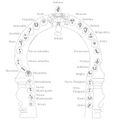
Display of all 28th nakshatra in silver arch with candles in Tirupperunthurai (Athmanathaswamy temple) near Aranthangi, India, 10th century CE. (SMH 2025).

Display of all 28th nakshatra in a door frame in Tirupperunthurai (Athmanathaswamy temple) near Aranthangi, India, 10th century CE. (SMH 2025).

Chitra Tibetean

Chitra as reconstructed by Jones (1720).


Mythology
mnemonic tales and cultural significance
Weblinks
References
- References (general)