Nunki
This modern star name originates from the Sumerian term mulNUNki in which "mul" designates an object in the sky and "ki" indicates placenames. It is also called "Asterism of Eridu", the asterism of the southernmost city in ancient Mesopotamia. The modern star name is erroneously applied to the star σ Sgr (SIMBAD) because of an early misinterpretation of cuneiform texts in the 19th century.
Etymology and History
Allen (1899)
Richard Hinckley Allen in his popular book "Star Names - Their Lore and Meaning" was rather influencial in the 20th century. He wrote for σ Sgr:
"has been identified with Nunki of the Euphratean Tablet of the Thirty Stars, the Star of the Proclamation of the Sea, this Sea being the quarter occupied by Aquarius, Capricornus, Delphinus, Pisces, and Piscis Australis. It is the same space in the sky that Aratis designated as the Water; perhaps another proof of the Euphratean origin of much of Greek astronomy."
Neither does he give sources for this identification nor is this early interpretation still considered correct. The first comprehensive edition and translation of the Babylonian compendium of astronomy, MUL.APIN, which gives an overview of the Mesopotamian uranography, appeared a quarter of a century later. At that time, only fragments were known. Also, the nomenclature of cuneiform texts was not yet standardized and it remains unclear what he refers to with the "Tablet of the Thirty Stars". It is not the "Catalog of 30 Stars" as it is not listed in Kurtik but could refer to the Great Star List.
With "Euphratean", Allen refers to the Babylonians (those days also called "Chaldeans" due to the Christian background of many scholars who dealt with the cuneiform language, it was believed that the culture between the big rivers Euphrates and Tigris was the source of the Jewish and Christian culture).
Today, Assyriology identifies the Sumerian term with an asterism (star or constellation) in Vela. Even with the earliest reconstruction of the text of the Babylonian astronomy compendium MUL.APIN around 1920, scholars doubted on a position of NUNki in Sagittarius. Still, the knowledge of Assyriologists did not reach astronomers who kept using Allen's book.
mulNUNki in modern scholarship
The dictionaries of Mesopotamian astral science by Gössmann (1959) and Kurtik (2007) offer various interpretations of the position of this name (cf mulNUNki). It likely referred to a constellation and not only to one star. In MUL.APIN it is associated with the god of wisdom and witchcraft, Ea, indicating that it is in the southmost area of the visible part of the sky in Mesopotamia. As Eridu is the southernmost city, its asterism might be considered one of the southernmost visible celestial objects. All identifications since the 1920s suggest stars or groups of stars in the constellation of Argo (Arg), e.g. Canopus or anything in the area of Vela, Carina or Puppis.
Hoffmann (2022) points out that the GU-text that dates around 500 BCE positions the NUNki-asterism in the area of Vela.
The Babylonian GU-text is an astrometrical text dating short before 500 BCE (roughly 520 BCE).[1] It is interpreted as a list of asterisms forming straight lines at the same right ascension. The seventh of these strings or ribbons (with a width of 5°) in the sky, GU VII, has "mulNUNki" as the last of its asterisms. The other two, namely "the chest of the Lion" (Leo) and the "the middle of the snake" (Hydra), being clearly identified, this stellar pattern leads to the identification of mulNUNki with the area around λ Velas.
The GU-text seem be part of the missing link from the Babylonian to the Egyptian culture. At the same position in the circular Denderah-zodiac,[1] the Egyptian goddess "Anuket" is depicted which might possibly originate from a pun with "Nunki" (Hoffmann 2022).
Transfer and Transformation
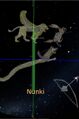
Position of mulNUNki according to the GU text (Hoffmann 2022)
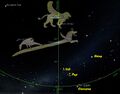
historical identifications for Nunki marked in a Stellarium map (Hoffmann 2024). As they mismatch the green vertical line, they are incorrect.
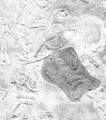
photograph of a detail in the circular zodiac of Denderah (Egypt), the goddess Anuket (Egyptian goddess of the Nile flood) is highlighted. She is drawn below the middle of The Snake (Hydra) and below the chest of The Lion (Leo).
.jpg)


Mythology
IAU Working Group Star Names
The name was approved by the IAU WGSN in 2017 for σ Sgr.
Weblinks
Reference
- References (general)
- References (early modern)
- Ian Ridpath's website (Argo, Argo_2)
- ↑ Hoffmann, S.M. (2022). Astronomical Information in the GU-Text, in Hoffmann and Wolfschmidt (eds.). Astronomy in Culture – Cultures of Astronomy, tredition Hamburg/ OpenScienceTechnology Berlin, 193-204