Shaowei: Difference between revisions
Boshunyang (talk | contribs) m (→Images) |
Boshunyang (talk | contribs) m (→Images) |
||
| (One intermediate revision by the same user not shown) | |||
| Line 13: | Line 13: | ||
=== Constellation & Star Name === |
=== Constellation & Star Name === |
||
See [[Zigong]] for better identification. |
|||
{| class="wikitable" |
{| class="wikitable" |
||
|+ |
|+ |
||
| Line 51: | Line 51: | ||
== Images == |
== Images == |
||
<gallery widths="300" heights="300" caption=" |
<gallery widths="300" heights="300" caption="Shaowei"> |
||
File:Shaowei on Suzhou Star Map.png|Shaowei on Suzhou Star Map |
File:Shaowei on Suzhou Star Map.png|Shaowei on Suzhou Star Map |
||
File:Shaowei on Xinyixinagfayao Star Map.jpg|Shaowei on ''Xinyixinagfayao'' Star Map |
File:Shaowei on Xinyixinagfayao Star Map.jpg|Shaowei on ''Xinyixinagfayao'' Star Map |
||
Latest revision as of 13:53, 5 December 2025
Shào Wèi (The Second Imperial Guard, 少衛) is the sixth star on the right wall of the Zǐ Gōng (Purple Palace, 紫宮) or Zǐwēi Yuán (Purple Forbidden Enclosure), counting northward from the southern gate. Although its identification has varied across historical sources, all recorded versions consistently place it within the modern constellation Camelopardalis.
Etymology and History of the Name
The Shi's Commentary (Shì shi zan, 石氏讚) records: “Within the Purple Palace are fifteen stars representing vassal ministers.” The star names—such as Shào Wèi and other “guard” designations—may have developed in reference to, or as elaborations upon, this passage.
Each of the fifteen stars of the Purple Palace bears an individual name. However, those martial or defensive names are absent from pre-Tang sources and only became widespread from the mid-Tang period onward (8th century CE). Earlier texts employed a different nomenclature system (See Zigong (紫宮)).
It should be noted that there were two stars named Shào Wèi (The Second Imperial Guard, 少衛): one is the sixth star on the right wall and another is the seventh on the left wall. In addition, the second star on the right wall was called Shào Wèi (The Second Commandant, 少尉), identical in pronunciation but written with a different character (尉 rather than 衞).
Constellation & Star Name
See Zigong (紫宮) for better identification.
| Star Name | Ho PENG YOKE[1] | Yi Shitong[2]
Based on catalogue in 18th century |
Pan Nai[3]
based on Huangyou Star Catalogue |
Pan Nai[4]
based on catalogues in Yuan dynasty |
SUN X. & J. Kistemaker[5]
Han Dynasty |
Boshun Yang[6]
before Tang dynasty |
Boshun Yang[6]
Song Jingyou(1034) |
|---|---|---|---|---|---|---|---|
| Shaowei (少衛, 6th on the Right Wall ) | alpha Cam | alpha Cam | BN Cam | gamma Cam | BK Cam | HIP 33694 | HIP33694 |
| Shaowei (少衛, 7th on the Left Wall ) | pi Cep | pi Cep | rho Cep | gamma Cep | 73 Dra | phi Dra | 73 Dra |
Images
- Shaowei
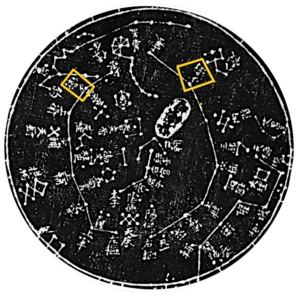
Shaowei on Suzhou Star Map
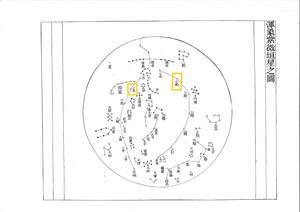
Shaowei on Xinyixinagfayao Star Map
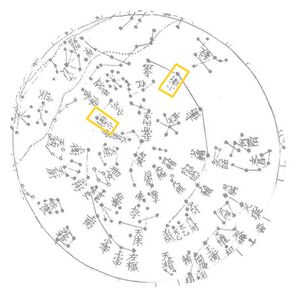
Shaowei on 18th Century Yixiang kaocheng Star Map


IAU Working Group on Star Names
In 202x, the name of the historical constellation "xxx" was suggested to be used for one of the stars in this constellation. ...
Decision: ...
References
- ↑ P.-Y. Ho, “Ancient And Mediaeval Observations of Comets and Novae in Chinese Sources,” Vistas in Astronomy, 5 (1962), 127-225.
- ↑ Yi Shitong [伊世同]. Zhongxi Duizhao Hengxing Tubiao [中西对照恒星图表1950]. Beijing: Science Press. 1981: p. 56.
- ↑ Pan Nai [潘鼐]. Zhongguo Hengxing Guance shi [中国恒星观测史]. Shanghai: Xuelin Pree. 1989. p. 226.
- ↑ Pan Nai [潘鼐]. Zhongguo Hengxing Guance shi [中国恒星观测史]. Shanghai: Xuelin Pree. 2009. p. 443.
- ↑ Sun Xiaochun & Kistemaker J. The Chinese sky during the Han. Leiden: Brill. 1997, pp. 241-6.
- ↑ 6.0 6.1 B.-S. Yang [杨伯顺], Zhongguo Chuantong Hengxing Guance Jingdu ji Xingguan Yanbian Yanjiu [中国传统恒星观测精度及星官演变研究] (A Research on the Accuracy of Chinese Traditional Star Observation and the Evolution of Constellations), PhD thesis, (Hefei: University of Science and Technology of China, 2023). p.238.